A practical decision guide for hospitals, diagnostic centers, and small clinics
“Cloud vs on-prem” sounds like an IT debate. In imaging, it’s a workflow decision.
The right deployment option affects turnaround time, uptime, remote reading, multi-site collaboration, disaster recovery, and cost predictability. And the “right” answer isn’t the same for a tertiary hospital as it is for a two-scanner diagnostic center or a small outpatient clinic.
This guide breaks down on-prem PACS, cloud PACS, and the option most organizations end up choosing in 2026: hybrid.
Quick definitions
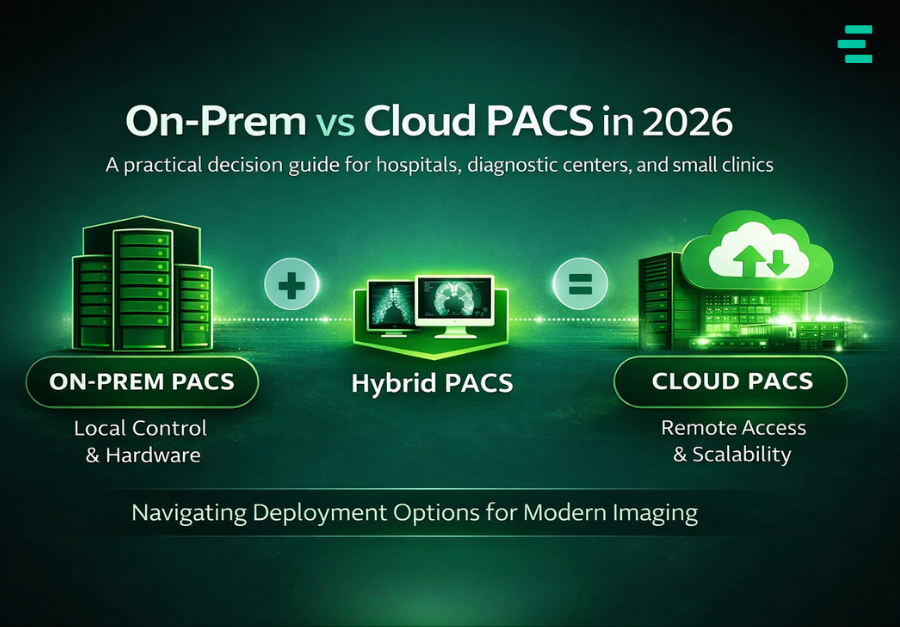
On-prem PACS
Your PACS servers (and typically your primary image storage) live inside your facility. You (or your vendor) manage hardware, storage growth, backups, updates, and security hardening.
Cloud PACS
Your PACS platform is hosted on remote servers managed by a provider and accessed over the internet, with fewer on-site hardware requirements.
Hybrid PACS
A combination: keep certain services or cache/edge components on-site for performance and resilience, while using cloud for scalability, distribution, and storage.
Many modern platforms—including evorad—support cloud-native, hybrid, or on-prem deployments, including edge nodes, data residency options, and resilient failover/caching.
The real tradeoffs (what matters in day-to-day radiology)
1) Cost: CapEx vs OpEx (and who carries the operational burden)
- On-prem tends to mean higher upfront spend on servers, storage, redundancy, and maintenance planning.
- Cloud typically reduces upfront hardware investment and shifts cost to subscription/operating expense—often bundling maintenance and updates into the service model.
What teams forget: on-prem cost isn’t just hardware. It’s staffing, patching, monitoring, backups, security posture, and replacement cycles.
2) Scalability: how painful is growth?
Imaging growth is relentless (more modalities, higher resolution, more priors, more sites). Cloud systems are often positioned as easier to scale because you’re not buying and installing new hardware every time you outgrow your current storage tier.
On-prem can scale too, but it’s usually a project, not a toggle.
3) Performance: speed, priors, and “feels instant”
On-prem can offer excellent local performance because systems are close to modalities and readers—especially if your network is stable and your storage is tuned well.
Cloud performance depends heavily on:
- connectivity quality
- intelligent caching
- edge nodes (local cache/ingest)
- how your viewer streams and retrieves studies
That’s why many modern deployments emphasize hybrid with edge caching and failover rather than purely “all cloud everything.” Evorad explicitly supports hybrid/on-prem/cloud options with resilient caching and recovery.
4) Uptime & disaster recovery: what happens at 2AM?
- On-prem DR is doable, but you must design and maintain it (replication, immutable backups, secondary site, restore testing).
- Cloud platforms often market easier DR and resilience, though you still need a real plan (downtime workflows, cache behavior, recovery objectives).
5) Remote reading and multi-site workflows
If you’re doing teleradiology, cross-coverage, or multi-site reading, cloud/hybrid models often simplify access—especially with web viewers and centralized routing/worklists.
Evorad positions itself as a platform unifying PACS and zero-footprint viewing, built for scaling “from a single imaging center to multi-site health systems.”
Best choice by facility type
A) Large hospitals and health systems
Typical reality: complex networks, strict governance, large volumes, multiple departments, and high availability requirements.
Cloud PACS tends to win when:
- you need multi-site consolidation (one imaging backbone across facilities)
- remote radiology coverage is routine
- you want predictable scaling without continuous hardware refresh cycles
On-prem tends to win when:
- data residency rules or internal policy require local hosting
- you have strong internal IT and security operations
- you need ultra-low latency inside a controlled network (and you already have the infrastructure)
What many hospitals pick in 2026: hybrid
- local ingest/caching for performance and continuity
- cloud services for scalability, sharing, and resilience
Platforms that offer cloud/hybrid/on-prem options with caching and failover are designed for this reality.
Hospital checklist (ask these before deciding):
- Can we keep reading if the WAN drops?
- How fast do priors load across sites?
- What are our recovery time and recovery point objectives?
- How do we handle upgrades without downtime windows?
B) Small Clinics & Diagnostic Imaging Centres (single site or small networks)
Typical reality: fewer IT resources, high throughput pressure, strong need for fast scheduling + reading + patient delivery, and sometimes multiple radiologists reading remotely.
Cloud PACS tends to win when:
- you want to avoid upfront IT investment and ongoing maintenance overhead
- you rely on remote radiologists or flexible reading locations
- you need quick expansion (new modality, second site, seasonal volume spikes)
On-prem can still make sense when:
- internet reliability is inconsistent
- you prefer full local control and have an IT partner ready to manage it
Best-fit pattern for many centers: cloud or hybrid with strong local caching
This gives you the simplicity of cloud with a safety net if connectivity hiccups.
A decision table you can use internally
| Requirement | On-prem PACS | Cloud PACS | Hybrid PACS |
| Lowest upfront hardware spend | ❌ | ✅ | ✅/⚠️ |
| Fastest local performance (with strong LAN) | ✅ | ⚠️ | ✅ |
| Easiest scaling for growth | ⚠️ | ✅ | ✅ |
| Best for multi-site access | ⚠️ | ✅ | ✅ |
| Strong continuity during WAN outage | ✅ | ⚠️ | ✅ |
| Most predictable ops model | ⚠️ | ✅ | ✅ |
| Best balance for hospitals | ✅/⚠️ | ✅/⚠️ | ✅ |
Security and compliance: the right question to ask
Most teams ask: “Is cloud secure?”
Better question: Which model gives us the most consistent security execution?
Cloud can reduce your burden of patching/maintenance if those are handled in the service model.
On-prem can be secure too—but only if you consistently patch, monitor, and audit.
Evorad highlights security and governance capabilities such as encryption, role-based access, and auditability, plus deployment options including data residency.
Where hybrid becomes the “default smart choice” in 2026
Hybrid isn’t a compromise. It’s often the most realistic architecture for imaging because it lets you separate concerns:
- Edge/local for ingest + caching + downtime resilience
- Cloud for storage scaling, collaboration, portals, and broader access
- VNA/tiered storage for long-term retention policies and cost control
Evorad’s platform description explicitly calls out tiered storage and cloud/hybrid/on-prem options aimed at uptime and cost management.
Practical recommendation by scenario
Choose on-prem if…
- you have strict internal hosting requirements
- your network is tightly controlled and highly reliable
- you have IT capacity to manage lifecycle, upgrades, monitoring, and DR
Choose cloud if…
- you want fast deployment and minimal hardware burden
- remote reading and collaboration are core to your model
- you expect growth and want scaling without hardware projects
Choose hybrid if…
- you need both performance continuity and cloud scalability
- you’re multi-site or moving that direction
- you can’t tolerate “internet down = radiology down”
- you want a safer migration path from legacy on-prem systems
The best PACS deployment model is the one that matches your clinical reality:
- Hospitals need resilience and governance at scale
- Diagnostic centers need speed, remote flexibility, and predictable ops
- Small clinics need simplicity and low IT overhead
In 2026, many teams end up choosing hybrid, not because they can’t decide, but because imaging needs both local continuity and cloud scalability.
Seek a reference architecture that facilitates cloud-native, hybrid, or on-prem deployment, in addition to modular PACS services, viewing, orchestration, and a controlled data layer, look no further. Talk to an expert