AI Orchestration in Radiology
Radiology departments across Europe are under growing pressure. CT and MRI volumes continue to rise much faster than the workforce, while radiologists are spending more and more time on work that has little to do with actual image interpretation. Moving between worklists. Searching for prior exams. We are manually reassigning cases due to the unavailability of the appropriate subspecialist. These tasks rarely appear in product brochures, yet they play a major role in whether a department can meet turnaround targets.
For hospital CMOs, CIOs, and leaders of large imaging networks, the conversation is no longer about whether AI matters. It is about where AI can make the most significant difference. In 2026, the answer is becoming increasingly clear: orchestration. The layer that decides which case goes to which radiologist, in what order, and with what context before an image is even opened may be one of the most valuable AI investments a radiology department can make. The challenge: radiology is outpacing the workforce
Researchers have well documented the scale of the problem. The Royal College of Radiologists’ 2024 workforce census recorded a 29% shortfall of clinical radiologists in the UK, projected to rise to 39% by 2029 if current trends continue. CT and MRI demand grew 8% in a single year — roughly double the pace of workforce expansion. Similar patterns are visible across the EU, where the combined pressure of an ageing population and expanding indications for cross-sectional imaging is a structural issue, not a cyclical one.
But raw volume is only half the story. Three operational challenges stack on top of the shortage and compound it:
Case mismatch
A neuroradiology case landing on a general radiologist’s worklist at 3 a.m. creates both turnaround and quality risks. In networked departments with multiple sites, floating rotas, and mixed locum coverage, matching each case to the right reader is difficult, time-consuming, and often unreliable when done manually.
Urgency prioritization
Traditional worklists are organised by time or modality, not by clinical urgency. That means a suspected stroke can sit behind routine follow-ups, simply because the system was not designed to recognise what matters most. In a modern department, urgent cases should not depend on calls, notes, or manual escalation.
Messy data
DICOM headers and RIS orders are often inconsistent, with wrong body parts, typos, vendor-specific codes, and unclear study descriptions. When the input data is messy, rules-based routing becomes fragile. And in most departments, the data is far less clean than teams would like to believe.
Why the European Society of Radiology treats orchestration seriously
The ESR’s 2025 recommendations on the EU AI Act specifically called out triage and workflow prioritisation tools as a distinct category. The ESR AI Working Group noted that radiology triage tools which prioritise imaging cases by urgency should rightly be treated as high-risk under the Act, because they can influence decision-making and the order in which humans see patients. The ESR’s framing is important for hospital leaders: orchestration is not a back-office feature. It is part of the diagnostic pathway and should be governed accordingly.
That also reframes procurement. Buying an orchestration layer is not the same as buying a cosmetic worklist plug-in. Under the AI Act, deployers — the hospitals that use these tools — have specific obligations regarding human oversight, monitoring, and documentation. Choosing a vendor that understands that regulatory posture is part of the job is important.
What AI orchestration actually does
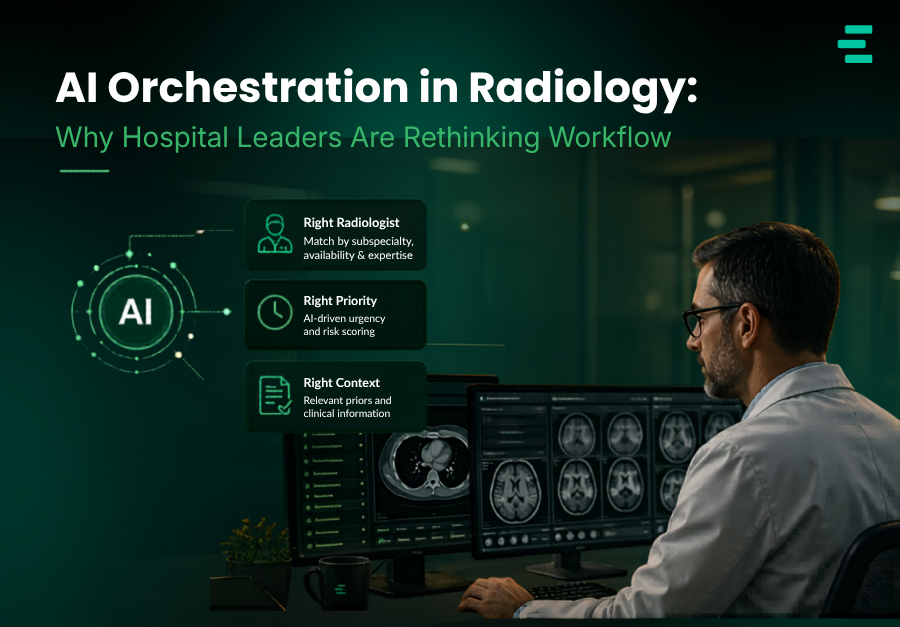
AI orchestration is the layer that helps radiology departments decide how work should flow before a radiologist even opens a study. For every incoming exam, it supports three core decisions:
- Who should read it — assigning the case to the radiologist best suited to handle it.
• How fast it should be read — prioritising the study according to urgency and clinical risk.
• What information should come with it — surfacing the context needed to report efficiently and accurately.
That is the practical value of orchestration. It does not just organise the queue. It helps the department route work more intelligently, prioritise what matters most, and reduce the manual friction around each case.
Effective orchestration is neither purely rules-based nor purely AI-driven. It combines both.
The distinction from traditional worklist management is that effective orchestration is both rule-based and AI-driven. When metadata is clean, rules are working quickly and cheaply. When metadata is ambiguous or missing, AI image classification takes over. A 2026 retrospective cohort study published in Academic Radiology reported that an integrated digital intelligence platform absorbed a 66.4% increase in examination volume while significantly reducing order-to-report times across CT and MRI at stable staffing levels — the kind of result that is simply unachievable with a classic PACS worklist and manual triage.
What hospital leaders should look for
Practical evaluation criteria that tend to separate mature platforms from demo ware:
- Vendor neutrality. Large networks often have multiple PACS. Any orchestration that only works inside one vendor’s stack creates a new silo. A vendor-neutral orchestration layer that overlays existing PACS and RIS environments is structurally different from a platform migration.
- Classification precision. For instance, evorad’s Maestro platform reports 89% precision on CT and MRI study classification across a 34,000-image validation set — the kind of figure a procurement team can actually stress-test, rather than vague “AI-powered” claims.
- Deployment disruption. Anything that requires wholesale PACS replacement is a multi-year initiative most departments cannot absorb. Evaluate whether the orchestration layer embeds into your RIS and overlays existing PACS, or whether it requires a complete system overhaul.
- EU AI Act readiness. Per ESR guidance, triage tools sit in a high-risk category. Any orchestration layer should have clear human-oversight controls, audit trails, and documentation that maps to deployer obligations under the Act.
The bottom line
For hospital leaders, AI orchestration in radiology is not a replacement for radiologists. It is a structural response to the reality of insufficient numbers and a workload growing faster than training pipelines. The departments best positioned to handle the next decade of imaging demand are the ones that treat orchestration as core infrastructure: vendor-neutral, auditable, and embedded in the workflows clinicians already use.
The tools to do this work are no longer experimental. They are operational, and the gap between the departments that adopt them and the ones that do not will show up first in turnaround times and eventually in patient outcomes.