What is a unified teleradiology platform?
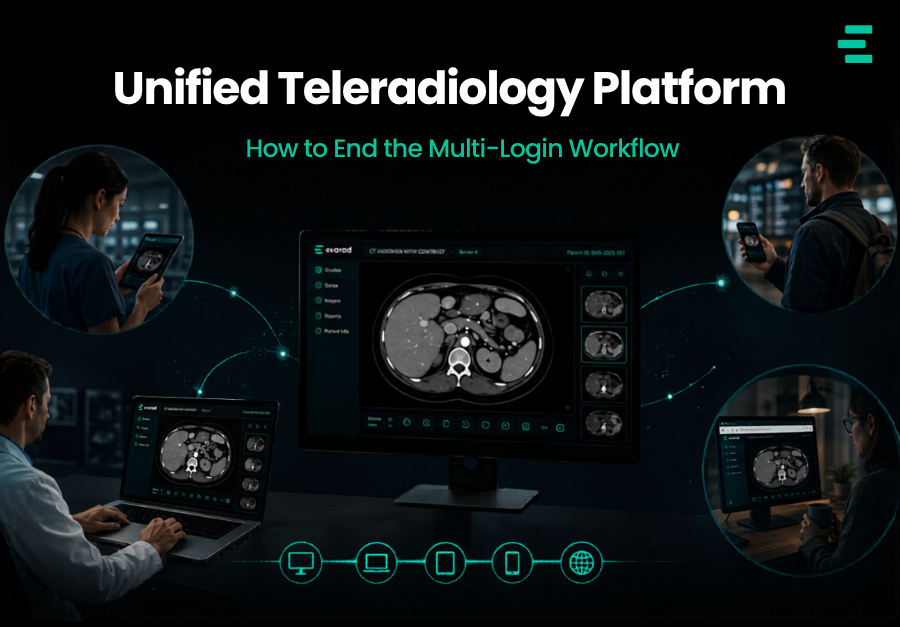
| Definition A unified teleradiology platform is a single system that gives distributed radiologists secure access to images, worklists and priors across multiple client sites and PACS sources through one login and one interface, rather than switching between separate systems for each client or facility. It consolidates the radiologist’s reading environment without necessarily replacing the underlying source systems — using federation, aggregation or a vendor-neutral archive to present a coherent view of work. |
How common is multi-PACS fragmentation in teleradiology groups?
Teleradiology exists because demand for radiological interpretation outpaces the supply of radiologists, and that gap is widening. The Royal College of Radiologists’ Clinical Radiology Workforce Census 2024 found the UK radiology workforce grew by 4.7% while demand for CT and MRI imaging grew by 8% — a 29% shortfall forecast to reach 39% by 2029. The NHS spent an estimated £325 million on temporary radiology staff in 2024. Teleradiology groups absorb that demand by spreading work across distributed radiologists serving multiple hospital clients in parallel. The structural consequence is that each client typically has its own PACS, its own worklist and its own credentials — and as a group adds clients, the number of platforms a single radiologist must navigate rises with them.How fragmented teleradiology environments arise
Nobody designed teleradiology to work this way. Fragmentation emerged gradually as group operations expanded across three distinct dimensions.- Client diversity. Each hospital or imaging centre that a group serves has its own PACS, often chosen years earlier under a different procurement. True integration is technically possible but commercially complex — and frequently the group simply inherits whatever is in place.
- Subspecialty tooling. Breast imaging, cardiac imaging, nuclear medicine and PET interpretation often happen on vendor-specific systems tied to particular equipment. General radiologists covering subspecialty work navigate between these purpose-built environments, each with its own conventions.
- Group consolidation. When teleradiology groups merge or acquire each other, they inherit the combined client list — and the combined PACS estate. True system consolidation is expensive and disruptive; many groups maintain separate logins indefinitely, connecting systems loosely through image exchange rather than fully integrating.
The hidden cost of switching between teleradiology systems
Group leaders often underestimate the cost of multi-system workflows because it is diffuse and rarely shows up directly on a profit-and-loss statement. The cost is real all the same.Time, training and competency overhead
Every system switch requires authentication, orientation and adaptation. Multiplied across a day, that overhead compounds into a measurable productivity tax – paid radiologist time spent on navigation rather than interpretation. Each platform also requires onboarding for new radiologists and ongoing competency maintenance as systems update. For a group bringing in locums or short-term cover, the training tax is particularly punishing.Increased error risk
Different systems display information differently. A measurement that appears in millimetres on one platform may display differently on another. Hanging protocols, prior-comparison logic and window/level presets do not transfer between environments. These inconsistencies create opportunities for misinterpretation — and the cognitive load of adapting to multiple interfaces leaves less mental capacity for the diagnostic task itself.Credential management and security
Multiple systems mean multiple credentials, expiring on different schedules and using different multi-factor tokens. Radiologists cope with workarounds—written-down passwords, shared logins, and weaker password choices—that undermine the security architecture intended to protect patient data. According to the Ponemon Institute and Proofpoint, 92% of surveyed US healthcare organisations reported at least one cyberattack in 2024, up from 88% in 2023. European centres face the same threat landscape, with stricter GDPR consequences if a breach occurs.A unified teleradiology platform vs traditional multi-PACS workflow
A side-by-side comparison makes the operational difference explicit.| Dimension | Multi-PACS workflow | Unified teleradiology platform |
| Login | Multiple per shift | Single sign-on |
| Worklist | Separate per client | Unified and priority-ordered |
| Interface | Different per system | Consistent across all studies |
| Prior access | Manual retrieval | Automatic, cross-source |
| Hanging protocols | Per-system, inconsistent | Configured once, applied everywhere |
| Onboarding new clients | New PACS to learn each time | Add to the existing workflow |
| Credentials | Many, different policies | One identity to manage |
| IT burden | High; multi-vendor support | Concentrated; one partner |
How fragmentation contributes to radiologist burnout
Beyond operational metrics, system fragmentation contributes to radiologist burnout. A 2024 meta-analysis in the American Journal of Roentgenology (Kang et al.) pooled 43 studies across validated instruments and found radiologist burnout prevalence between 34% and 39% globally. A systematic review in the European Journal of Radiology Open (Fawzy et al., 2023) reported a wider range — 33% to 88% — reflecting differences in measurement tools, but consistently elevated. UK data echoes the pattern: the RCR’s 2024 workforce census reports that, for the third consecutive year, every clinical director surveyed was concerned about morale; the median age of UK consultant radiologists leaving the NHS workforce dropped to 50 in 2024, down from 56 in 2020. Burnout is multi-causal — workload, leadership, compensation and culture all matter. But the workflow environment is one of the few levers a group leader directly controls, and unlike most operational improvements, the gains are visible to every radiologist on every shift.What this means for teleradiology group leaders
For the operator running a teleradiology group, the unified-platform argument is not really about radiologist comfort — it is about the operating model. Four things matter in particular.Retention
Radiologists are scarce and mobile. A group that asks its radiologists to live in five interfaces while a competitor offers one will lose people. With the RCR forecasting a 39% UK consultant shortfall by 2029, the cost of replacing a senior radiologist now far exceeds the cost of better workflow tooling. Retention is no longer an HR concern; it is a commercial one.Multi-client SLAs
Each client hospital negotiates its turnaround commitments. Missing them costs contracts. A unified worklist prioritises all clients simultaneously – instead of relying on radiologists to remember which queue is most urgent – turning SLA compliance from a memory test into a system property. Dashboards on the same platform let the group see where work is building up and rebalance before a breach occurs.Subspecialty routing
The group’s commercial value increasingly depends on getting the right study to the right subspecialist quickly. That is a routing problem, and it scales badly when every client sits in a separate system. A unified platform with intelligent routing turns subspecialty distribution into a durable competitive advantage rather than a roster-management headache.Onboarding speed
When the group wins a new client, the integration time directly affects the time to revenue. A platform designed to add new client feeds quickly — through DICOM, DICOMweb, HL7/FHIR and IHE profiles — lets the group say yes to growth without a six-month IT project.What a unified teleradiology platform actually delivers:
Four practical things distinguish a unified platform from a stack of point tools. They are the standard against which a teleradiology platform for radiology groups should be evaluated.- Single authentication. One login grants access to every worklist and every site that the radiologist is authorised to read. Password management simplifies, multi-factor fatigue eases, and security improves because strong authentication on one platform is more practical than weak authentication across many.
- Consistent interface. Every study opens in the same viewer. Hanging protocols, measurement tools and annotation conventions stay stable. The cognitive cost of adapting to different systems disappears.
- Consolidated worklist. All pending cases are presented in one prioritised view, regardless of source. A STAT study from one client sits beside STAT studies from another, in priority order — not hidden in a separate system that may not be checked immediately.
- Seamless prior access. Comparison requires priors. A unified platform aggregates or federates prior studies from across client sites, so subtle interval change is visible without leaving the viewer.
Technical approaches: aggregation, federation and cloud
Unified platforms achieve consolidation through several technical routes, each with different implications for IT and clinical operations.Image aggregation
Aggregation pulls studies from the source systems into central storage. The viewer experience is simple; the data management is more complex because synchronisation has to keep the unified store current. Storage costs are higher because images effectively exist in two places.Federation
Federation leaves images in source systems and queries them on demand. No data duplication, but performance depends on connectivity to each source, and integration must be built with each system’s APIs or DICOM endpoints.Cloud-native delivery
Cloud-native platforms remove the on-premise infrastructure burden and naturally support the distributed radiologists teleradiology groups actually employ. For European groups, the cloud decision is linked to GDPR: medical images are special-category personal data, and data residency, sub-processor disclosure, and a written data processing agreement are all important. The choice between approaches is not a hard rule — many platforms combine aggregation and federation depending on the client. What is relevant for a group leader is that the result reaches the radiologist as a single coherent environment.AI and the EU AI Act: what teleradiology groups need to know
Most clinical radiology AI falls under the EU AI Act (Regulation (EU) 2024/1689) as high-risk, because it is or is part of a medical device requiring third-party conformity assessment under the EU Medical Device Regulation. The primary compliance burden sits with the AI provider, but the teleradiology group acts as the deployer — with explicit obligations: procure only compliant systems; maintain meaningful human oversight; log performance in real use; and cooperate with post-market monitoring. For a unified teleradiology platform, this means AI tools should surface inside the same viewer the radiologist already uses, not in a separate application that gets bypassed when work is busy — and the platform itself should support the audit trails and oversight records the deployer needs to keep. High-risk obligations are being phased in across 2026 to 2028, with the timetable subject to revision; verify current dates with vendors before procurement.How to plan a teleradiology platform consolidation
A consolidation project lives or dies on sequencing. The following seven steps keep the focus on operating outcomes rather than features.- Map the current estate. List every client, every PACS, and every login per radiologist. Time how long a typical shift spends on system-switching.
- Define the operating outcomes. Decide what good looks like—SLA compliance, faster onboarding, retention— before evaluating platforms.
- Check regulatory fit. Confirm GDPR data-residency options, CE marking under MDR for any AI components, and the platform’s position under the EU AI Act.
- Pilot with two or three clients first. Please select representative cases, rather than the easiest ones. Measure against the baseline you recorded in step 1.
- Plan client onboarding. Most of the change-management work is at the client end: data feeds, integration testing, change of habit for referring clinicians.
- Train staff and document. New conventions, new credentials, new escalation paths — documentation matters more than a launch event.
- Measure and iterate. Use dashboards to track turnaround, SLA performance and utilisation. Improvement that isn’t measured doesn’t last.
End the multi-login workflow
If your radiologists log into five systems before reading their first study of the day, you are paying for that overhead – in time, in errors, in attrition. See how the Evorad teleradiology platform for radiology groups consolidates worklists, viewers and priors across every client into a single environment, or book a 20-minute demo to see it on your studies.Frequently asked questions
A unified teleradiology platform is a single system that gives distributed radiologists secure access to images, worklists and priors across multiple client sites and PACS sources through one login and one interface, rather than switching between separate systems for each client or facility.
Yes. Modern unified platforms use either image aggregation (copying studies into a central archive) or federation (querying source systems via DICOM, DICOMweb and HL7/FHIR) to present multi-vendor environments through one interface. Many platforms combine both approaches depending on the client.
Not necessarily. A unified platform is about consolidating the radiologist’s reading environment; cloud PACS is about where the underlying images are stored. The two often go together, especially for distributed teleradiology groups, but they solve different problems, and the buying decisions are separate.
Reducing context-switching and login fatigue is one of several factors that can ease daily cognitive load and improve daily experience. Retention is multi-causal — workload, compensation and culture all matter — but workflow environment is one of the few levers a group leader directly controls, and the gains are visible on every shift.