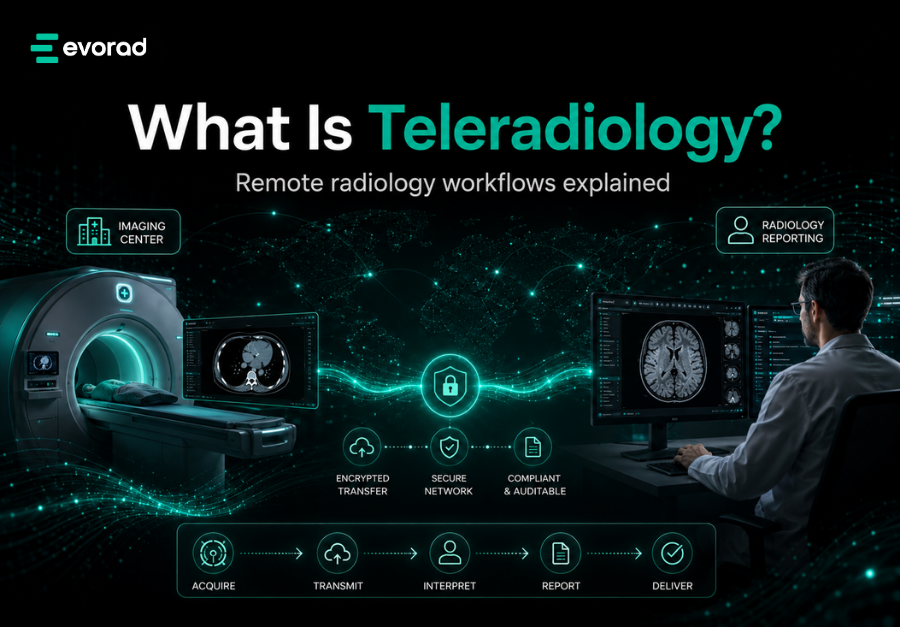
Teleradiology is the practice of transmitting medical images from where they are acquired to a radiologist in another location for interpretation. The scan happens in one place; the expert reading happens in another. The report flows back to the clinician who ordered it — often within minutes and often across cities, countries or time zones.
What began as an after-hours stopgap has become core infrastructure. Imaging demand keeps rising while radiologist supply does not keep pace, and remote reading is one of the few levers that lets scarce expertise serve more patients in more places. This guide explains how teleradiology works end to end, when organisations use it, the technology it depends on, and how quality is safeguarded.
Teleradiology in one definition
Teleradiology is remote diagnostic interpretation: the electronic transfer of radiological studies — CT, MRI, X-ray, ultrasound, mammography and more — from the acquiring site to a radiologist elsewhere, together with the clinical context needed for an accurate read, followed by delivery of a formal report back into the ordering clinician’s workflow.
Two things distinguish real teleradiology from simply emailing an image. First, it operates on diagnostic-quality data with full fidelity and complete metadata, not screenshots. Second, it is a governed workflow: patient identity, prior studies, urgency, reporting and traceability are all managed, because the output is a medico-legal document that drives treatment decisions.
The practice has a longer history than its current profile suggests. Early services grew around overnight emergency coverage — the ‘nighthawk’ model, often reading across time zones — and carried a stopgap reputation for years. What changed was less the concept than the infrastructure: web-based diagnostic viewers, reliable connectivity and orchestrated worklists removed the compromises that once separated remote from on-site reading. Today the same platforms serve overnight coverage, daytime subspeciality routing and whole-network reading interchangeably; teleradiology stopped being a service category and became a property of well-architected imaging operations.
When and why organisations use it
- After-hours and overnight coverage. Emergency imaging does not follow office hours. Remote readers provide overnight and weekend interpretation so hospitals avoid staffing every site around the clock.
- Subspeciality access. A small hospital rarely employs a neuroradiologist or a musculoskeletal specialist, but its patients still need one. Teleradiology routes each study to appropriately qualified expertise wherever it sits.
- Surge and backlog management. Volumes spike — seasonal demand, staff absence, and screening programmes. Remote capacity absorbs peaks without permanent hires.
- Coverage for underserved regions. Rural facilities and emerging health systems use teleradiology to offer services that local staffing could never support.
- Multi-site efficiency. Imaging networks centralise reading across their sites, balancing workload and standardising quality rather than running isolated rosters per location.
- Second opinions and peer review. Complex cases and quality programmes benefit from structured access to additional expert reads.
For imaging centres and smaller hospitals, the economics are often the deciding argument. Employing subspeciality coverage across every reading hour is impossible at modest volumes; buying it as a service converts a fixed staffing problem into a variable cost that tracks activity. The same logic serves growth: a new site or a new modality can open with full reading coverage from day one, with capacity scaling as volumes build rather than being hired ahead of them.
How it works, end-to-end
A well-run teleradiology workflow follows a consistent chain – and its reliability depends on every link:
- Order and scheduling: the exam is ordered and becomes a tracked entity with consistent patient and exam identifiers.
- Acquisition: The modality pulls those details via DICOM Modality Worklist, preventing the data-entry errors that remote readers cannot easily fix.
- Transfer and ingest: images move as DICOM objects to the reading platform, where they are indexed and quality-checked, and relevant priors are fetched.
- Assignment: routing logic sends the case to the right reader based on subspeciality, urgency, service-level timers, licensing and current workload.
- Interpretation: The radiologist reads in a diagnostic viewer with priors and clinical context, wherever they are.
- Reporting and delivery: the finalised report flows back to the ordering system and referrer, with critical findings escalated through a formal notification path.
For a deeper walk-through of each step, see our companion guide, Teleradiology Workflow from Order to Report.
One element of the chain deserves explicit mention because it is human rather than technical: coordination. Remote reading still generates questions — an ambiguous clinical history, a protocol query, or an urgent finding needing a phone conversation — and mature services design them with defined contact paths, escalation procedures and documented communication rather than hoping the need away. The technology shortens distances; the workflow design is what keeps remote reading clinically connected.
Ingest quality control is the unglamorous step that protects everything downstream: verifying the study is complete; the series are intact; the patient and order identifiers match; and the examination is labelled consistently with the network’s conventions. Every error caught here costs seconds; the same error discovered by a reader mid-interpretation costs a phone call, a delay and a fragment of trust in the service.
The technology behind reliable remote reading
- A diagnostic-grade viewer, increasingly zero-footprint: running in a standard browser with server-side rendering, so studies load fast on ordinary connections and no software needs installing or maintaining on the reader’s machine.
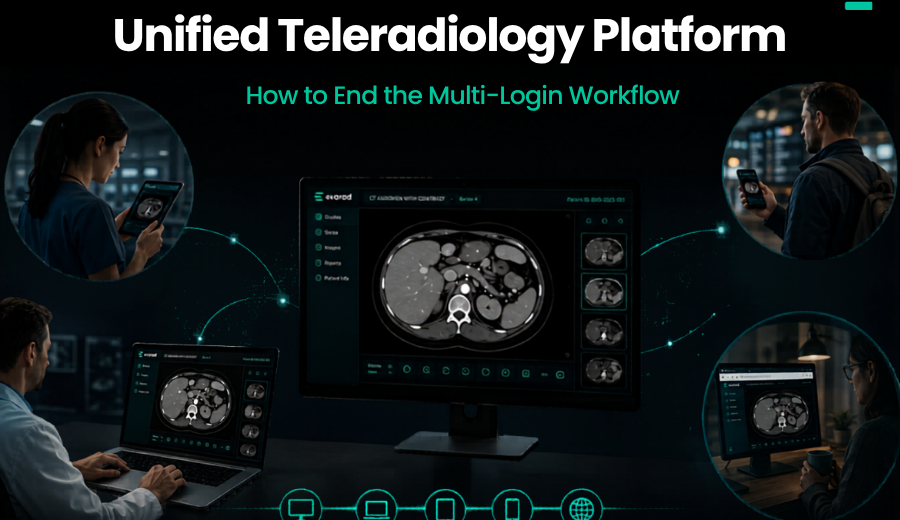
- Unified worklists: one queue across all connected sites, so priorities are visible in one place instead of five logins.
- Intelligent routing and SLA timers: automation that assigns and escalates cases so deadlines are protected without manual list-watching.
- Priors access: fast retrieval of relevant prior studies across sites — often the single biggest determinant of whether remote reading feels seamless.
- Security architecture: encrypted transfer, role-based access, audit trails, and designs that keep patient data server-side rather than scattered across remote devices.
- Standards-based integration: DICOM, DICOMweb and HL7 connections so the service plugs into hospital systems rather than beside them.
Reporting deserves equal weight to viewing in any evaluation. The read is only complete when a finalised report has landed in the referrer’s workflow, so the platform must close that loop natively: structured reporting in the same environment as the images, automated delivery back to the ordering system, and a critical-results pathway with acknowledgement tracking. Services that read brilliantly but deliver reports by improvisation have automated the middle of the chain and left both ends manual.
Quality, governance and licensing
Remote reading is held to the same clinical standard as on-site reading, and mature operations make that visible rather than assumed. Expect defined reporting standards and templates, documented critical-results procedures, structured peer review and discrepancy management, and full auditability of who read what and when.
Licensing and registration are jurisdiction-specific: in most frameworks the interpreting radiologist must be appropriately licensed or recognised where the patient is located, and cross-border services must satisfy data-protection law, such as GDPR in Europe. Reputable providers treat these as design inputs, not afterthoughts — routing rules can and should encode credentialing constraints automatically.
Data protection deserves specific attention in cross-border arrangements. Under GDPR, imaging transfers for remote reading require an appropriate legal basis and safeguards, and national rules may add residency or notification requirements on top. Architecture helps here as much as paperwork: platforms that keep patient data server-side — streaming pixels to the reader’s browser rather than distributing files to remote devices — shrink the compliance surface dramatically compared with download-based workflows.
Benefits and honest limits
The benefits are substantial: faster access to expertise, around-the-clock coverage without around-the-clock staffing, subspeciality reads for every site, resilient capacity, and better use of a scarce workforce.
The limits deserve equal honesty. Teleradiology does not perform procedures or stand in the room for consultations; interventional work and some direct patient interactions remain on-site. It cannot compensate for poor upstream data discipline — wrong-patient and mismatched-order errors are harder to resolve remotely. And done badly, with fragmented systems and slow priors, it simply relocates inefficiency. The difference between good and bad teleradiology is almost entirely workflow architecture.
For organisations evaluating providers or platforms, the practical shortlist questions follow directly from this guide: How are priors retrieved and how fast, across which sites; how is the worklist unified and prioritised? What does the reporting and critical-results loop look like? What governance and peer-review evidence is available; and can the service demonstrate all of it live, on your cases, rather than in a slide deck?
The workforce context explains why this matters more each year. Imaging volumes grow steadily while radiologist numbers do not keep pace, and the shortfall is unevenly distributed — some regions and subspecialties feel it acutely. Teleradiology does not create radiologists, but it is the most effective mechanism yet for letting the existing workforce serve demand wherever it arises, which is why it has moved from the periphery of imaging strategy to its centre.
Purpose-built for remote reading
Everything that separates smooth teleradiology from frustrating teleradiology — unified worklists, fast priors, zero-footprint viewing, SLA-aware routing and clean reporting integration — is a platform property. evoTelerad was built as exactly that platform: secure remote viewing, analysis and reporting that extends your imaging operation instead of fragmenting it.
Explore evoTelerad or see how teleradiology groups run on Evorad.