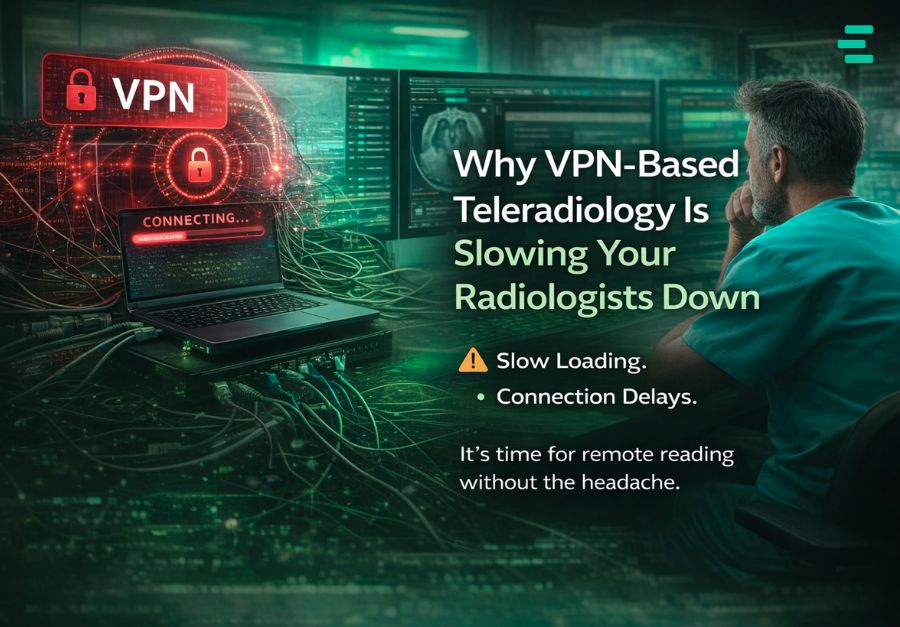
Every radiologist working remotely has experienced it. You sit down to start reading cases, launch your VPN client, enter your credentials, wait for the connection, and then wait some more. Sometimes it connects on the first try. Often it does not. And when it finally does connect, a single network glitch can force you to restart the entire process.
VPN-based remote access was never designed for diagnostic imaging. It was built for office workers accessing email and spreadsheets. Yet healthcare organizations have relied on VPNs as the default method for enabling remote radiology reading for years. The result is a workflow that frustrates radiologists, creates an unnecessary IT burden, and ultimately slows down patient care.
This article examines why VPN-based teleradiology has become a bottleneck, what it actually costs healthcare organizations, and how modern browser-based solutions are replacing legacy infrastructure with faster, simpler, and more secure alternatives.
The Hidden Costs of VPN-Based Teleradiology Workflows
Connection Delays Add Up
A radiologist who spends five minutes each morning establishing a VPN connection loses over 20 hours per year just on initial login. But the real productivity drain comes from mid-session disconnections. VPN connections are notoriously unstable, particularly when radiologists work from home networks that were never configured for enterprise-grade connectivity.
Each disconnection means re-authenticating, re-launching the PACS viewer, and navigating back to the case in progress. For complex studies requiring sustained concentration, these interruptions break diagnostic focus and extend interpretation time. Research published in the American Journal of Roentgenology confirms that even minor workflow disruptions compound across a reading session, reducing overall efficiency.
IT Support Burden
VPN-related tickets are among the most common support requests in healthcare IT departments. Password resets, client software updates, firewall conflicts, and connection troubleshooting consume hours of IT staff time each week. When a connection fails at 6 AM and IT support is not available until 8 AM, those cases sit unread. For time-sensitive studies, that delay matters.
Security Risks Are Growing
Ironically, VPNs are often implemented for security reasons, yet they introduce their own vulnerabilities. Once a user authenticates to a VPN, they typically have broad network access. If a radiologist’s home computer is compromised, that VPN connection becomes a pathway into the hospital network.
The data is alarming. According to the Health-ISAC Heartbeat Q1 2025 report, VPN provider vulnerabilities and compromised credentials remained a consistent theme causing risk for healthcare organizations throughout 2024 and into 2025. The healthcare sector reported 158 ransomware attacks in Q1 2025 alone, with VPN exploits cited as a key attack vector. Between January and September 2024, healthcare organizations in the United States experienced 491 large-scale data breaches, with many exploiting remote access vulnerabilities.
Why VPNs Were Never Built for Teleradiology
VPN technology emerged in the 1990s as a way to extend corporate networks to remote workers. The assumption was that remote workers needed access to the same resources as on-site workers. This approach works reasonably well for low-bandwidth applications like email and file sharing. It works poorly for diagnostic imaging, where radiologists need to rapidly load large image datasets, manipulate 3D reconstructions, and compare current studies with relevant priors.
The Bandwidth Problem
A typical CT study contains hundreds of images. A cardiac CT or whole-body PET-CT can exceed one gigabyte. When these images must travel through a VPN tunnel, they compete with all other traffic on that connection. The encryption and decryption overhead adds latency. Radiologists experience this as slow loading times, sluggish scrolling, and delayed response when adjusting window and level settings.
This matters because radiology workloads are increasing dramatically. Research published in Diagnostic Imaging found that from 2009 to 2020, diagnostic radiologist workloads increased by 80%. With this volume growth, any inefficiency in the reading environment directly impacts capacity and turnaround times. Understanding how PACS integrates with teleradiology workflows is essential for optimizing remote reading operations.
The Architecture Problem
VPNs require client software installed on the radiologist’s computer. That software must be kept updated. It must be compatible with the operating system. It must not conflict with other security software. Each of these requirements creates potential failure points. When organizations support radiologists reading from multiple devices or locations, the complexity multiplies.
The Shift to Zero-Footprint, Browser-Based Teleradiology
The limitations of VPN-based teleradiology have driven the development of a fundamentally different approach: zero-footprint, browser-based viewers that require no client software installation and no VPN connection.
These solutions work by running the image processing and rendering on server-side infrastructure, then streaming the visual output to the radiologist’s browser. The heavy computational work happens in a controlled data center environment with direct access to image storage. Only the pixels travel to the radiologist’s screen.
Faster Loading, Faster Reading
Because image processing happens server-side with high-speed access to storage, studies load in seconds rather than minutes. Scrolling through a CT stack feels responsive. 3D reconstructions render quickly. Prior studies pull up without delay. Research from Children’s Hospital of Alabama found that implementing integrated, streamlined workflow systems yielded a 40% increase in radiologist efficiency—enabling them to handle the workload of eight radiologists with just five.
Simplified IT Management
Zero-footprint solutions eliminate the burden of managing client software entirely. There is no VPN client to install, update, or troubleshoot. Radiologists access the platform through a standard web browser. For IT departments, this shift is transformative. Support tickets for connection issues drop dramatically. New radiologists can be onboarded in minutes rather than days.
Security Through Isolation
Browser-based architectures can actually improve security compared to VPN-based approaches. Because image data is processed server-side, no patient data is ever downloaded to the radiologist’s local device. The browser displays pixels, not DICOM files. This architecture also enables granular access controls, limiting each radiologist to specific facilities or study types.
The Impact on Radiologist Wellbeing
Beyond operational metrics, VPN frustration contributes to radiologist burnout. According to a systematic review published in the European Journal of Radiology Open, burnout prevalence among radiologists ranges from 33% to 88%. A 2024 Medscape poll found that 54% of radiologists report experiencing burnout.
Technology friction is a known contributor. When radiologists must fight their tools rather than focus on diagnosis, frustration accumulates. The reading room should support concentration and efficiency, not create additional obstacles. Radiologists often face the “swivel chair” problem—rotating between multiple workstations, logging into different systems, and searching for the correct study to read. This fragmented process wastes valuable time and creates unnecessary administrative burdens.
The Business Case for Modern Teleradiology
The return on investment for eliminating VPN-based teleradiology comes from multiple sources:
Radiologist productivity improves when connection delays and mid-session disruptions disappear. Even a modest improvement in cases read per hour compounds into significant capacity gains across a full radiology team.
IT support costs decrease when VPN troubleshooting is eliminated. Staff time previously spent on connection issues can be redirected to higher-value projects.
Recruitment and retention benefit when radiologists can work from anywhere without technology friction. In a competitive market for radiology talent, offering a modern, frustration-free remote work experience is a meaningful differentiator. Research shows that flexible work arrangements improve job satisfaction by 20%.
Bottom line
VPN-based remote access served its purpose when it was the only option available. But teleradiology has evolved, and the technology enabling remote reading has evolved with it. Browser-based, zero-footprint platforms now offer faster performance, simpler management, and stronger security than legacy VPN approaches.
For radiology practices and healthcare organizations still relying on VPN connections for remote reading, the question is no longer whether to make the switch but when. Every day of continued VPN-based operation is a day of preventable friction, inefficiency, and risk. The technology to solve this problem exists today. What remains is the organizational will to implement it.
How evoTelerad Solves the VPN Problem
evoTelerad was built specifically to eliminate the frustrations of VPN-based teleradiology. Our zero-footprint, browser-based platform delivers:
One viewer, every case: Access all your facilities and worklists through a single, unified interface—no VPN required.
Zero installation: Read from any device with a modern browser. No client software to install, update, or troubleshoot.
Sub-second image loading: Server-side rendering ensures fast, responsive viewing regardless of your local network conditions.
Enterprise-grade security: Granular access controls and no local data storage mean stronger protection than traditional VPN architectures.
Ready to give your radiologists the tools they deserve? Book a demo and see how zero-footprint access transforms remote reading.