When radiology is running smoothly, it rarely feels “technical.” Exams are booked, scanners stay productive, priors show up when needed, and reports reach clinicians without delays. But behind that calm experience is a workflow that depends on three systems working together:
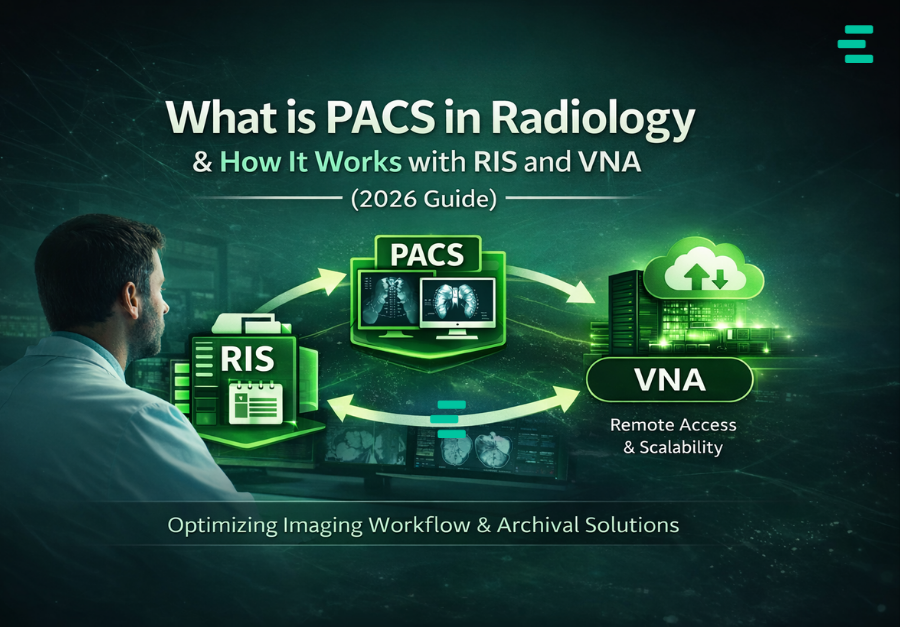
- RIS to manage the radiology workflow and operational truth
- PACS to manage imaging storage, access, and diagnostic viewing
- VNA to keep imaging data portable, governed, and accessible long-term
In 2026, most imaging organisations aren’t simply asking “What is PACS?” They’re asking a more practical question:
How do we make imaging faster, safer, easier to scale across sites, and less dependent on one archive or one vendor?
This guide explains PACS in plain language, shows how it works step-by-step, and clarifies how RIS and VNA fit into a modern imaging environment.
What is PACS in radiology?
PACS (Picture Archiving and Communication System) is the system that handles medical imaging studies after they are acquired—so they can be stored, found, viewed, and shared.
A PACS typically:
- receives studies from modalities (CT, MR, US, CR/DR, etc.)
- stores and indexes images for fast search and retrieval
- retrieves priors and relevant studies when needed
- routes exams to the right worklists and readers
- supports diagnostic viewing through a viewer
- distributes images securely to clinicians, sites, and external partners
It replaced film libraries and manual image distribution. Today it sits at the centre of imaging operations.
But PACS doesn’t do everything. It needs strong workflow context (RIS) and a long-term archive strategy (VNA) to truly scale.
PACS, RIS, and VNA: what each one is responsible for
Here’s the simplest way to avoid confusion: each system “owns” a different truth.
| System | What it’s for | What it “owns” day to day |
| RIS | Radiology workflow | Orders, scheduling, exam status, reporting flow, operational tracking |
| PACS | Imaging access and diagnostic workflow | Ingest, storage, indexing, retrieval, routing, viewing, distribution |
| VNA | Long-term, enterprise imaging archive | Portability, retention policies, lifecycle storage, cross-site access, archive continuity |
RIS (Radiology Information System)
RIS is where the radiology operation lives. It keeps exams organised and makes workflow visible: what’s scheduled, what’s completed, what’s waiting to be read, and what’s final.
PACS (Picture Archiving and Communication System)
PACS deals with imaging studies as objects: receive them, store them, retrieve them, display them properly for diagnosis, and distribute them efficiently.
VNA (Vendor Neutral Archive)
VNA is best understood as the archive strategy that outlives individual systems. It helps organisations keep imaging data accessible and governed across time, sites, and vendor changes.
How PACS works in the real workflow (step by step)
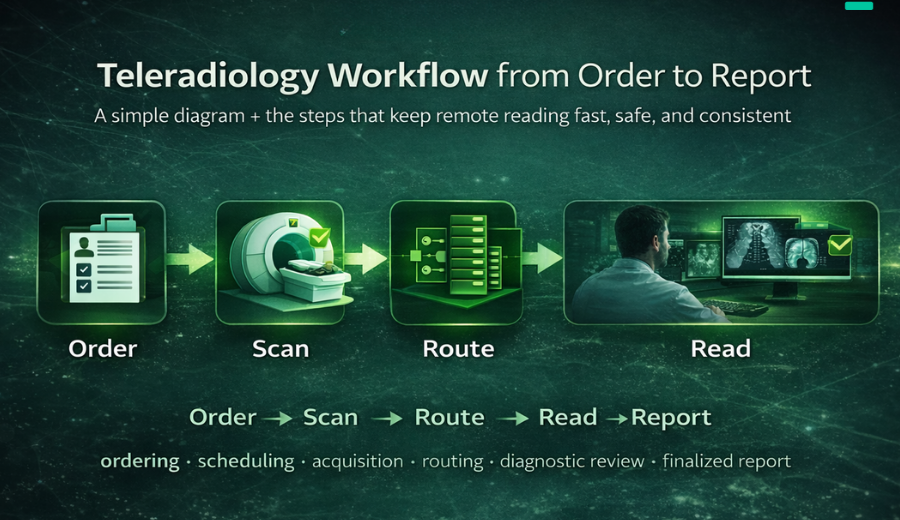
To understand PACS, follow a single exam from order to report.
1) The exam is ordered and scheduled (EHR → RIS)
A referring clinician orders imaging in the EHR. That order flows to RIS, where it becomes a scheduled exam with key identifiers (commonly including an accession number) and procedure details.
This stage matters because clean workflow data is what keeps the rest of the chain stable.
2) The modality pulls patient and exam details (RIS → modality)
On the scanner side, retyping patient demographics is where errors begin.
That’s why many environments use DICOM Modality Worklist (MWL). The modality pulls the right patient and exam details from RIS, which helps ensure the resulting images are linked correctly.
When MWL is inconsistent or not enforced, you typically see:
- mismatched studies and orders
- missing or inconsistent identifiers
- time lost on manual fixes
- downstream confusion in PACS and reporting
3) Images are acquired and sent (modality → PACS)
Once the exam is performed, the modality sends images to PACS in DICOM format. PACS receives the study, indexes it, and stores it so it can be found instantly.
At this point, PACS may also apply routing logic such as:
- which site should read the exam
- which worklist it belongs to
- how priors should be retrieved
- how images should be shared for clinical viewing
4) Radiologists read the study (PACS + diagnostic viewer)
This is where PACS becomes a daily productivity tool.
Radiologists open the study, compare priors, and use reading tools depending on modality and case type. Viewer performance and workflow fit matter more than most teams expect. Small delays multiply across a day of reading.
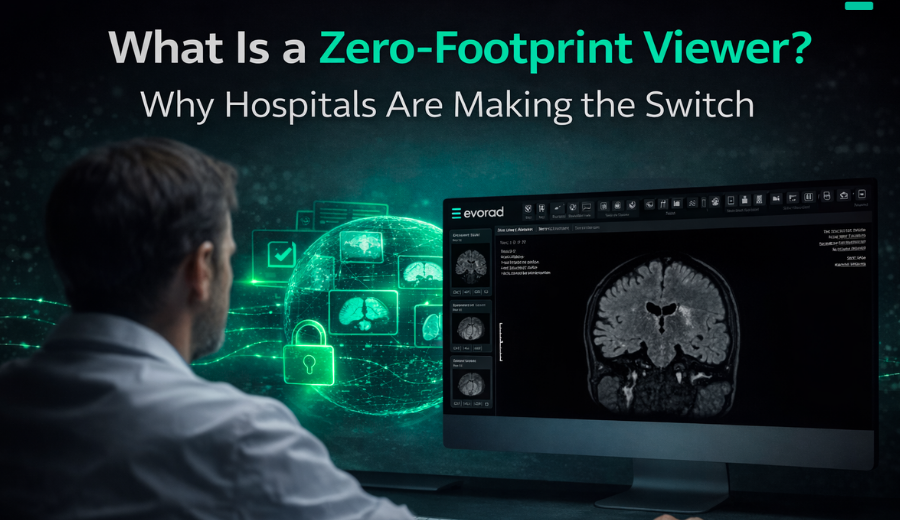
In 2026, many organisations also expect the viewer experience to support distributed work across sites without heavy installs, which is why web-based, zero-footprint diagnostic viewing is increasingly common.
5) Reporting and distribution complete the loop (RIS → EHR and stakeholders)
RIS tracks status and the reporting workflow, then results are distributed back to the EHR and other stakeholders based on how the organisation integrates systems.
That closes the loop: order → schedule → scan → store → read → report → distribute.
Where VNA fits, and why it matters in 2026
A lot of teams treat VNA like “extra storage.” That’s rarely the real value.
VNA is about control and continuity.
It becomes important when you need:
- multi-site imaging continuity (especially across growth or acquisitions)
- a stable archive that doesn’t force painful migrations during upgrades
- cross-department imaging access beyond radiology
- long-term retention governance and tiered storage policies
- portability so your archive isn’t trapped inside one PACS
Think of PACS as the working imaging hub. A VNA helps turn your archive into an enterprise asset that can support system evolution over time.
The integration layer: what connects PACS, RIS, and VNA
Most imaging environments rely on a few core standards and profiles to prevent fragile, custom interfaces:
- DICOM for imaging objects and modality communication
- DICOMweb for modern web-based imaging access and integrations
- HL7 for orders, patient context, and results messaging
- IHE profiles to standardise common workflow implementations
You don’t need to know every detail of these standards to benefit from them. In practice, they reduce interface breakage, simplify multi-site operations, and make future changes less disruptive.
What “modern PACS” really means in 2026
When organisations modernise imaging, they’re usually trying to improve measurable outcomes: turnaround time, access speed, staff workload, and reliability across sites. “Modern PACS” often comes down to four expectations.
1) Priors are fast and reliable
Radiologists need priors. If priors are slow or inconsistent across sites, productivity drops and clinical confidence can suffer.
2) Viewing works where care happens
Distributed reading and multi-site collaboration are normal now. That pushes organisations toward viewing options that are easier to deploy and maintain, without sacrificing diagnostic capability.
3) Workflow orchestration reduces manual effort
Routing logic, worklists, automation rules, and status visibility often have a bigger effect on throughput than “storage size.” When orchestration is solid, cases go to the right place at the right time with less human interference.
4) Archive strategy is built for change
Imaging data grows fast. If the archive is locked to one system, every upgrade or transition becomes a major project. VNA helps reduce that long-term friction by separating archive continuity from day-to-day PACS usage.
Common PACS workflow problems (and how to prevent them)
These issues show up everywhere, regardless of organisation size. The positive side is they’re usually predictable.
Images don’t match the correct exam
Often caused by manual entry or inconsistent identifiers. Strong RIS-to-modality worklist discipline prevents most of this.
Priors are missing or slow
Common in multi-site environments with fragmented archives or weak retrieval strategy. A coherent archive layer and smart routing/retrieval approach makes a noticeable difference.
The archive is tied to one PACS
When the archive lives entirely inside PACS, vendor changes can become painful. A VNA approach keeps archive continuity stable while systems evolve.
Putting it together: how to think about PACS, RIS, and VNA as one system
If you’re evaluating imaging technology, the most useful frame is simple:
- RIS runs the workflow truth
- PACS runs imaging access and diagnostic work
- VNA protects the archive long-term
- Standards keep integration stable and scalable
Platforms built as modular services—PACS, viewer, orchestration, VNA, portals—fit well with how imaging operates in 2026: across sites, across environments, and with constant pressure to move faster without compromising quality.
To see how this platform approach is structured in practice, explore the Evorad platform overview:
https://www.evorad.com/platform/