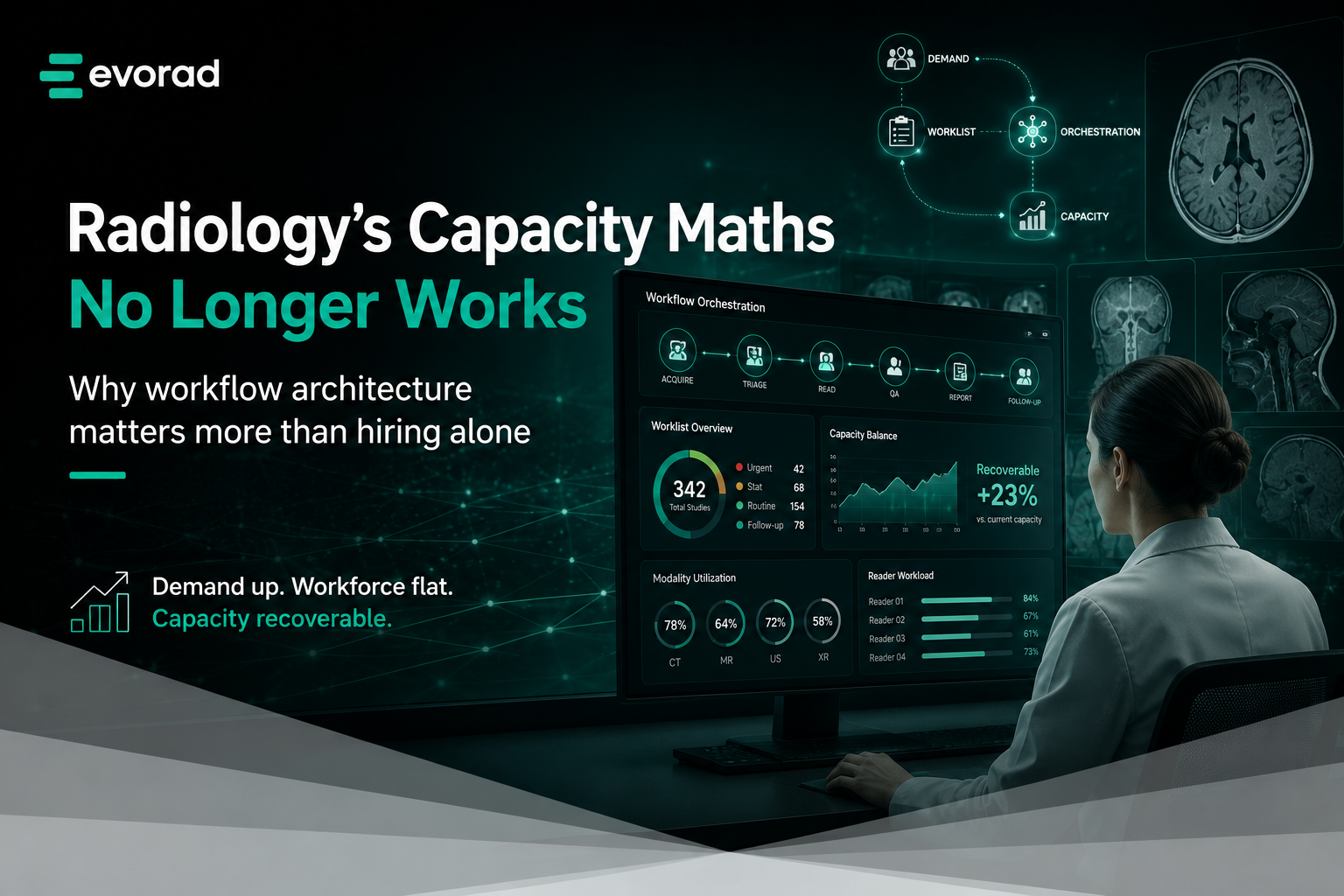
The radiologist shortage in Europe is structural.
The fastest near-term gains will come from protecting interpretive time, orchestrating work across sites and moving cases—not clinicians—to available expertise.
| Key takeaways
· Europe cannot recruit its way out of a workforce gap that takes years to train for and is already ageing toward retirement. Every day, fragmented worklists, interruptions, missing priors, manual reassignment and repeated system switching cause a loss of capacity. · The strategic goal is not to make radiologists work harder. It is to increase the proportion of their day spent on interpretation while preserving quality, resilience and wellbeing. |
Every radiology strategy meeting eventually reaches the same slide: imaging demand rising, the workforce growing too slowly and reporting backlogs widening. The default response is usually to recruit harder. Recruitment matters—but the numbers show that hiring alone cannot close the gap on a planning horizon that is relevant to today’s patients.
The 2025 EU-REST workforce study found that radiologist density across the EU-27 ranges from 51 to 270 per million inhabitants. Sixteen of 27 Member States are below the EU average of 127, and 45% of European radiologists were over 51 years old in 2022. Among the countries that supplied age-profile data, approximately 19% of radiologists were expected to retire within five years. This is not a temporary recruitment cycle. It is a structural capacity problem.
The radiologist shortage in Europe is structural, not temporary
A five-fold difference in radiologist density across a single regulatory and economic area is more than a staffing variation. It means that access to diagnostic expertise depends heavily on geography. It also means that local recruitment can become a zero-sum game: one hospital fills a vacancy by creating another vacancy somewhere else.
Training pipelines cannot be accelerated indefinitely. Radiology speciality training commonly lasts several years, and the people entering training today will not solve next quarter’s backlog. International recruitment may provide relief for an individual organisation, but it can also transfer scarcity from lower-density health systems to higher-paying ones rather than creating new European capacity.
The workforce still needs investment. Europe must train, recruit and retain more radiologists. But workforce expansion is a medium- to long-term lever. Hospital and network leaders also need a near-term operating model that extracts more clinical value from the scarce expertise already available—without extending shifts, increasing fatigue or compromising quality.
Why headcount alone cannot close the capacity gap
The usual capacity calculation is simple: more studies require more radiologists. The problem is that it treats every paid radiologist hour as an hour of diagnostic interpretation. In practice, a reading day is divided between image interpretation and the operational work surrounding it: opening different systems, finding the correct queue, locating priors, clarifying incomplete requests, answering avoidable calls, reassigning cases and moving information between disconnected tools.
The real capacity equation is not headcount × hours. It is headcount × protected interpretive time × effective case distribution.
This distinction changes the investment question. A new hire adds the output of one person. A workflow improvement can increase the usable capacity of every reader across every site and shift. That does not make technology a substitute for workforce planning. It makes workflow design a multiplier on workforce investment.
The capacity metric most departments miss: interpretive time
Workflow friction is often invisible because it is distributed into seconds and minutes rather than recorded as a budget line. Yet the evidence shows how quickly those increments accumulate.
In one observational study of 13 paediatric radiologists over 61 hours, only 52% of observed time was spent interpreting studies; active and passive interruptions accounted for the remainder. Interruptions increased interpretation time across every modality studied, adding an average of six minutes for CT and ten minutes for MRI.
A separate study of overnight neuroradiology coverage found that the duration of phone calls was the strongest independent predictor of report turnaround time. More recently, a year-long intervention at a Swiss imaging department found that 35% of incoming calls could be redirected because they did not require a consultant radiologist.
These studies come from specific settings and should not be treated as universal benchmarks. Their strategic message is broader: radiologist productivity is not determined only by reading speed. It is shaped by how much non-interpretive demand the operating environment places around each case.
Recoverable capacity sits in the workflow around the report
The fastest capacity gains are usually not dramatic. They come from removing repeated friction at scale:
- One prioritised worklist across sites, rather than several queues that radiologists must manually compare.
- Rules-based and AI-supported routing by urgency, subspeciality, availability and service-level commitment.
- Automatic retrieval of relevant priors and harmonised study descriptions reduces search and comparison delays.
- A consistent zero-footprint reading environment that supports secure work across locations without repeated installations or login changes.
- Structured reporting and integrated clinical context that reduce copying, re-keying and avoidable follow-up.
None of these changes is clinically glamorous. That is exactly why they matter. Capacity leakage is operational, so the response must also be operational. The goal is to ensure that the correct next case, the necessary context, and the relevant priors are presented together before the radiologist has to search for them.
This is the role of radiology workflow orchestration: not simply displaying a queue, but coordinating how work is classified, prioritised, assigned, escalated and completed across a network.
Teleradiology should redistribute expertise—not reproduce fragmentation
Teleradiology is often discussed as overflow capacity or after-hours outsourcing. That is too narrow. In a region where radiologist density varies five-fold, remote reporting can connect demand in under-resourced locations with qualified expertise elsewhere. Used well, it is capacity infrastructure.
Moving images is not the same as creating an effective distributed service. If remote readers must navigate multiple logins, inconsistent worklists, different viewers and incomplete clinical context, the model simply transfers local friction into a remote setting. It may add nominal capacity while losing effective capacity to system switching and coordination.
A mature model requires unified teleradiology workflows: a single view of demand, subspeciality-aware assignment, common quality controls, visible turnaround commitments and secure access to the same clinical information available on site.
The strategic test is not whether a report was produced remotely. It is whether remote and local work are governed as one diagnostic service—with consistent accountability, peer review and access to priors. When that standard is met, teleradiology becomes a way to move cases to expertise rather than forcing patients or clinicians to absorb geographic scarcity.
Capacity design is ultimately a patient-safety issue
The workforce gap becomes clinically meaningful when it delays diagnosis, treatment or follow-up. The United Kingdom is not a proxy for every EU health system, but its latest data illustrates the consequences of an unresolved capacity mismatch. In June 2026, the Royal College of Radiologists reported a 32% consultant shortfall, demand growing at more than twice the rate of the radiologist workforce and eight in ten radiology leaders saying they had seen patients’ conditions worsen because of staff shortages.
The patient does not experience a workforce model, a worklist configuration or a procurement decision. The patient experiences the wait: for the scan to be interpreted, for the result to reach the referrer and for treatment to begin. That is why radiology capacity should be measured not only in headcount or studies per day but also in time to clinically useful diagnosis.
What imaging leaders should measure now
Departments can only improve capacity if they instrument it. A practical measurement set should include the following:
- Interpretive-time ratio: the percentage of a reading session spent actively interpreting and reporting.
- Time in state: arrival-to-assignment, assignment-to-open, open-to-preliminary and preliminary-to-final.
- Prior availability at first open: how often the correct comparison is ready when the study is opened.
- Manual reassignment rate: how frequently cases are moved because routing was wrong or capacity changed.
- Subspeciality match rate: the proportion of cases reaching the appropriate reader without intervention.
- Interruption burden: calls, messages and consults per reader-hour, separated into clinically necessary and avoidable.
- Output per reader-hour, quality-adjusted: interpreted volume tracked alongside discrepancy, peer review and reopen rates.
- Patient-facing turnaround: time from image acquisition to report availability for the referring team.
These measures shift the conversation from abstract shortage to specific, recoverable loss. They also prevent a common mistake: improving throughput while allowing quality, equity or wellbeing to deteriorate elsewhere.
A practical 90-day capacity audit
A capacity programme does not need to start with a multi-year platform replacement. It can begin with a focused audit:
Days 1–30: Map the reading journey. Observe real shifts across sites. Record system changes, queue decisions, missing priors, calls, reassignment and waiting time. Establish the interpretive-time baseline.
Days 31–60: Remove the highest-frequency friction. Standardise worklist logic, redirect avoidable contacts, improve prior-fetch rules and resolve the metadata issues that create manual routing.
Days 61–90: Test network-level orchestration. Pilot unified prioritisation or subspeciality routing in one service line, then compare turnaround, reassignment, reader experience and quality indicators against the baseline.
The workforce curve is difficult to bend. The workflow curve is not.
Europe must expand its radiology workforce. But leadership teams that treat recruitment as the only capacity strategy will spend years waiting for supply while demand continues to compound.
The near-term opportunity is to recover the expertise already being paid for: protect interpretive time, route cases intelligently, make priors available at first opening and distribute work across sites without creating new fragmentation. That is not a call to make radiologists read faster. It is a call to stop spending radiologist time on work that does not require a radiologist.
Evorad’s Maestro and evoTelerad reflect this operating model by connecting prioritisation, routing, remote reading and quality workflows across existing imaging environments. The value is not another dashboard. It is more of the radiologist’s day returned to diagnosis.