Patients can track a parcel across three continents in real time, yet many still collect their MRI on a burnt CD and carry it between hospitals by hand. The gap between everyday digital experience and imaging access has become impossible to defend — and regulators, referrers and patients have all stopped defending it.
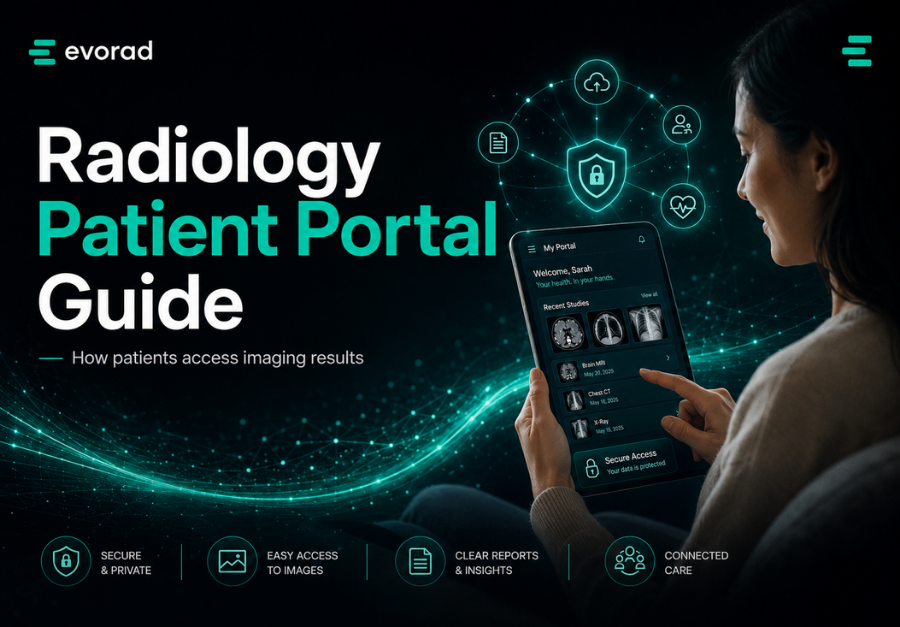
A radiology patient portal closes that gap: secure, self-service access to imaging exams, reports and sharing tools. This guide covers what a good portal should actually do, how referring-physician access fits in, the security and GDPR obligations involved, and the operational return that makes the business case.
Why patient imaging access is now table stakes
Three forces converged. Patient expectations moved: people who bank, book and consult online expect their health data to behave the same way. Referral patterns moved: patients increasingly seek second opinions and cross-organisation care, which means images must travel with them. And regulation moved: GDPR established the right of access to personal data, and the European Health Data Space is now building an EU-wide framework in which patients access and share their electronic health data – with medical images and imaging reports becoming a mandatory exchange category by 2031.
Providers that treat patient access as an optional extra are, in practice, choosing a higher administrative workload today and retrofitting costs tomorrow.
For private imaging centres, there is a competitive edge on top of the compliance floor. Patients increasingly choose providers the way they choose everything else — partly on experience — and ‘your images and report, on your phone, an hour after your visit’ is a differentiator that costs nothing to demonstrate and is remembered at the next referral conversation. Centres compete on scanners and turnaround; the portal is often the only part of the service the patient personally experiences at its best.
Core features of a modern radiology patient portal
- Secure exam access: patients view their imaging studies and reports through a web platform on any device, without software installation — which, in practice, means a zero-footprint viewer behind the portal.
- Complete history: a longitudinal view of the patient’s exams over time, not just the most recent visit.
- Controlled sharing: patients grant access to a clinician or institution of their choice — securely, revocably and with an audit trail — instead of couriering discs.
- DICOM download: full-fidelity export for the situations that still require it, preserving diagnostic quality rather than screenshots.
- Notifications: automated email or SMS alerts when new results are available, which quietly eliminates a large volume of ‘Is my result ready? ’ phone calls.
- Strong authentication: multi-factor and, where available, national identity schemes – the pattern is proven at a national scale in Greece’s National Radiology Studies Repository, where access combines national identification credentials with one-time mobile verification.
Two quieter features separate portals people use from portals people abandon. First, longitudinal completeness: a portal showing only the latest visit trains patients to keep phoning for everything else, while a complete exam history makes the portal the obvious first stop. Second, language and branding: a portal in the patient’s language, under the provider’s identity, reads as part of the service; a generic vendor-branded page in the wrong language reads as an afterthought — and adoption follows the impression.
Referring-physician access: the other half of the portal
Patient access solves one flow; referrer access solves the one that drives your revenue. A referring clinician who can open the study and report in a browser minutes after finalisation — without an account request ticket, a CD or a fax — refers again. Look for role-based referrer views, per-study or per-patient scoping, notifications on result availability, and the same zero-footprint viewing experience patients get, with clinical tools appropriate to the audience.
For imaging centres in particular, referrer experience is a competitive weapon: turnaround time gets you compared; access convenience gets you remembered.
Practically, referrer adoption is won at onboarding. The successful pattern is friction-free enrolment — accounts are provisioned proactively for your active referrer base, a one-paragraph explanation, and result notifications that deep-link straight into the study. The failed pattern is a registration form referrers must discover, complete and wait on. Measure referrer portal usage as a KPI from day one; it predicts referral retention better than most satisfaction surveys.
Security, consent and GDPR
A portal expands access, so it must tighten control in equal measure. The non-negotiables:
- Encryption in transit and at rest, with patient data rendered server-side so studies are viewed, not downloaded, by default.
- Granular authorisation: patients see only their own record; shared access is explicit, scoped and time-limited where appropriate.
- Complete audit trails: every access, share and download logged and reviewable — both a GDPR expectation and your evidence base in any dispute.
- Consent and transparency: clear presentation of what is shared, with whom, and how access is revoked.
- Data residency options: deployment choices that satisfy national hosting requirements where they apply.
Treat certification and compliance posture as procurement criteria, not documentation to request after selection.
Ask vendors for the evidence behind the posture, not just the claims: relevant certifications, the date and scope of the last penetration test, breach-notification procedures, and how quickly security patches reach production deployments. A portal is an internet-facing door into clinical data; the vendor’s security operations are as much a part of the product as the interface.
The operational ROI
The business case is unusually concrete because the costs a portal removes are visible line items:
- Media and handling: CDs, films, printing, postage and the staff time spent producing and reissuing them.
- Front-desk load: fewer status calls, fewer repeat-collection visits, fewer manual report sends.
- Repeat imaging: when priors travel with the patient, fewer exams are reacquired for want of access — better for cost, capacity and radiation dose alike.
- Sustainability: less physical media and fewer patient journeys, a measurable footprint reduction that national deployments explicitly cite.
- Referrer retention: faster, easier results access strengthens the relationships that fill tomorrow’s schedule.
Instrument the return so it can be defended at budget time: media units produced per month before and after; front-desk call volumes by category; portal activation and repeat-use rates, referrer usage share; and repeat-imaging trends where measurable. Deployments that publish these numbers internally not only justify themselves — they typically reveal the next improvement because the remaining CD-burning and phone traffic points precisely at the workflows the portal has not yet absorbed.
There is also a soft return that surveys keep surfacing: patients who can see their own results promptly report higher confidence in the provider, and clinicians spend fewer consultations re-explaining what an accessible report already answered. Neither line lands neatly in a budget spreadsheet, but both show up where it matters — in repeat visits and referral conversations.
Evaluation checklist
- Zero-footprint viewing for patients and referrers on any device.
- Sharing with audit trail, revocation and DICOM-quality download.
- Notification workflows (email/SMS) with configurable triggers.
- Multi-factor and national-ID authentication options.
- GDPR posture: logging, consent handling, residency options, documented certifications.
- Native integration with your PACS/archive rather than a copy-based silo.
- Branding and multilingual support appropriate to your patient population.
- Reference deployments at your scale — ask specifically about the largest live installation.
A sensible procurement pattern is a scoped pilot before full commitment: one patient population or referrer group, real studies, and honest measurement of activation and usage over a defined period. Portals reveal their quality in adoption data faster than in demonstrations — and a vendor confident in the product will welcome being measured on it.
FAQs
Is a patient portal safe enough for medical images?
Done properly, yes — and typically safer than the CDs it replaces, which are unencrypted, unlogged and routinely lost. Server-side viewing, strong authentication and full audit trails give a portal a security posture physical media never had.
What is the difference between a patient portal and an EHR portal?
An EHR portal shows the general medical record and often only the text report of an imaging exam. A radiology patient portal serves the actual images at diagnostic fidelity, with imaging-specific sharing and download. The two are complementary and can be linked.
Do patients actually use imaging portals?
Adoption follows friction: portals with simple authentication, automatic result notifications and no app installation see routine use because the alternative — phoning, queueing, collecting discs — is strictly worse for the patient.
Can referring physicians use the same portal?
Yes, and they should — a role-based portal serving patients and referrers from the same platform avoids running two systems and gives referrers the fast access that keeps referrals flowing.
How does this relate to the EHDS?
The European Health Data Space regulation is building EU-wide patient access and exchange of health data, with imaging in the mandatory second wave by 2031. A standards-based portal deployed now is a head start on obligations that are already scheduled.
Patient access, proven at national scale
The strongest evidence that patient imaging access works is a deployment where an entire country uses it. evoPortal is the patient and referrer access layer of the Evorad platform — the same technology foundation behind Greece’s National Radiology Studies Repository, giving patients secure, GDPR-compliant access to their exams with multi-level authentication, sharing and DICOM download.
See evoPortal or book a walkthrough for your organisation.