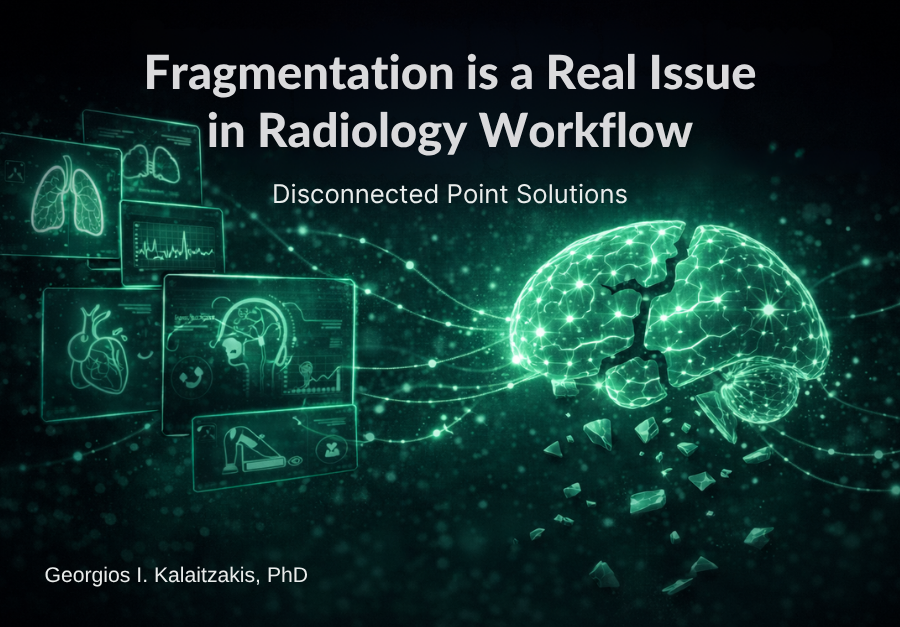
Artificial intelligence in radiology is not lacking innovation. It is lacking integration.
Across Europe and beyond, radiology departments are experimenting with AI tools for detection, triage, post-processing, and structured reporting support. Yet as adoption increases, a different challenge is emerging — fragmentation within the radiology AI workflow.
The 2024 EuroAIM/EuSoMII survey among members of the European Society of Radiology confirms this reality. Clinical practice, particularly in CT, MRI, mammography, and screening environments, is increasingly using AI tools (Zanardo et al., 2024).
However, respondents also identify cost, legal responsibility, lack of validation, and systems integration as primary barriers to implementation.
In other words, the obstacle is not algorithmic capability. It is a workflow implementation.
The Rise of AI in Radiology — But At What Operational Cost?
AI adoption in radiology has nearly doubled in recent years, with almost half of surveyed radiology professionals reporting current clinical use.Yet increased adoption does not automatically translate into improved efficiency.
Many hospitals use multiple point solutions:
- One AI for lung nodules
- Another for pulmonary embolism
- Another for cardiac scoring
- Another for incidental findings
Each tool may perform well independently. But collectively, they often create:
- Multiple dashboards
- Parallel reporting streams
- Fragmented outputs
- Additional integration layers
- Rising cost per study
This is not a support system in the radiology workflow. It is a patchwork of disconnected systems.
Fragmentation vs. Workflow Embedded
There are two fundamentally different models shaping AI in radiology today.
Add-On AI Model
AI is layered on top of PACS and RIS. Outputs appear in separate windows. Radiologists manually reconcile fragmented text. Structured reporting remains disconnected from algorithmic outputs.
This model increases cognitive load and introduces technical debt.
Embedded Radiology AI Workflow Model
AI is embedded directly inside the reporting environment. Structured reporting templates are dynamically supported. Worklists remain unified. PACS integration is seamless.
This model reduces context switching and preserves reporting coherence.
The difference between these models determines whether AI simplifies flows or complicates them.
Why Structured Reporting Is Central to Sustainable AI
Structured reporting is not simply a formatting preference. It is the backbone of an optimized radiology reporting workflow.
The EuroAIM/EuSoMII survey identifies support for structured reporting as a relevant AI application.
That is significant when AI contributes directly to structured report generation:
- Reporting variability decreases
- Documentation becomes standardized
- Subspecialty workflows become scalable
- Quality assurance improves
- Data becomes extractable for analytics
But when AI outputs remain fragmented, radiologists must manually synthesize multiple algorithmic findings into coherent reports.
The Financial Sustainability of Radiology AI Workflow
Cost and lack of budget remain the most cited barriers to AI implementation
When multiple AI vendors are layered together, hospitals often require:
- Middleware platforms
- Text normalization engines
- Integration services
- Ongoing maintenance
If AI increases cost per study without proportionally reducing reporting time or improving clinical outcomes, return on investment becomes untenable. A financially sustainable radiology AI workflow must minimize vendor complexity, reduce reporting friction, and maintain predictable per-study costs.
Teleradiology Requires Unified Architecture
In multi-site and cross-border environments, fragmentation is amplified.
AI in teleradiology must operate across:
- Multiple hospitals
- Multiple subspecialties
- Variable case volumes
- Distributed radiologists
Without a unified worklist and adaptable workflow engine, AI adds complexity rather than scalability.
A unified radiology platform allows:
- Centralized case routing
- Consistent structured templates
- Embedded AI insights
- Cross-site standardization
From Algorithm Performance to Workflow Engine
For much of its early development, radiology AI has been assessed primarily on sensitivity, specificity, and detection performance. These metrics remain necessary but are no longer sufficient. The next phase will be defined by:
- Workflow integration
- PACS compatibility
- Structured reporting support
- Regulatory alignment
- Cost sustainability
- Radiologist cognitive load
Fragmentation is not a failure of AI capability. It is a failure of system design.
Rethinking Radiology AI flows
The central question for the field is no longer how many additional findings AI can detect — it is how effectively AI integrates into the broader radiology workflow. Platforms that embed AI natively within structured reporting environments, rather than adding further complexity to existing infrastructure, represent the more architecturally sound and clinically sustainable path forward.
AI in radiology should reduce operational friction, clarify professional responsibility, and support long-term financial viability. Complexity disguised as innovation achieves none of these goals.
This is where platforms such as evorad become relevant to the broader workflow engine discussion.
By embedding AI directly into a structured reporting workflow with seamless PACS integration, evoViewer addresses the fragmentation problem at its root.
Not by adding another layer. But by unifying the existing ones.
AI should reduce operational friction, protect professional responsibility, and sustain financial viability.
Anything less is simply complexity disguised as innovation.