The Real Problem with AI in Radiology Isn’t the Model — It’s the Workflow
There is no shortage of AI in radiology. Open any conference programme from the past two years and you will find detection models, triage tools, post-processing engines, and structured reporting assistants competing for attention. The technology is advancing fast. The question that matters now is different: once all these tools arrive inside a radiology department, do they actually make a radiologist’s day better — or worse?
For a growing number of departments across Europe, the honest answer is ‘worse’.
Not because the models fail. Because the workflow around them is fragmented.
A Radiologist’s Morning, Fragmented
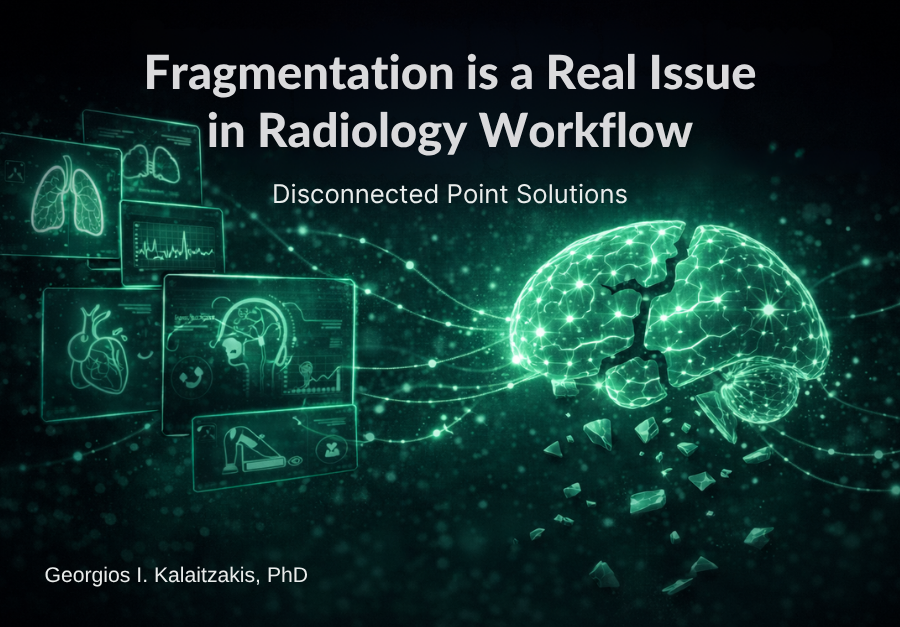
Picture this. A radiologist sits down at 7:30 a.m. to begin reading. There is a worklist in the RIS. A PACS viewer on one screen. A lung nodule AI sending alerts to a separate dashboard. A cardiac scoring tool with its own interface. An incidental-findings engine producing outputs in yet another window. And a structured reporting template that none of these tools talk to directly.
Each tool, taken on its own, performs well. Together, they create a patchwork that demands constant context switching — toggling between windows, mentally reconciling outputs, copying findings from one system into another. The radiologist becomes the integration layer. That is not empowerment. That is cognitive overhead.
The 2024 EuroAIM/EuSoMII survey among members of the European Society of Radiology confirms what many departments already feel. AI adoption in clinical practice has nearly doubled in recent years, particularly across CT, MRI, mammography, and screening environments. But the survey’s respondents also name the barriers clearly: cost, unclear legal responsibility, lack of validation – and, critically, poor systems integration.
The obstacle is no longer whether AI can detect a pulmonary embolism. It is whether the detection fits cleanly into the way a radiologist actually works.
Two Models, Two Very Different Realities
This is where the conversation splits. There are fundamentally two ways AI enters a radiology workflow today, and they lead to very different outcomes.
The first is the add-on model. AI is layered on top of existing PACS and RIS infrastructure. Outputs appear in separate windows. Structured reports remain disconnected from algorithmic findings. The radiologist must manually synthesise everything. It works — technically. But it adds friction, increases cognitive load, and introduces technical debt that compounds over time.
The second is the embedded model. AI lives directly inside the reporting and viewing environment. Structured templates respond dynamically. Worklists stay unified. PACS integration is seamless, not bolted on. The radiologist does not leave their reading flow to find out what the algorithm noticed. The insight meets them where they already are.
The difference sounds architectural. In practice, it is deeply human. One model asks the radiologist to work harder. The other asks the technology to work smarter.
Why Structured Reporting Is the Backbone, Not a Formatting Choice
Structured reporting often gets treated as a preference — a nice-to-have that some departments adopt and others skip. That misses the point entirely.
When AI contributes directly to structured report generation, reporting variability decreases, documentation becomes standardised, subspecialty workflows scale, quality assurance improves, and — perhaps most importantly — data becomes extractable for analytics and research. The report stops being a static document and becomes a living, queryable asset.
But this only works when AI outputs and report templates inhabit the same environment. When they don’t — when a radiologist has to manually pull model findings from one screen and type them into a template on another — the promise of structured reporting collapses under the weight of fragmentation.
The EuroAIM/EuSoMII survey identifies structured reporting support as a relevant AI application area. That is significant precisely because it points beyond detection performance toward something more durable: workflow coherence.
The Financial Reality No One Wants to Talk About
Cost and lack of budget remain the most frequently cited barriers to AI adoption in radiology.
And fragmentation makes the economics worse.
When multiple AI vendors are layered together, hospitals often need middleware platforms to normalise outputs, integration services to connect systems, and ongoing maintenance to keep everything running. The per-study cost rises. If that cost is not offset by proportional reductions in reporting time or measurable improvements in clinical outcomes, the return on investment becomes difficult to defend.
A financially sustainable approach to AI in radiology requires the opposite: fewer vendors, less middleware, predictable per-study costs, and a reporting environment where AI insights arrive without extra steps. Simplicity is not a compromise. It is a prerequisite for long-term viability.
In Teleradiology, Fragmentation Gets Amplified
If fragmentation is a problem inside a single hospital, it becomes acute in multi-site and cross-border teleradiology environments. Studies flow across multiple hospitals, subspecialties, variable case volumes, and distributed radiologists working in different time zones.
Without a unified worklist and an adaptable workflow engine, every additional AI tool adds complexity rather than scalability. Centralised case routing, consistent structured templates, embedded AI insights, and cross-site standardisation are not features — they are the minimum conditions for teleradiology AI to function at all.
FromModel Benchmarks to Workflow Design
For much of its early development, radiology AI has been assessed primarily on sensitivity, specificity, and detection performance. Those metrics remain necessary. They are no longer sufficient.
The next phase of radiology AI will be defined by how well tools integrate into PACS environments, how naturally they support structured reporting, how cleanly they align with regulatory requirements, and how sustainably they manage cost. The question shifts from “how many findings can this model detect?” to “how effectively does this fit into the way radiologists actually work?”
Fragmentation is not a failure of AI capability. It is a failure of system design.
This Is the Problem Evorad Was Built to Solve
Every design decision behind the Evorad platform starts from a single conviction: AI should meet the radiologist inside their workflow, not pull them out of it.
evoViewer embeds AI directly into the reading and reporting environment — structured templates, model insights, and PACS integration unified in one place. No extra dashboards. No parallel windows. No manual reconciliation.
maestro orchestrates worklists and case routing across single-site and multi-site environments, keeping teleradiology workflows coherent at scale.
evoRIS and evoPacs provide the infrastructure backbone — cloud-native, vendor-neutral, designed to connect rather than fragment.
The result is not another layer on top of an already complicated stack. It is a unified platform that removes layers, reduces clicks, and gives radiologists back the thing fragmentation takes from them: focus.
Because complexity disguised as innovation helps no one. Least of all the radiologist who still has 200 studies to read before lunch.
Want to see how a unified workflow changes the reading experience? Book a demo and explore the evorad platform.