


Veterinary PACS for Clinics
and Animal Hospitals
Pet care, every modality, one imaging platform.
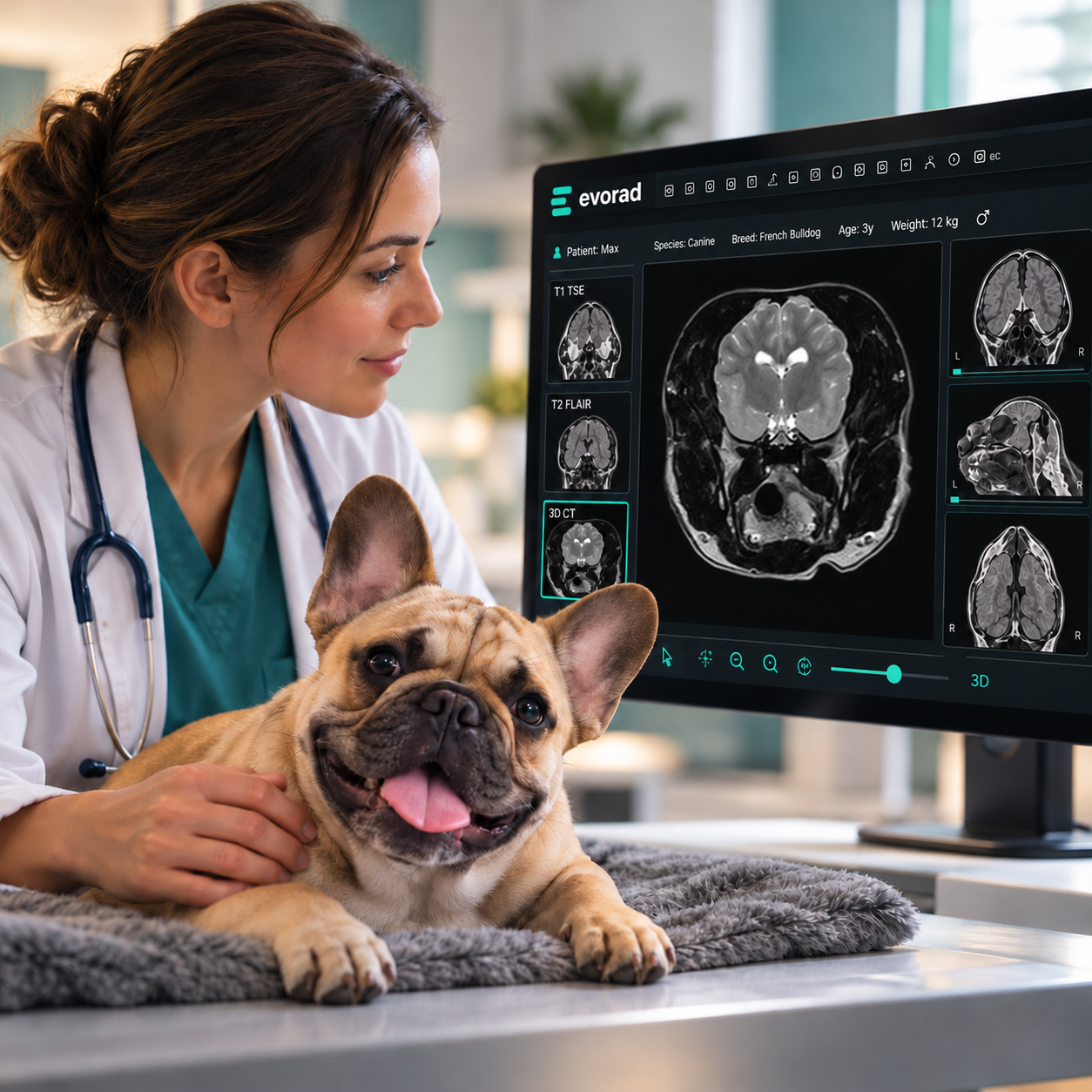
Imaging grew.
The tools around it didn't.
Human PACS, veterinary needs
The worklist contains veterinary-related information and tags
Specialist reads are a bottleneck
Sending a case to a radiologist means exporting, uploading, emailing and waiting — outside the system that holds the images.
The record and the images live apart
Animal and owner details get re-keyed at every modality, and results get copied back into the practice system by hand. Every re-entry is another chance to attach a study to the wrong patient.
Why veterinary teams choose evorad

Zero-footprint viewing
Diagnostoc images in any browser. No installs, no VPN.

Every modality you run
X-ray, dental, US, CT, MRI, endoscopy, and more in one worklist.

Specialist reads, built in
Route cases to radiologists without leaving the platform.

Owners and referrers on a link
Route cases to radiologists without leaving the platform.

Storage that scales with you
Cloud-native, hybrid or on-prem solutions.

Flexible integration
Seamless integration in days.
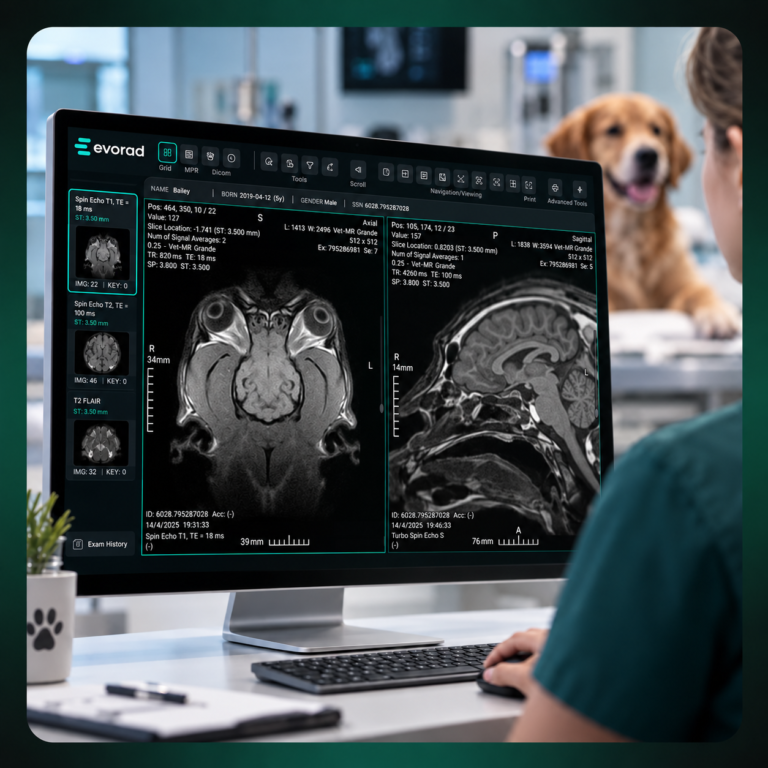
Built around veterinary DICOM, not adapted to it
Veterinary imaging has its own place in the DICOM standard. The worklist contains veterinary-specific information tags and the evoviewer has specialised veterinary tools:
- Vertebral Heart Scoring (VHS): Heart size measured against thoracic vertebrae to assess heart enlargement.
- Norberg Angle (NBA): Measures hip joint fit to screen for hip dysplasia.
- Tibial Plateau Angle (TPA / TPLO): Measures tibial plateau slope to plan cruciate ligament surgery.
Deployment
Cloud, on-premise or hybrid — deployed to fit your practice
Cloud-hosted
For multi-site groups and practices without internal IT. No server to maintain, no patching weekends, no ransomware exposure on a box in the back office.
On-premise
For practices on limited bandwidth or with data-residency requirements. Everything stays on site.
Hybrid
A fast local cache for diagnostic reading, with cloud archive behind it for long-term retention.
Move between them later without re-procurement.
All-in-one imaging with EVORAD
01
View, report, collaborate -anywhere
Zero-footprint diagnostic viewing with sub-second loads, structured reporting, and in-browser 3D.
02
Reach a specialist without leaving the platform
Route cases to radiologists by priority, read and diagnose remotely, with peer review built in.
Modern imaging. Every patient, every species.
FAQ
Frequently asked questions
What is veterinary PACS?
A veterinary PACS (Picture Archiving and Communication System) stores, retrieves and distributes diagnostic images from veterinary modalities — X-ray, dental, ultrasound, CT and MRI — and presents them in a viewer alongside the animal and owner details that veterinary practices work from. Evorad's veterinary configuration runs on the same standards-based platform used by hospitals and imaging centres worldwide.
How is a veterinary PACS different from a human PACS?
The clinical workflow is built around a different record. Cases arrive by owner rather than by referrer, a single practice runs several species across several modalities in a day, and results go back to a practice management system rather than a hospital EHR. Underneath, both run the same DICOM, DICOMweb and HL7 standards — which is why an enterprise imaging platform is the right foundation for a veterinary practice.
Does it integrate with my practice management system?
Yes. Integration runs over HL7, DICOM Modality Worklist, or a REST API, depending on what your PIMS supports. The specific integration is scoped and confirmed during implementation.
Can I use it on an iPad or phone?
Yes. The zero-footprint viewer runs in any modern browser on tablet or phone with no app to install, and mobile access with dictation is supported. This matters most for ambulatory vets, on-call reads and second opinions.
Can I migrate my existing studies?
Yes. Studies can be imported directly from your modalities, from network folders, from DICOM CDs and DVDs in bulk, or transferred from a legacy PACS. Whether you migrate recent studies only or the full archive is scoped during implementation.
Should my practice choose cloud or on-premise?
It depends on your bandwidth, your IT support and any data-residency requirements. Multi-site practices usually benefit from cloud or hybrid; single-site practices on limited connectivity often prefer on-premise. All three are supported, and you can move between them later without re-procurement.
How is imaging data kept secure?
End-to-end encryption in transit and at rest, role-based access control and full audit logging are built in. Owner names and contact details are personal data under GDPR and are handled accordingly. Backup and recovery objectives are documented as part of every deployment.
Do I own my imaging data?
Yes. Everything is stored in standard DICOM in a vendor-neutral archive, and you can export the full archive at any time. There is no proprietary wrapper and no exit fee for taking your data with you.
