Why the future of diagnostic imaging is built around seamless patient access and collaboration
For decades, radiology has operated behind the scenes. Patients enter, images are captured, reports are written, and somewhere along the way, a diagnosis emerges. The radiologist, often invisible to the patient, has been the unseen interpreter of medical mysteries.
Today, healthcare systems are under pressure from multiple directions: rising patient expectations, radiologist shortages, mounting workloads, and the relentless demand for faster, more accurate diagnoses. In this environment, radiology departments must improve not only diagnostic performance, but also communication, accessibility, and the overall patient experience.
The Shift from Volume to Value
Traditional radiology departments have been measured by throughput: how many scans per hour, how many reports per day. Efficiency was king. But efficiency without empathy creates a system that processes patients rather than serves them.
Patient-centred radiology reframes the equation. Instead of asking “How many studies can we complete?” It asks, “How effectively are we serving each patient’s diagnostic journey?” This is not about slowing down. It is about designing workflows, technology, and communication pathways that place patients’ needs at the centre of every decision.
The distinction matters because value-based care is reshaping reimbursement models across healthcare. Providers who demonstrate better outcomes, higher patient satisfaction, and more coordinated care will thrive. Radiology departments that cling to volume-only metrics will find themselves increasingly marginalised.
This is where patient-centred radiology becomes both a clinical and operational priority: it connects efficiency with transparency, access and better coordination across the patient journey.
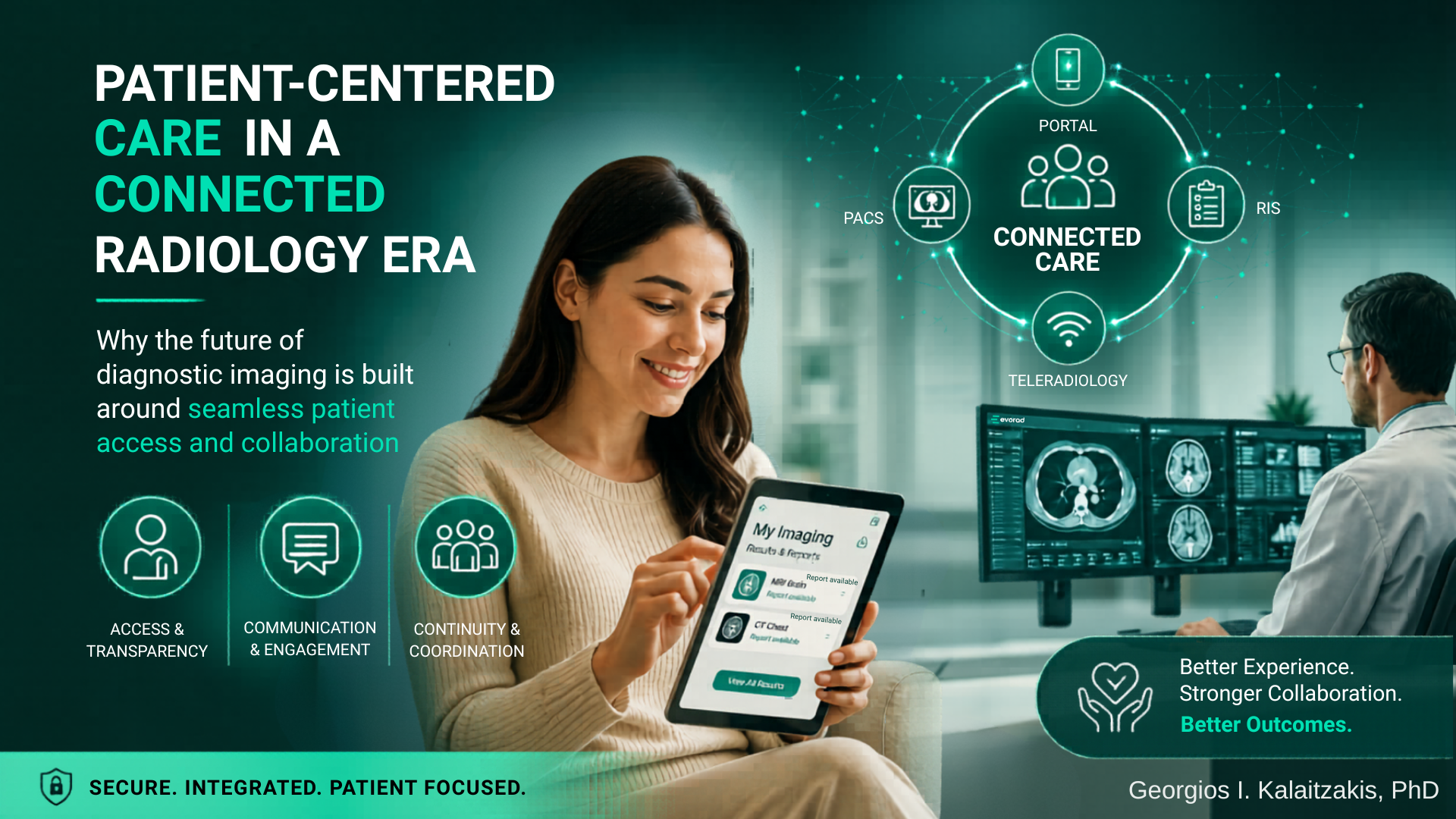
Three Pillars of Patient-Centered Radiology
- Access & Transparency
Patients today expect to be active participants in their healthcare, not passive recipients. This requires providing secure, easy access to imaging results and reports—not days after the study, but as soon as they become available. Patient portals and mobile-friendly interfaces make this possible, giving patients timely visibility into their results and care journey. In this context, digital access is no longer a luxury feature, but a core requirement for modern radiology services.
- Communication & Engagement
Clear and timely communication is essential to reduce patient anxiety. Automated notifications, transparent status updates, and direct communication channels between patients and care teams ensure that patients are informed throughout their diagnostic journey. This continuous engagement helps build trust and reduce uncertainty while waiting for results.
- Continuity and Coordination
Efficiency improvements in radiology are increasingly enabled by digital tools such as patient portals and integrated information systems. By reducing administrative bottlenecks and improving the speed of information delivery, these tools allow clinical teams to focus on diagnosis and care rather than coordination and follow-up tasks.
Technology as the Enabler, Not the Solution
It would be easy to mistake patient-centered radiology for a technology problem. Deploy a better PACS, implement AI, roll out a patient portal—problem solved. But technology alone changes nothing. What matters is how that technology is orchestrated to serve the patient journey.
Enterprise imaging platforms must unify fragmented systems. AI must enhance, not replace, clinical judgement. Teleradiology must extend access without sacrificing quality. And every digital touchpoint—from appointment scheduling to results delivery—must be designed with the patient’s experience in mind.
The organisations that succeed will be those that use technology to support a better patient experience—not those that adopt technology for its own sake.
The Strategic Advantage
Healthcare organisations that embrace patient-centred radiology will unlock tangible competitive advantages. Patient satisfaction scores rise when people feel informed and respected. Referring physician loyalty strengthens when reports arrive quickly and communication flows smoothly. Operational efficiency improves when workflows are designed holistically rather than in silos.
Perhaps most importantly, the radiology department transforms from a cost center to a value driver. When imaging services are perceived as accessible, reliable, and patient-friendly, they become a differentiator for the entire health system.
How Evorad Brings Patient-Centered Radiology to Life
Evorad, developed by iKnowHealth, exemplifies what patient-centred radiology looks like in practice. Instead of offering separate point solutions, Evorad provides a complete enterprise imaging suite based on one main idea: that every workflow decision should ultimately serve the patient.
The evoPortal empowers patients with secure, mobile-friendly access to their imaging results and reports—promoting active involvement in their own healthcare journey. Integrated appointment scheduling reduces friction and waiting times. Robust authentication mechanisms ensure privacy without creating barriers to access.
For clinicians, evorad’s unified RIS and PACS streamline workflows, reduce manual tasks, and accelerate report delivery. AI-powered triage and smart worklists ensure that urgent findings reach the right people at the right time. Teleradiology capabilities extend subspecialty expertise to underserved regions without compromising quality or security.
Crucially, evorad prioritises interoperability and seamless data exchange. Whether a patient is seen at a private clinic, a university hospital, or a diagnostic center, their imaging history remains accessible and coherent. With over 100 installations across public, private, and academic institutions, evorad has proven that patient-centred radiology is not just aspirational—it is achievable, scalable, and delivering measurable results.
The Path Forward
Patient-centred radiology is not a trend to watch. It is a transformation already underway. The question for healthcare leaders is not whether to embrace it, but how quickly they can align their people, processes, and platforms around this new reality.
Those who move decisively will find themselves leading a radiology department that patients trust, referring physicians value, and health systems depend upon. Those who delay will find themselves explaining why their imaging services feel like a relic of an era that has already passed.
The patient is waiting. The technology is ready. The strategy is clear.
Learn more about how Evorad is transforming radiology workflows at www.evorad.com
Frequently asked questions
Patient-centered radiology is an approach to imaging that improves access, communication, transparency and continuity across the patient’s diagnostic journey.
A radiology patient portal gives patients secure access to imaging results, reports and updates, helping them stay informed throughout their care journey.
Connected radiology helps PACS, RIS, reporting tools, portals and communication workflows work together, reducing friction for patients, clinicians and administrative teams.
Radiology departments can improve patient experience by offering faster access to results, clearer communication, secure digital access and better coordination between care teams.