Teleradiology Worklist Consistency at Scale
Teleradiology worklist consistency is becoming one of the most important operational challenges for multi-site radiology groups trying to scale distributed reading without adding more cognitive burden for radiologists. For nearly fifteen years, the midnight-read arbitrage was the teleradiology industry’s best-kept structural advantage. Send US Nighthawk volume to Sydney. Route the UK overnight to Bangalore. The math was elegant: while one hemisphere slept, another worked. Coverage gaps became profit centres.
That era is over. And most multi-site operators haven’t fully reckoned with what comes next.
The radiologist shortage has become globalised. There is no longer a surplus timezone to import capacity from. The same recruitment pressures compressing rosters in the United States are present in India, Australia, and South Africa. The 2024 RANZCR workforce data, the RCR census in the UK, and JACR modelling for North America all point in the same direction: demand is outpacing supply on every continent, and the top quartile of radiologists is already reading 30% or more cases than they were in 2018. That is not a curve that bends back down through geography alone.
The next decade’s winners in teleradiology will not be the groups with the widest geographic spread. They will be the ones who figured out something far less glamorous and far more consequential: worklist consistency at scale.
Time: The Fragmentation Cost Nobody Talks About
Ask any radiologist reading across five hospital sites what their biggest daily frustration is. They will not say “too many cases.” They will describe some version of the same operational friction: five logins, three different worklist interfaces, inconsistent priority flags, and priors that either do not load or load in a different viewer than the one they are currently working in.
This is the fragmentation cost. It is paid in seconds, not dollars — which is precisely why it never appears in a budget line and almost never gets fixed.
A radiologist who spends 15 seconds per case managing worklist orientation, repeated across a 100-case session, loses 25 minutes per shift to navigation overhead alone. Scale that across a team of twenty readers and 250 working days, and the fragmentation tax is the equivalent of losing one full-time radiologist per year — without ever appearing on a headcount report.
The Hidden Math Behind Worklist Fragmentation
- Navigation Penalty:
15 seconds per case × 100 cases = 1,500 seconds
1,500 seconds ÷ 60 = 25 minutes lost per shift
- Annual Team Navigation Tax
25 minutes × 20 radiologists × 250 working days = 125,000 minutes per year
125,000 minutes ÷ 60 = 2,083 hours per year - Full Time Radiologist Equivalent Impact
2,083 hours ÷ 2,080 annual working hours per FTE = 1.0 Full-Time Radiologist Equivalent
In practical terms, a seemingly small 15-second navigation penalty per case can translate into the equivalent of one full-time radiologist lost each year across a 20-reader team.
Now compound that with inconsistent metadata. A STAT flag assigned at one facility means “patient is decompensating”. At another site in the same network, STAT means “the referring physician wants the study today”. The worklist sees both as having identical priority. The radiologist, if they are experienced enough, learns to distrust the flags entirely and develops their own mental triage heuristics. That cognitive overhead is invisible in turnaround time data – until the day an actually critical study sits three screens down because the system did not surface it correctly.
Why Asynchronous Routing Is the Real Opportunity
The geographic arbitrage model is essentially synchronous: a reader in timezone B is awake when timezone A needs coverage. It is a staffing solution dressed up as a technology solution. When that labour pool tightens, the model breaks.
Asynchronous routing is structurally different. It does not ask, “Who is awake in which timezone?” It asks, “Given everything we know about this case — modality, urgency, clinical context, subspecialty fit, SLA window, and current reader workload — what is the optimal routing decision right now?”
That is a metadata problem. And it is a problem that most multi-site teleradiology operations are not set up to solve, because their metadata is not harmonised across sites.
Consider what “metadata harmonisation” actually requires across a real multi-site operation:
- Consistent priority taxonomy: STAT means the same thing at every site feeding into your worklist, or the routing logic is making decisions on noise.
- Reliable patient identity linkage: priors from a patient’s previous visit at a different facility in the same network must surface automatically, not require manual retrieval.
- Subspecialty tagging that travels with the study: a chest CT with suspected PE should not need human triage to reach the right reader queue.
- SLA clock logic that accounts for acquisition time, not just receipt time: a study that arrived at your PACS at 3am but was acquired at 11pm the previous night has a different urgency profile than the timestamp suggests.
All of it requires discipline in implementation that most organisations skip because it is unglamorous and because the short-term cost of fixing it always looks larger than the diffuse, invisible cost of not fixing it.
AI triage is only as effective as the systems behind it.
The radiology AI market is not short of capability. Detection algorithms for intracranial haemorrhage, pulmonary embolism, lung nodules, and cardiac scoring are clinically validated and commercially available. The 2024 EuroAIM/EuSoMII survey confirmed that AI adoption in clinical practice has nearly doubled across European radiology departments.
And yet the same survey identifies systems integration — not algorithmic performance — as the primary barrier to implementation.
That is the correct diagnosis. An AI triage tool that flags a haemorrhage as high priority is only useful if that flag travels cleanly into the worklist logic, elevates the case appropriately, and routes it to a reader who is both credentialled for the site and currently available. If the AI output lands in a separate dashboard that the radiologist checks intermittently — or worse, generates a notification that competes with four other notification streams — the clinical value is largely lost.
AI does not fix fragmented infrastructure. It amplifies it. Operators who invest in detection algorithms before they have solved worklist consistency and metadata harmonization are building a faster engine into a car with no steering.
What a Unified Environment Actually Looks Like
“Unified” is one of the most overused words in radiology IT marketing. So let’s be specific about what it means in practice for a multi-site teleradiology operation.
One worklist, one set of mechanism
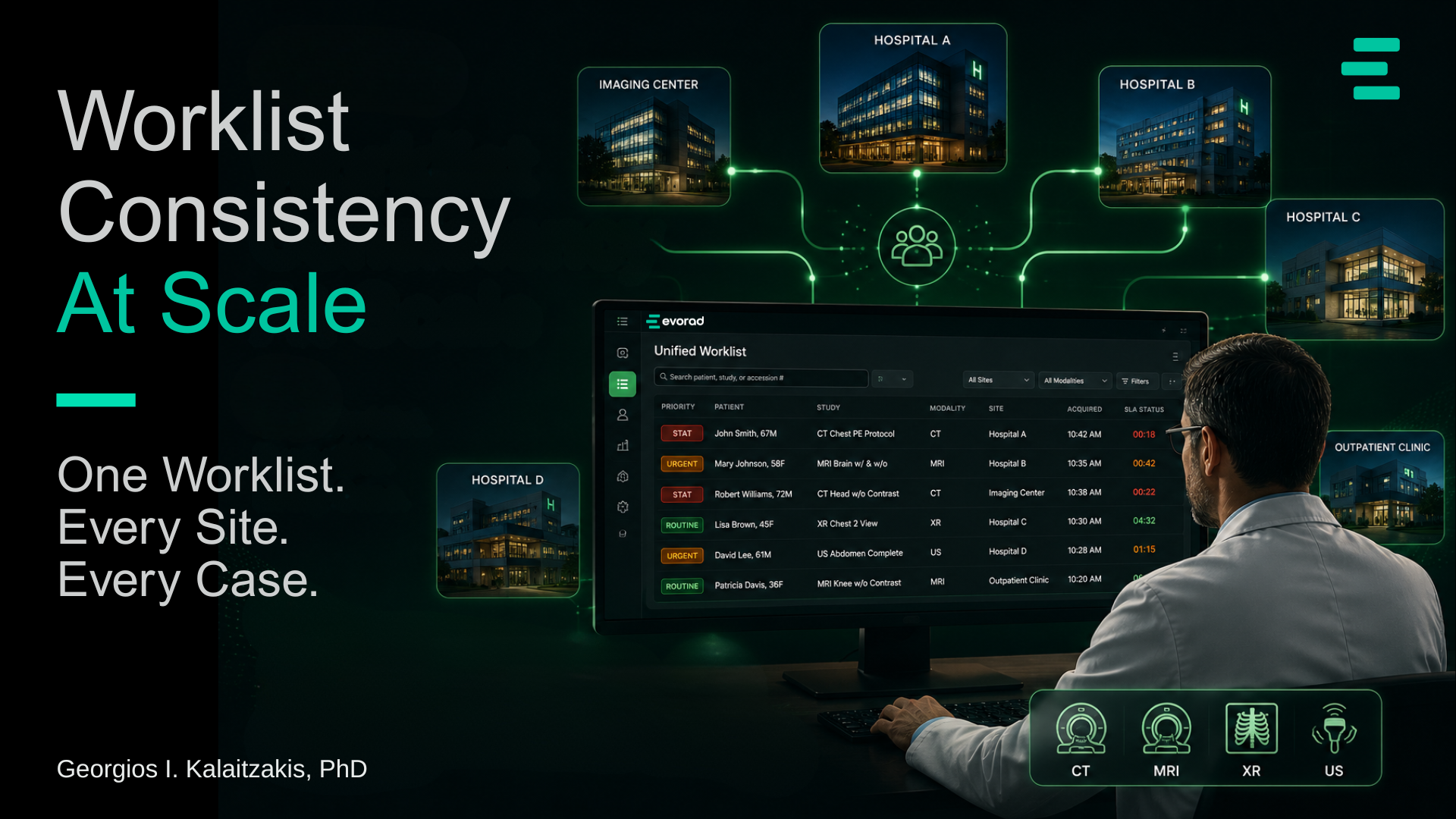
A reader should open a single interface and see their entire workload — every site, every modality, every priority tier — sorted by the same routing logic. Not five separate worklists that require mental consolidation. One list, one set of rules, consistently applied.
SLA-aware prioritisation that escalates automatically
Studies approaching their turnaround window should surface automatically, regardless of when they arrived or what priority flag, they were originally assigned. A routine study at hour 46 of a 48-hour SLA should be elevated above a routine study that just arrived. The system should handle that surveillance — not the radiologist.
The evidence on this is clear. A quality improvement study published in PMC in 2025 demonstrated that implementing automated clinical urgency scoring improved SLA compliance from 88% to 95% over nine months. An AI-assisted prioritisation study on intracranial haemorrhage cases found flagged cases were read in approximately 73 minutes versus 132 minutes for non-flagged cases — a 45% improvement driven entirely by better routing, not faster radiologists.
Priors that are transferred with the case
In a multi-site environment, a patient’s imaging history is distributed across multiple archives. Relevant priors should surface automatically in the reading environment — not require the radiologist to navigate to a different system, log in separately, and manually retrieve comparison studies. Every context switch is time lost and focus broken.
Zero-footprint access that does not degrade under real network conditions
Distributed reading is now the norm, not the exception. The viewer architecture needs to reflect that reality. A radiologist reading from a home network in a secondary city should get the same responsive experience as a reader in a hospital data centre. VPN-dependent architectures that treat the home network as an enterprise extension have demonstrated, repeatedly, that they are not fit for purpose at scale.
The Operational Bet Worth Making
The time zone arbitrage model required operators to think geographically. The next model requires operators to think architecturally.
The question is not “Where are our readers located?” It is “how clean is our data, how consistent is our routing logic, and how much cognitive overhead are we imposing on our readers before they even open the first image?”
Operators who solve those three questions will extract significantly more capacity from the radiologists they already have — exactly where the leverage is, given that the supply side of the market will not ease materially in the next decade.
The Children’s Hospital of Alabama case, cited in Radiology Business, is instructive: an integrated RIS/PACS workflow model enabled five radiologists to handle the workload that previously required eight — a 40% efficiency gain attributable entirely to eliminating system-switching overhead. That is the magnitude of improvement available from workflow consolidation alone, before any AI capability is introduced.
This is the design problem that platforms like evoTelerad are built to address: a unified reading environment that brings worklist consistency, SLA-aware routing, priors access, and zero-footprint viewing into a single interface — across every site in the network, under one set of rules. Not because the technology is novel, but because the operational problem it solves is increasingly urgent.
The Hard Conversation
Most multi-site teleradiology operators know their worklist infrastructure is fragmented. They have known for years. The reason it persists is not ignorance — it is that fixing it is expensive, disruptive, and politically complex when multiple incumbent PACS vendors are involved.
But the cost of not fixing it is now compounding faster than the cost of fixing it.
When radiologist supply was elastic, operational inefficiency was an acceptable cost. When every reader is running near capacity and recruitment pipelines are strained globally, that tax becomes existential. The organisations that rationalise their infrastructure in the next three years will have a structural advantage that geography alone can no longer provide.
The 24/7 coverage model is not going away. But the operators who survive the next decade will not win on timezone coverage. They will win on metadata quality, routing intelligence, and the discipline to build a reading environment their radiologists can actually work in efficiently.
That work starts with the worklist. It almost always does.
Ready to See What Worklist Consistency Actually Looks Like?
If your operation is still managing coverage through geographic spread and hoping the routing logic holds together across sites, the window to get ahead of this is narrowing.
Evorad’s enterprise imaging platform was built for exactly this environment: multi-site teleradiology operations that need unified worklists, SLA-aware routing, harmonised metadata, and zero-footprint reading — all under one set of rules, across every facility in the network.
See how evoTelerad supports distributed reading at scale with unified worklists, SLA-aware routing, harmonised metadata and zero-footprint viewing. Book a demo and speak with one of our imaging workflow specialists.
SOURCES & FURTHER READING
AAG Health. “Radiology Turnaround Time (TAT) Benchmarks.” 2024.
Philips. “Future Health Index 2024 Report.”
Zanardo et al. EuroAIM/EuSoMII Survey on AI in Radiology Clinical Practice. 2024.
Radiology Business. “RIS-driven PACS Workflow”. Children’s Hospital of Alabama case study.
Teleradiology worklist consistency means radiologists can work from one unified, standardised worklist across multiple sites, with consistent priority rules, metadata, SLA logic and access to relevant priors.
Fragmented worklists create repeated logins, inconsistent priority flags, missing priors and unnecessary context switching. These small delays can accumulate into significant lost reading capacity.
Metadata harmonization helps ensure that priority labels, patient identity, subspecialty tags and timestamps are consistent across sites, so routing logic can make safer and more reliable operational decisions.