Every imaging organisation eventually asks the same uncomfortable question: if we changed our PACS tomorrow, what would happen to twenty years of studies sitting inside it? For many, the honest answer is a long, expensive migration project — and that answer is exactly the problem a vendor neutral archive exists to solve.
This guide explains what a VNA is in plain language, how it differs from the archive inside your PACS, when it becomes genuinely necessary rather than merely fashionable, and what to look for when you evaluate one.
What is a vendor neutral archive?
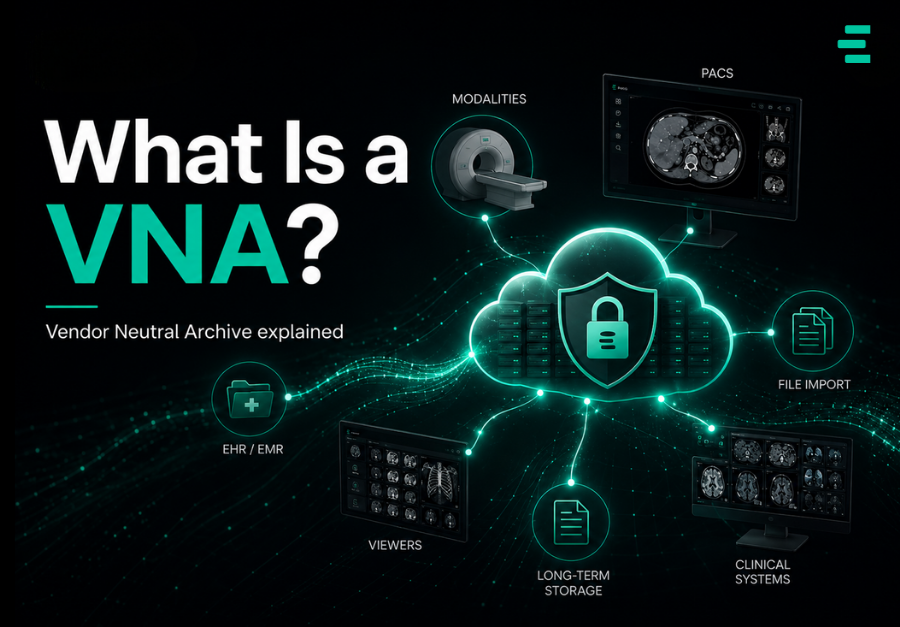
A vendor neutral archive (VNA) is a long-term storage and management layer for medical imaging that is deliberately decoupled from any single PACS or viewing application. It stores studies in standard, non-proprietary formats, indexes them with consistent metadata, and makes them available to any compliant system through open interfaces such as DICOM, DICOMweb and HL7.
The word that matters is neutral. A conventional PACS archive stores images in whatever structure suits that PACS. A VNA stores them in a way that assumes the systems around it will change — different viewers, different PACS vendors, different departments — while the archive itself carries on. It is designed to outlive the applications that write to it.
The concept grew out of hard experience. As first- and second-generation PACS installations aged, organisations discovered that replacing the application meant ransoming the data: extraction projects measured in months, proprietary structures that resisted conversion, and studies that emerged with damaged metadata. The VNA was the industry’s structural answer — separate the layer that must last decades from the layer that changes every few years. Increasingly, the same layer also absorbs non-radiology content, which is why VNA strategy and enterprise imaging strategy are now largely the same conversation.
VNA vs PACS archive: what actually differs
On the surface, both store images, so the distinction can feel academic. In practice, four differences carry most of the weight:
- Ownership of format. A PACS archive may wrap studies in proprietary structures, private DICOM tags or database dependencies. A VNA commits to standards-based storage, so any compliant system can read the data without translation projects.
- A PACS archive serves one department’s workflow. A VNA is built to serve the enterprise: radiology, cardiology, and increasingly non-DICOM content such as visible-light photos, reports and scanned documents.
- Lifecycle management. VNAs typically own retention policies, tiered storage (fast storage for recent studies, cheaper tiers for older ones), legal-hold rules and deletion governance — functions that many PACS handle poorly or not at all.
- Migration posture. When you replace a PACS that owns its own archive, you migrate the archive too. When the archive is a VNA, you replace the PACS and simply point the new one at the same data.
Put simply: PACS is where imaging work happens today; the VNA is where imaging data is protected across time, sites and vendor changes.
What a VNA owns day to day
Beyond passive storage, a working VNA typically takes responsibility for:
- Ingest and normalisation — receiving studies from multiple PACS or modalities and harmonising identifiers and metadata so a patient’s history is coherent across sources.
- Retention and lifecycle rules — applying policies by study type, jurisdiction or age, and moving data between storage tiers automatically.
- Enterprise access — serving priors and comparisons to viewers, portals and downstream systems through standard query and retrieve interfaces.
- Audit and governance — logging who accessed what, supporting GDPR obligations, and providing a defensible record for legal and regulatory purposes.
- Disaster recovery participation — acting as the durable copy that replication and continuity plans are built around.
When do you actually need a VNA?
Not every organisation needs one on day one. A single-site clinic with one PACS and modest volumes can operate for years without a separate archive layer. The case strengthens sharply in four situations:
- Multi-site operations. When several facilities — possibly running different PACS — need a single coherent patient imaging history, a VNA becomes the natural consolidation point.
- Planned or likely system change. If a PACS replacement is on the horizon within the archive’s lifetime (and over a decade, it almost always is), separating the archive first turns a future forklift migration into a configuration exercise.
- Retention and compliance pressure. Long statutory retention periods, paediatric records, mammography and legal-hold requirements are easier to govern in a system whose job is governance.
- Growth through acquisition. Imaging networks that acquire centres inherit heterogeneous archives; a VNA is how those estates become one asset rather than a museum of legacy systems.
There is also a forward-looking reason gaining weight in Europe: regulation. The European Health Data Space will make medical images and imaging reports a mandatory cross-border exchange category by 2031, which rewards organisations whose archives are already standards-based and portable rather than locked inside one application.
There is a cost dimension too. Because a VNA owns lifecycle management, it is where tiered storage becomes practical: recent studies on fast storage, aged studies migrated automatically to cheaper tiers, retention rules enforced rather than remembered. Across a growing multi-year archive, that policy engine typically funds a meaningful share of the VNA itself — storage growth is relentless, and paying premium rates for studies nobody has opened in eight years is a choice, not a necessity.
The standards that make neutrality real
Vendor neutrality is not a marketing claim; it is a checklist of standards support. At minimum, expect native DICOM storage and query/retrieve, DICOMweb (WADO-RS, QIDO-RS, STOW-RS) for modern web-based access, HL7 for patient and order context, and IHE profiles (such as XDS-I for cross-enterprise document and image sharing) where cross-organisational exchange matters.
A useful test question for any vendor: if we ended this contract, describe exactly how we would extract every study, every report and every piece of metadata, in what format, at what cost, and over what timescale. A genuinely neutral archive vendor answers this in writing without flinching.
Neutrality also applies to metadata, not just pixels. A VNA that stores standard DICOM objects but keeps its index, annotations or audit history in proprietary structures has simply relocated the lock-in one layer up. Ask how the full record — objects, metadata, access logs — exports, and whether cross-enterprise sharing profiles such as IHE XDS-I are supported where regional exchange infrastructures exist or are planned.
VNA evaluation checklist
- Standards: DICOM, DICOMweb, HL7 and relevant IHE profiles supported natively, not via bolt-on gateways.
- Metadata handling: tools for tag morphing, identifier reconciliation and study-description harmonisation across sources.
- Lifecycle: configurable retention, tiered storage, legal hold and defensible deletion.
- Scale and performance: prior retrieval speeds measured under realistic multi-site load, not lab conditions.
- Deployment options: on-premises, cloud or hybrid, with data residency controls appropriate to your jurisdiction.
- Security: encryption at rest and in transit, role-based access, complete audit trails.
- Exit terms: documented, costed data-extraction process written into the contract.
- Ecosystem fit: proven integrations with your PACS, viewer and portal — or a platform where those components are already designed to work together.
Keeping your archive yours
The strongest argument for a VNA is independence: your imaging history should not be a hostage in your next vendor negotiation. That principle is built into evoVault, the vendor neutral archive within the Evorad platform — standards-based storage, tiered lifecycle management and enterprise access designed to serve whichever systems you run next, not just the ones you run today.
Explore evoVault or talk to our team about your archive strategy.
Frequently asked questions
No. Cloud is a deployment choice; a VNA is a functional layer. A VNA can run on-premises, in the cloud or in a hybrid model. What defines it is standards-based neutrality and lifecycle governance, not where the disks live.
No. The PACS continues to run day-to-day imaging workflow — ingest, worklists, diagnostic viewing. The VNA takes over long-term archiving and enterprise access. They are complementary layers.
Usually not immediately. The tipping points are multi-site growth, an approaching PACS change, or retention obligations that outstrip what the PACS archive can govern. Until then, insisting on standards-based storage and clear exit terms in your PACS contract achieves much of the same protection.
By separating the durable data layer from the replaceable application layer. When systems change, data stays where it is; only the connections are re-pointed. The expensive part of most PACS migrations — extracting and converting years of studies — largely disappears.