Multi-site radiology operations growth can quietly turn one efficient imaging operation into several disconnected ones. Each new site may bring its own queue, PACS conventions, reporting habits and staffing model. Radiologists move between systems, while managers reconcile separate data sources to answer a basic question: how is the network performing as a whole?
Running multi-site radiology as one operation is an architectural decision before it becomes a management one. This guide looks at the hub-and-spoke model, centralised worklists and routing, cross-site priors, workload balancing, quality standardisation and the KPIs that show whether a network is genuinely operating as one.
The hub-and-spoke reality
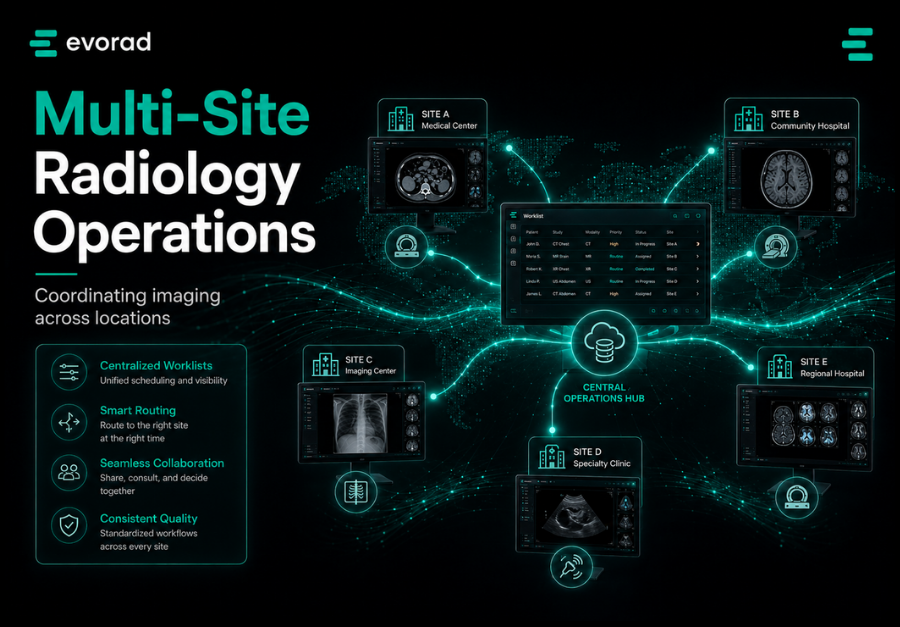
Many multi-site imaging groups evolve toward a hub-and-spoke model: acquisition remains distributed, while reading capacity, subspeciality expertise and governance are pooled. The model can extend scarce expertise across locations, but only when the connecting workflow is strong enough: studies from every site must be visible, routable to the right qualified reader, and supported by relevant priors and reports regardless of where the patient was scanned.
Without that connecting layer, hub-and-spoke becomes multi-silo: shared branding over separate operations, with radiologists acting as the integration layer. The symptoms are familiar – multiple logins, site-specific rosters, priors that stop at organisational boundaries and no reliable network-wide view of performance. Our companion article on ending the multi-login workflow covers the reader experience; here, the focus is the operator’s view.
Growth by acquisition makes the challenge particularly visible. Each acquired centre can arrive with its own PACS contract, renewal cycle, study-naming conventions and local workflows. A pragmatic integration sequence is to connect the site to the network worklist first, normalise metadata at ingest, and then converge infrastructure at an appropriate renewal or migration point. That allows operational integration to begin before a full platform consolidation is complete.
The radiologist’s experience is a useful diagnostic. Ask a reader in a fragmented network to describe a normal shift, and the architecture becomes visible: separate logins, different queues, site-specific rules and manual calls for priors. In a more unified model, the target experience is simpler – one prioritised worklist with the relevant context available when the case is opened.
Centralised worklists and routing rules
The foundational move is a single logical worklist across the network – every pending study from every site visible through one governed workflow – with routing rules determining which reader sees which case:
- By subspeciality: neuro to neuro readers, MSK to MSK, and paediatric studies to appropriately credentialed readers across the network rather than site by site.
- By urgency and SLA: priority classes and deadline timers are applied consistently, so an urgent case is surfaced according to the same policy regardless of where it originated.
- By coverage calendar: nights, weekends, leave and on-call coverage managed against one network schedule rather than separate site rotas.
- By credential and jurisdiction: licensing, credentialing and site privileges are encoded into routing logic rather than left to manual memory.
- By load: assignment takes account of each reader’s current queue and availability so work can move toward capacity rather than remain trapped at the site where it originated.
Rules-based routing turns a collection of queues into a governed operating system. It is also where orchestration creates most of its value: prioritisation, eligibility, workload and SLA policy become executable rather than manual. This is the role maestro is designed to support within the Evorad platform.
Routing rules are operational policy expressed in software, so they should be governed like policy: a named owner, controlled changes, documented logic that readers and operations teams can understand, and an audit trail of what changed and when. Without that discipline, exceptions accumulate until the routing engine becomes difficult to test, explain and trust.
Keep the rule set legible. As micro-exceptions accumulate, conflicts and workarounds become more likely. A regular review of which rules fired, which conflicted and which are no longer needed helps keep orchestration aligned with the way the network actually operates.
The priors problem (and the metadata behind it)
A multi-site network delivers more clinical value when a patient scanned at site A can be read with relevant prior imaging from sites B and C available at the point of interpretation. Cross-site priors commonly become difficult when archives are fragmented or metadata is inconsistent – for example, when the same examination is described differently across several sites.
The remedies are architectural: a consolidated or federated archive layer that makes studies discoverable across the network, plus metadata harmonisation that normalises identifiers and study descriptions at ingest. Standards-based approaches matter here; IHE Radiology profiles include workflows for importing external priors, cross-enterprise imaging exchange and worklist prioritisation. The less visible work of metadata governance is critical to reliable prior matching and hanging protocols.
Balancing workload and subspeciality coverage
Pooled reading works best when the assignment is both efficient and visibly defensible. Load-aware routing can distribute volume across available readers; subspeciality demand can be compared with subspeciality capacity; and escalation policies can define when a case should wait for a specialist and when it should move to another appropriately qualified reader to protect a clinical or contractual deadline.
The same telemetry supports planning: which sites generate enough demand to justify dedicated coverage, when out-of-hours volume peaks, where bottlenecks recur, and which subspeciality gap should shape the next recruitment decision.
Transparency can also improve confidence in a pooled model. Sharing appropriate workload, case mix and out-of-hours metrics with radiologists gives teams a way to see whether assignment policies are operating as intended and gives managers evidence when the distribution needs to be adjusted.
Rota planning and routing should draw from the same source of truth. When the coverage roster is machine-readable – who is working, for which subspecialties, at which sites and under which credentialing constraints – schedule changes can feed assignment logic directly, and coverage gaps can be identified before they become SLA breaches.
Standardising QA and reporting across sites
A multi-site network needs consistent quality controls without pretending every site is identical. Pooled governance should define the elements that must be standard across the group:
- One reporting framework: shared templates and reporting conventions so referrers receive a consistent clinical product across sites and readers.
- One critical-results procedure: a governed approach to notification, acknowledgement and escalation, with any necessary local parameters documented rather than improvised. The ACR Practice Parameter for Communication of Diagnostic Imaging Findings is a useful external reference point for designing timely and reliable communication processes.
- One quality-assurance programme: peer review, discrepancy review and agreed quality indicators across the reading pool so performance can be compared using the same definitions.
- One protocol governance model: acquisition protocols aligned where appropriate across sites, helping reduce unnecessary variation and supporting more reliable cross-site comparisons.
Standardisation also simplifies onboarding. When a new site or radiologist joins the network, one reporting framework, one critical-results procedure and one governance model reduce the number of local conventions that must be learned. The aim is not uniformity for its own sake; it is to remove variation that adds risk or operational friction without adding clinical value.
Standardise deliberately, not blindly. Sites differ in case mix, referrer expectations, language and local regulation. The stronger model is a common governed standard with explicit local parameters, documented exceptions and a process for reviewing them.
KPIs for the network operator
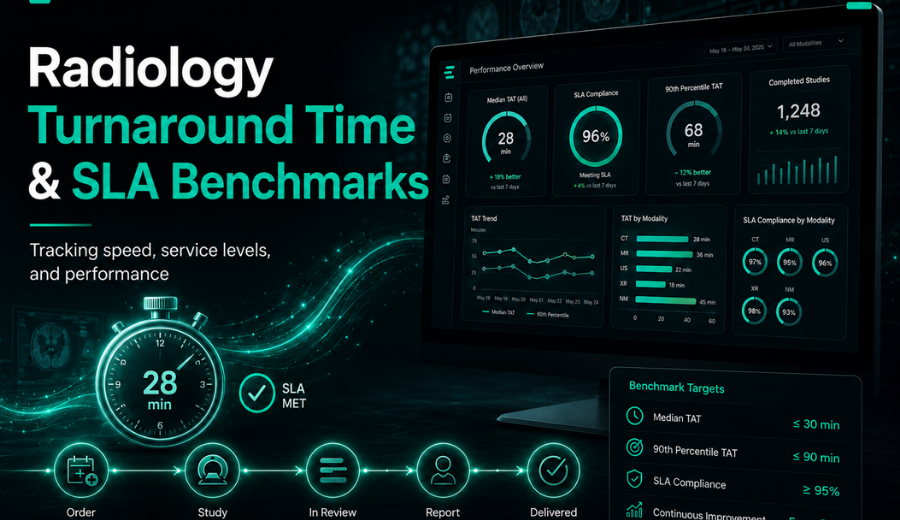
- Turnaround compliance by priority class, by site and network-wide – use distributions or percentiles alongside averages so outliers are not hidden.
- Time-in-state across the workflow – arrival, assignment, open, final and delivered – to show where delay is actually accumulating.
- Prior-availability rate: the proportion of applicable reads where relevant cross-site priors are available when the study is opened.
- Assignment equity: volume, case mix and out-of-hours burden across readers, trended over time.
- Subspecialty match rate: the proportion of studies read by the intended subspecialty, together with the urgency or deadline pressure behind exceptions.
- Quality indicators: agreed peer-review or discrepancy measures and critical-results acknowledgement times, using consistent definitions across sites.
- Referrer experience: report delivery time and use of referrer-facing access tools, measured in ways that reflect what referring clinicians actually experience.
Publish these metrics from one source of truth. The operator’s weekly review, site managers’ dashboards and the board’s monthly summary can be different views of the same workflow event data rather than separate spreadsheets that require manual reconciliation. One of the practical benefits of centralised architecture is that network performance becomes easier to query, compare and act on.
FAQs
Do all sites need the same PACS to operate as one network?
Not necessarily. A unified worklist and federated archive strategy can span heterogeneous PACS environments during a transition. The key requirement is that the network can present a coherent operational layer across sites. Over time, platform convergence may reduce integration and support complexity, but it is not a prerequisite for beginning to operate more centrally.
How do we handle different procedures and naming at each site?
Normalise metadata at ingest: map local study descriptions, codes and identifiers to a governed network standard while retaining the source values needed for traceability. This improves worklist consistency, prior matching and network-wide analytics.
Can radiologists still have site preferences or duties?
Yes. Site duties, reader preferences, credentials, subspecialties and jurisdictional constraints can all become inputs to routing logic rather than exceptions managed manually.
What breaks first as networks grow?
Cross-site priors, metadata inconsistency, rota complexity and fragmented performance reporting often become visible early because each problem grows with the number of systems and local workflows involved. Addressing the shared worklist, identity, archive access and data definitions early reduces the amount of manual coordination required as the network expands.
How does teleradiology fit a multi-site network?
It can become part of the same operating model. Once remote readers receive cases through the same governed worklist, they can be assigned according to the same eligibility rules, SLAs and quality processes as on-site readers. The aim is to add reading capacity without creating a separate operational silo.
Run the multi-site radiology as one operation.
The strategic goal is straightforward: all sites should feed a governed workflow, relevant priors should be available across site boundaries, and quality and performance should be measured consistently. Evorad supports this model through maestro for workflow orchestration and evoTelerad for extending the reading pool across locations.
See how Evorad supports multi-site and teleradiology groups.