

An MDT meeting is only as good as the information in front of it. evorad brings the current study, the relevant priors and the comparisons that matter into a single browser-based view, so radiologists, surgeons, oncologists and referring clinicians examine the same evidence at the same time — without exported images, chased files or a queue for the workstation.
The MDT Workflow Challenge
Preparing the case shouldn't take long
Multidisciplinary review depends on assembling a complete picture of a patient from systems that were never designed to work together. Most of the effort happens before anyone sits down.

Imaging sits across different systems, sites and archives

Case preparation is manual: exporting & assembling

Meetings stall while someone retrieves a missing study

Hard to find priors with inconsistent study descriptions

Not everyone can access & open the study

The full imaging history is rarely visible in one place
CAPABILITIES
Supporting Multidisciplinary Teams
evorad does not run the meeting or interpret the case. It removes the work that surrounds them — locating the imaging, surfacing the right priors, and making the study reviewable by everyone in the room. Clinical judgement stays where it belongs.

One connected view of the case
Imaging for a single patient is rarely in one place. evorad consolidates studies through evoPACS and a vendor-neutral archive, while evoTag harmonises free-text labels so the right prior surfaces in seconds rather than on the morning of the meeting.

Diagnostic-grade review in the browser
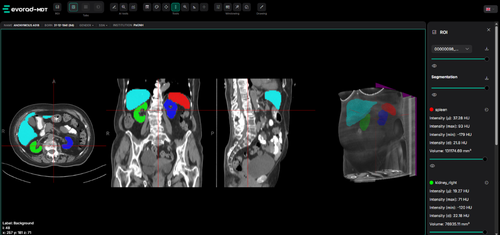
evoViewer gives every participant zero-footprint access to the full study — no installation, no workstation to book. Sub-second loads, MPR reconstructions and ROI tools mean the case is interrogated live, from the meeting room or a reading room at another site.

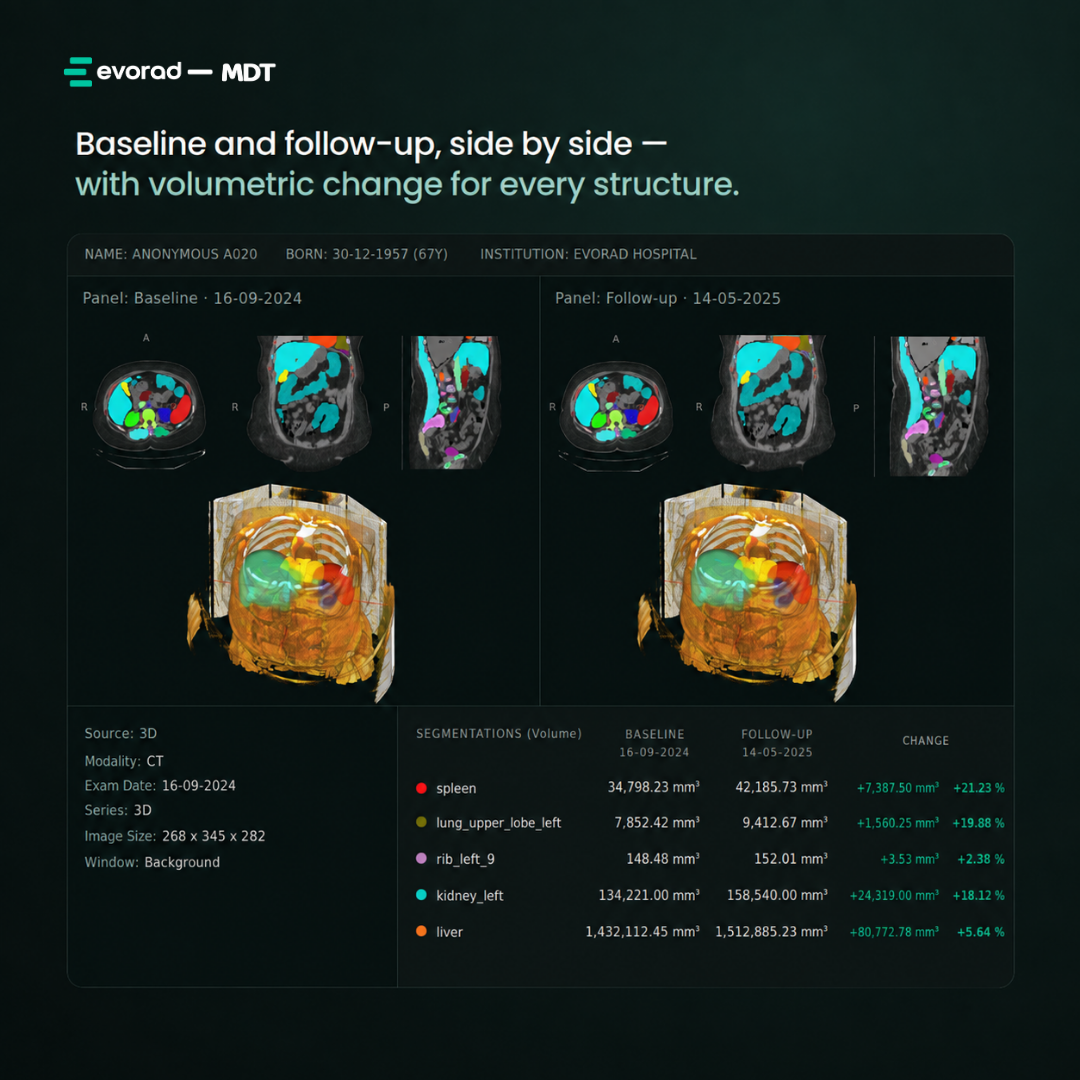
Baseline and follow-up, side by side
evorad MDT opens both timepoints in linked panels with synchronised navigation and a 3D view of the same anatomy. Where segmentation is applied, the sidebar reports both volumes and the percentage difference for every structure.

Faster orientation to a long history
When a patient has years of imaging behind them, the clinician preparing the case needs a starting point rather than a list. Synopsis summarises prior diagnoses by extracting the key historical findings.
From fragmentation to connection
Complex cases exceed what any single specialty can assess alone — but that only works when everyone sees the same thing. When a surgeon has an exported still, an oncologist a report and the radiologist the full study, the discussion runs on three different versions of the case.
A complete picture means the current study, the priors that show how the disease has behaved, the reports that interpreted them and, where useful, a measure of what has changed between timepoints.
-
Case is identified
-
Priors compared
-
Case is prepared
-
The team reviews
-
Outcome is documented
What each part of the team gets
Radiologists
Present the case from a diagnostic-grade viewer rather than exported stills, with reconstructions, measurements and priors available live. Preparation happens in the same environment used for reading, so nothing is duplicated.
Referring clinicians and specialists
Open the imaging directly in a browser, from wherever the clinic happens to be, without an installation or a workstation booking. Surgeons and oncologists see the same view as the radiologist, not a compressed copy of it. |
MDT coordinators
Spend the preparation window assembling the discussion rather than chasing files. Studies and priors are located in one place, and the case is ready to open when the meeting starts. |
Healthcare IT teams
Integrate through DICOM, DICOMweb, HL7 and FHIR with the systems already in place. Deploy in the cloud, hybrid or on-premise, and add MDT capability as a module rather than as a separate system to maintain. |
The modules behind MDT collaboration
evoViewer
Zero-footprint, diagnostic-grade access to the full study, with reconstructions in the browser.
evoPACS
Consolidates studies across modalities and sites so the case is assembled from one place.
