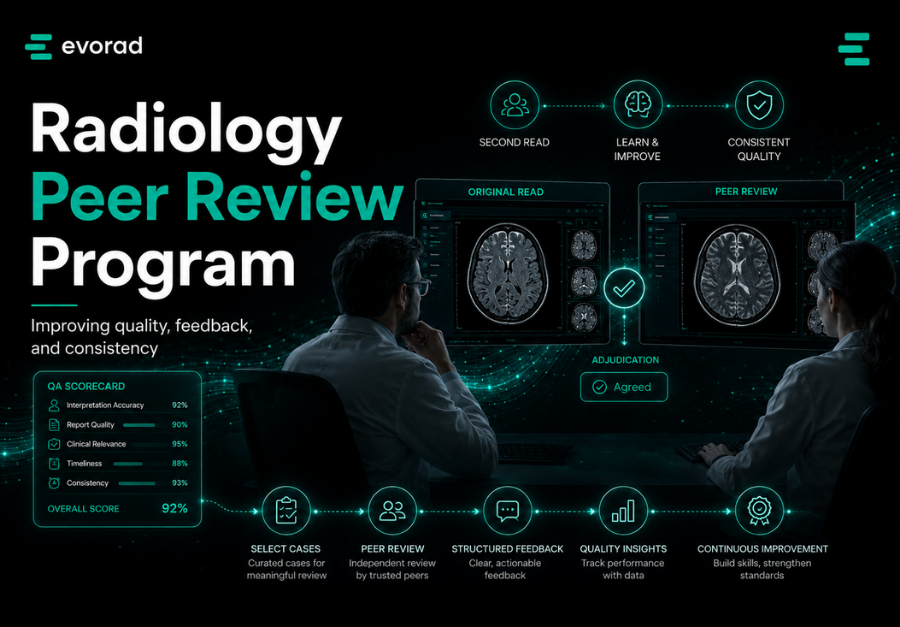
Every radiology group says quality is its first priority; radiology peer review is where that claim becomes checkable. A working programme samples real cases, compares interpretations, learns from discrepancies and feeds the lessons back — routinely, fairly and without turning colleagues into adversaries. According to a report on Applied radiology, “In radiology peer review is a cornerstone of maintaining diagnostic accuracy and ensuring high standards of patient care.”
That last clause is where programmes live or die. Radiologists have seen peer review done as surveillance, as box-ticking and as blame allocation, and they remember. This guide covers why peer review is back on the agenda, the sampling approaches available, how scoring and discrepancy handling should work, the cultural design that determines acceptance, and what automation changes.
Why is radiology peer review back on the agenda?
Several currents converged. Distributed and teleradiology reading means groups now vouch for the output of readers; their clients may never meet — quality assurance is part of the product being sold, and sophisticated clients ask to see it. Referrers and regulators increasingly expect documented quality processes rather than professional reputation alone. And as AI enters the reading workflow, discrepancy data becomes doubly valuable: the same programme that assures human quality provides the ground truth against which assistance tools are judged.
There is also an internal driver that deserves more airtime: done well, peer review is education. A steady, blame-free flow of ‘here is a subtle finding a colleague caught’ is among the most effective continuing education a group can run — and it is generated from your own case mix.
For teleradiology groups the commercial framing is explicit: peer review is part of the pitch. Prospective client facilities increasingly ask what the quality programme looks like — sampling rates, discrepancy handling, what happens when something significant is found — and a group that can show a running programme with real data answers in a way a policy document cannot. Quality assurance has quietly moved from a back-office obligation to a sales differentiator.
Sampling approaches
- Random sampling: a defined percentage of each reader’s cases selected automatically for review — the backbone of most programmes, because randomness is what makes the data fair and comparable.
- Prospective double-reading: a second read before the report is finalised, standard in some screening programmes and useful for high-stakes examination types; expensive in capacity, so deployed selectively.
- Targeted review: focused sampling by modality, examination type or clinical scenario — appropriate when introducing a new service line or responding to a signal, provided targeting criteria are transparent.
- Follow-up-triggered review: cases revisited when subsequent imaging or clinical outcome invites comparison with the original read — the richest learning source, since it reviews against reality rather than against another opinion.
- Committee case review: periodic group discussion of selected discrepancies and great catches — where the educational value is actually harvested.
Mature programmes blend these: random sampling for fairness and statistics, follow-up triggers for depth, and a regular learning meeting to close the loop.
A practical note on numbers: at low sampling rates, individual discrepancy statistics take a long time to become meaningful, especially for low-volume readers. Resist drawing conclusions from small counts; report trends over sensible periods, aggregate where volumes are thin, and treat early signals as prompts for a closer look rather than verdicts. Statistical humility is not a weakness in a quality programme — it is what keeps the programme credible with the people being measured.
Whatever the blend, write the sampling policy down — rates, triggers, review turnaround expectations — and publish it to the group. A programme whose rules are visible is trusted by default; one whose case selection appears discretionary is suspected by default, however innocent the mechanics.
Scoring and discrepancy handling
Scoring frameworks vary in detail, but defensible ones share a structure: they grade the clinical significance of a disagreement, not merely its existence — distinguishing differences of style or judgement from discrepancies likely to affect management — and they separate the score from the consequence. A significant discrepancy triggers a defined pathway: second review, addendum or corrected report where care is affected, referrer notification where required, and entry into the learning loop.
Two design rules keep scoring credible. First, review the case, not the career: reviewers should assess the study as presented, ideally blinded to the original reader where practical. Second, adjudicate disagreements about the disagreement: a small committee, not the loudest voice, settles contested scores. Programmes that skip these rules generate resentment data, not quality data.
Documentation discipline matters more here than anywhere else in the programme. Where a discrepancy affects care, the clinical record needs the correction — addendum or amended report — handled through the normal reporting channel with the referrer informed; the peer-review record needs the learning. Keep the two purposes distinct and both well-documented: quality data that wanders into clinical records, or clinical corrections that hide inside quality files, create exactly the medico-legal tangle the programme exists to prevent.
Culture: learning versus blame
- State the purpose in writing: education and system improvement, with a separate, explicit and rarely used pathway for genuine competence concerns — mixing the two poisons both.
- Report at the level that teaches: individual feedback privately and constructively; trends and anonymised cases to the group; rates to governance.
- Normalise discrepancy: published error-rate literature is consistent that some level of discrepancy is inherent to radiology practice; a programme that implies perfection is achievable will be gamed.
- Review the reviewers: second opinions are opinions; calibration sessions keep scoring consistent across the panel.
- Celebrate catches both ways: the great call and the instructive miss belong in the same meeting, with the same tone.
- Protect time: peer review scheduled inside the working day signals it is real work; peer review squeezed after hours signals it is theatre.
Leadership behaviour sets the ceiling on all of it. When senior radiologists submit their own discrepancies to the learning meeting — visibly, occasionally, without drama — the message lands in a way no policy wording achieves: this applies to everyone, and it is safe. Programmes where leadership is conspicuously absent from the sampled population are read, correctly, as surveillance of the junior by the senior and behave accordingly.
What automation changes
The administrative burden — selecting cases, chasing reviews, compiling statistics — is what historically reduced peer review to a compliance ritual. Automation removes most of it: sampling rules run inside the reading workflow, review cases appear on worklists like any other task, scores and outcomes are captured in structured form, and compliance and trend reporting assemble themselves.
Just as importantly, workflow-native peer review is fairer: sampling is genuinely random, allocation respects subspeciality, blinding is enforceable, and the data is complete rather than whatever the spreadsheet remembered. For distributed groups, it is also the only practical way to run one programme across many sites and readers — the peer review capability within evoTelerad exists for exactly this reason.
Automation also upgrades what the quality committee actually does with its time. When sampling, chasing and tabulation run themselves, the monthly meeting stops auditing spreadsheets and starts reviewing cases — the trends worth investigating, the discrepancies worth teaching, the templates or protocols the data suggests changing. The measure of a well-automated programme is that its committee talks about radiology, not administration.
FAQs
What sampling rate should a peer review programme use?
Enough to be statistically meaningful per reader over a review period without consuming disproportionate capacity — commonly a low single-digit percentage of volume, adjusted for group size and case mix. Consistency and randomness matter more than the precise rate.
Should peer review be anonymous?
Blinding the reviewer to the original reader’s identity improves fairness where practical. Feedback to the original reader, by contrast, works best attributed and private — anonymity in feedback prevents the conversation that creates the learning.
Is peer review a regulatory requirement?
Requirements vary by country, accreditor and contract; many jurisdictions and clients expect a documented quality-assurance process even where the mechanism is not prescribed. Build the programme for learning, and the compliance evidence falls out of it.
How does peer review relate to AI in the reading workflow?
Discrepancy and outcome data from peer review is the natural ground truth for evaluating AI assistance — and AI-flagged cases can feed targeted review. The two programmes strengthen each other when they share infrastructure.
What is the biggest reason programmes fail?
Administrative friction and perceived unfairness are usually together: manual sampling that drifts from random, chasing that breeds resentment, and scores without adjudication. Automation fixes the first; governance design fixes the second.
Quality assurance that runs itself
A radiology peer review programme should cost your radiologists’ judgement, not administration. Within evoTelerad, peer review runs natively in the reading workflow — automated sampling, worklist-integrated review tasks and structured outcomes — so one programme covers every reader and site, and the learning loop actually loops.