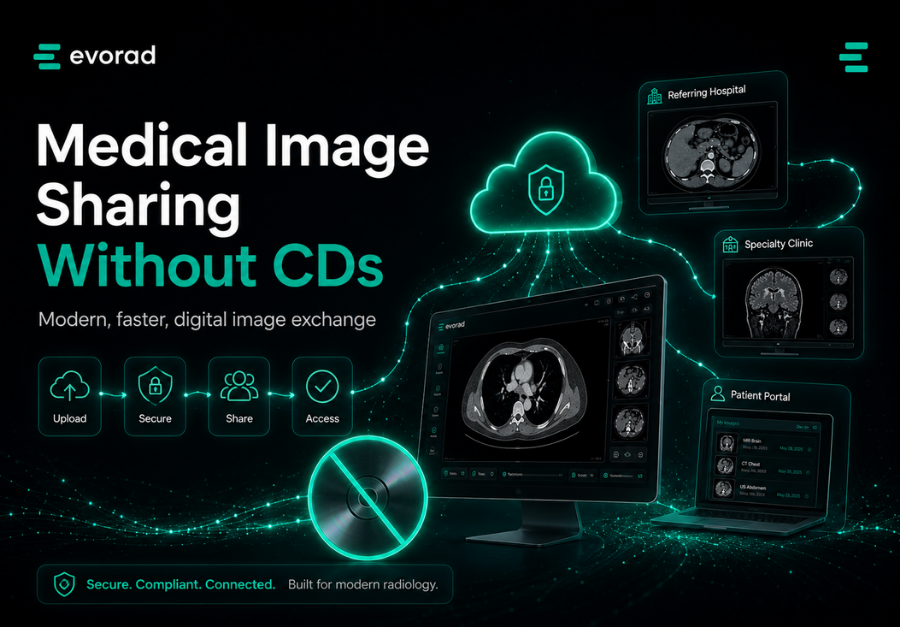
Somewhere in your facility right now, a member of staff is burning a CD. Another is explaining to a patient that a disc from another hospital will not open. A third is rescheduling an examination because the prior study never arrived. Better technology has existed for years, yet physical media still survives wherever medical image sharing has not been redesigned as an end-to-end workflow.
This guide explains the operational cost of CDs and films, the three main models for medical image sharing, the governance and GDPR considerations that come with electronic exchange, what patients and referrers actually need, and a pragmatic path for replacing physical media.
The real cost of CDs and films
- Direct materials and handling: discs, sleeves, printing, postage, and the staff time required to prepare, label, hand over or send each item.
- Failure and rework: discs that do not open on the receiving system, include incompatible viewing software, arrive late or are lost, each creating calls, re-burning and repeat handling.
- Repeat imaging: when prior studies are unavailable at the point of care, examinations may be repeated unnecessarily – consuming scanner capacity and, for ionising-radiation examinations such as CT, potentially adding avoidable exposure.
- Delay: clinical decisions, transfers and second opinions can be slowed when image access depends on collection, courier or postal logistics.
- Security and governance exposure: portable media can be lost, copied or accessed outside the organisation, while access is difficult to revoke and activity is harder to audit than in a controlled digital sharing workflow.
- Environmental footprint: physical media, packaging and avoidable collection journeys add material and travel costs that digital access can reduce.
Before building the business case, spend a week measuring the baseline: discs and films produced, staff minutes per item, failure-related calls, collection visits and examinations repeated because priors were inaccessible. The aim is to turn a diffuse operational burden into a measurable cost that can be compared before and after implementation.
The three sharing models that replace media
- Patient-mediated sharing: patients access their imaging through a portal and can share a specific study or episode with another clinician or institution using controlled digital access rather than carrying physical media. Full DICOM export can remain available when the receiving workflow requires it.
- Referrer access: authorised referring clinicians open images and reports directly in a browser-based environment, scoped to the patients they are entitled to view, and notified when results are available. This can replace a large share of routine outbound disc production in organisations where referrer requests are a major source of physical media.
- Site-to-site exchange: standing electronic transfer between organisations for transfers, tumour boards, teleradiology and second opinions, built on standards such as DICOM/DICOMweb and IHE radiology profiles such as XDS-I.b where cross-enterprise infrastructure is in place, rather than couriered media.
Most organisations need a combination of these models because they solve different journeys. The common foundation is standards-based exchange, clear identity and access controls, and browser-accessible viewing that reduces dependence on locally installed software at the receiving side.
Sequence the rollout according to measured demand. If referrer requests account for most physical media, start with referrer access. If collection visits and status calls dominate, prioritise patient access. Site-to-site exchange can then address transfers, tumour boards, teleradiology and second-opinion workflows. A shared platform foundation is usually easier to govern and scale than separate point solutions for each journey.
Consent, logging and GDPR
Electronic sharing can be more governable than physical media, but only when governance is designed into the workflow:
- Lawful basis and transparency: define the appropriate GDPR lawful basis for processing and explain clearly what data is shared, with whom and for what purpose. Do not assume that patient consent is always the lawful basis for processing health data.
- Scoped and revocable access: limit sharing to the relevant study, episode or time window where appropriate, with the ability to withdraw access when the workflow permits.
- Audit trails: log relevant views, shares and downloads so the organisation can investigate access, support accountability and answer the practical question: who accessed this study?
- Strong authentication: apply identity verification and authentication controls proportionate to the risk, with stronger measures such as multi-factor authentication where appropriate for external access.
- Controlled viewing and download: browser-based viewing can reduce unnecessary local copies, while DICOM export should be a deliberate, permissioned and logged action where clinically or operationally required.
One governance detail deserves explicit design: recipient identity. When a patient shares a study with a named clinician, the system must have a defensible way to verify who opens it. Options include verified professional accounts, secure one-time access codes and organisation-managed identity. An open or weakly verified link can undermine much of the governance benefit that digital sharing is meant to create.
What patients and referrers actually need
Adoption follows convenience. Patients need access without specialist software, mobile-friendly use, clear notification when results are ready, a simple sharing action and confidence over who can access their information. Referrers need images and reports together, straightforward authentication, and a viewer that performs reliably enough to become easier than calling the imaging provider.
Each requirement is a friction test. Every failed step creates another reason for staff, patients or referrers to fall back to physical media.
Design for the receiving clinician you have never met, too: the specialist at another institution who may open a patient-shared study once and never use your platform again. The first experience should require minimal setup and provide access to the original study and report at a quality appropriate to the intended clinical use.
Implementation: a pragmatic sequence
- Measure the baseline: track discs produced per month, staff time, failure calls, collection visits and repeat-imaging events so the organisation can quantify change.
- Start with the highest-volume sharing journey: use the baseline to identify whether referrer, patient or site-to-site requests are driving the most physical-media work.
- Add patient access and notifications: self-service can reduce collection visits and status calls while giving patients a clearer role in sharing their own records.
- Retire media deliberately: define a date after which physical media becomes exception-only, document the exceptions and communicate the digital alternative clearly to patients and referrers.
- Keep an assisted path: some patients and external organisations will still need support. Design that support around the digital workflow rather than defaulting immediately to a new disc.
- Report the wins: track media costs, staff handling time, call volumes, access failures and repeat-imaging trends so the organisation can demonstrate whether the change is delivering the expected value.
Communicate the change as a service improvement, not simply an IT migration. For patients, the message is access without returning to collect a disc and the ability to share imaging digitally. For referrers, it is secure browser access to images and reports as soon as they are released. The benefit is easier to understand when communication focuses on the experience being improved rather than the technology being retired.
FAQs
Is emailing images an acceptable alternative to CDs?
Usually not as the default workflow. Secure email can be configured for specific use cases, but ordinary email offers limited control over onward sharing and revocation, while diagnostic imaging files are often too large for practical attachment-based exchange. Dedicated image-sharing workflows provide stronger access control, auditability and support for original DICOM data.
Can shared studies keep diagnostic quality?
Yes, when the platform preserves the original DICOM data and the viewer is suitable for the intended use. Diagnostic interpretation may also depend on the viewer, display, device and local regulatory requirements. Screenshots and compressed attachments should not be treated as substitutes for the original imaging data.
What happens when the receiving hospital has different systems?
Standards are what make cross-system exchange possible. Browser-based viewing can reduce dependence on the recipient’s local software, while DICOM export or standards-based transfer can support import into another PACS when required. The receiving organisation may still have local identity, security and workflow requirements.
Do we still need to produce CDs at all?
Sometimes, as an exception. Local policy, recipient capability or connectivity may still require physical media in specific cases. Treat those cases as a defined exception workflow rather than the default method of medical image sharing.
How does sharing relate to the EHDS?
The European Health Data Space (EHDS) Regulation entered into force in March 2025. Under the European Commission’s implementation timeline, the cross-border exchange of medical images and imaging studies is part of the second group of priority health-data categories and should be operational across EU Member States from March 2031. Organisations that build standards-based, patient-centred sharing capabilities now are moving in the same direction as the regulatory framework.
Sharing that already works at a national scale
A relevant proof point is Greece’s National Radiology Studies Repository, which gives patients digital access to hospital imaging and supports functions such as sharing, comments and DICOM download. It demonstrates what medical image sharing can look like when patient access is designed at national scale, while Evorad’s evoPortal brings the same patient- and referrer-facing model to individual imaging organisations.
Explore secure patient and referrer access with Evorad evoPortal.