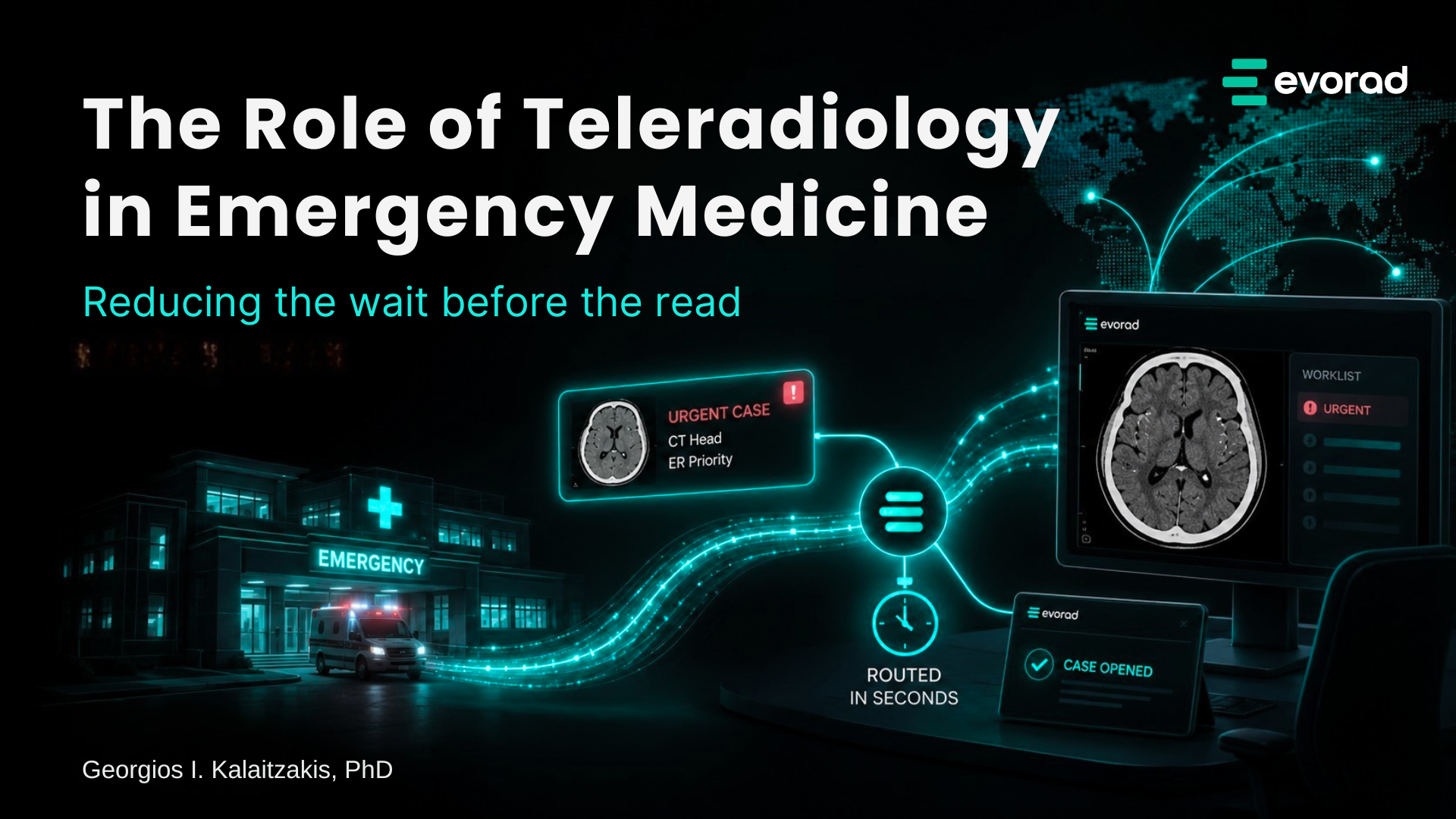
Emergency teleradiology can help healthcare organisations provide timely access to radiology expertise during nights, weekends and periods of increased demand. However, it does not require one fixed staffing model. Remote reporting capacity may be provided by the organisation’s own radiologists, an external reporting partner or a combination of both.
In emergency imaging, interpretation time is only one part of the turnaround pathway. A CT head for suspected intracranial haemorrhage may take only a few minutes to interpret, but the study must first be transferred, prioritised, assigned and surfaced in the correct worklist.
Effective emergency teleradiology depends on how reliably these steps connect the study with an appropriately qualified radiologist. The technology should support the organisation’s preferred operating model while maintaining its clinical governance and quality standards.
What the clock looks like in emergency imaging
Turnaround targets vary according to the organisation, modality, clinical urgency and agreed service level. The overall pathway may include acquisition and reconstruction, transfer and ingest, prior retrieval, queue wait, interpretation and report delivery.
Interpretation may represent only part of the total turnaround time, while queue wait can be one of its largest and most variable components.
One prospective randomised study of 620 emergent-care head CT scans illustrates the potential effect of worklist prioritisation. Among cases identified as positive for intracranial haemorrhage by an AI tool, the mean turnaround time was 73 minutes when the case was flagged and 132 minutes when the flag was hidden.
The findings suggest that better worklist visibility can reduce reporting delay in some settings, although results will vary across organisations and workflows.
In emergency imaging, prioritisation can influence how quickly interpretation begins.
How emergency departments organise continuous reading capacity
Emergency departments need reliable access to radiology expertise at all hours. How that capacity is organised depends on the size of the organisation, its internal resources, clinical governance model, subspecialty availability and operating priorities.
Some healthcare organisations build round-the-clock remote reading capacity within their own radiology department. Others use an external teleradiology provider for selected shifts or specialties, while many combine both approaches.
The important requirement is not a specific staffing model. It is the ability to route every urgent study to an appropriately qualified radiologist without unnecessary delay.
Emergency volume does not follow staffing patterns
Emergency imaging continues throughout nights, weekends and periods of unexpected demand. Larger organisations may support this through an internal, round-the-clock radiology team. Others may extend their internal capacity through an external provider or a wider regional network.
In every model, urgent studies must remain visible and reach the appropriate available radiologist quickly.
Subspeciality requirements do not respect the hour
A paediatric head CT at 3am requires the same level of expertise as it would at 3pm. Organisations with sufficient internal subspecialty capacity can route the study within their own network. Others may use an external specialist or a hybrid arrangement when the required expertise is unavailable locally.
The platform should support each of these models without compromising clinical governance, communication or quality control.
Turnaround affects the wider emergency pathway
Delayed imaging results can postpone clinical decisions, extend the use of emergency resources and contribute to patient-flow pressure. Research has associated CT and MRI delays with increased hospital episode costs, although turnaround is only one of several factors affecting length of stay and operational performance.
The design of the reporting workflow can therefore influence more than diagnostic capacity. It can also affect how efficiently patients, clinicians and emergency resources move through the care pathway.
Research in Current Problems in Diagnostic Radiology has associated longer radiology turnaround times with extended hospital stays, increased costs of care, and delayed treatment initiation. Analysis from the Emergency Medicine Residents’ Association similarly links longer radiology turnaround to increased length of stay and higher cost of care.
Emergency departments are flow systems. A held imaging result holds a bed, a clinician, and a decision.
There is no single operating model for emergency teleradiology
| Model | How it works | Potential advantage |
|---|---|---|
| Internal | The organisation’s own radiologists read remotely across its sites | Direct governance, continuity and alignment with internal protocols |
| External | Selected studies are routed to an outside reporting provider | Additional coverage, capacity or subspecialty access |
| Hybrid | Internal teams provide core coverage, supported externally when required | Internal control with flexible overflow and after-hours resilience |
The appropriate model depends on each organisation’s clinical priorities, internal expertise, volumes, governance requirements and quality standards. Technology should support that decision—not dictate it.
Quality depends on credentialing, access to clinical information and prior studies, communication pathways, peer review, reporting standards and oversight. These requirements apply regardless of whether the radiologist is part of the organisation’s internal team or an external network.
The failure modes that cost time
Four common sources of avoidable delay are worth monitoring.
- Priority flag dilution
When STAT labels are applied inconsistently, they become less useful for distinguishing genuine urgency. Where it has been overused to mean “read today”, radiologists may to distrust the flag and apply their own heuristics – which requires constant vigilance and does not scale with volume.
A more robust approach is to treat the flag as one input among several: modality, clinical context, patient location, elapsed time, and SLA position, weighted together into a dynamic score. A STAT study flagged eight hours ago should outrank one flagged ten minutes ago, even though both carry the same label.
- Studies isolated in a separate system
Where emergency cases from one site sit in a worklist the radiologist checks less often, urgency may be less visible. This can be a consequence of running multiple reading platforms: a genuinely urgent study is not deprioritised so much as unseen.
A consolidated worklist can improve reliable handling of emergency cases. If a STAT study from Hospital A is not surfaced alongside STAT studies from everywhere else, urgency is being determined by which system the radiologist happens to have open.
- Access friction at the moment of need
A radiologist woken at 2am who then spends several minutes establishing a VPN connection and who may need to repeat that after a mid-session drop is losing time from precisely the interval that matters most. Browser-based, zero-footprint access can reduce this access friction.
- Critical findings without closure
Fast interpretation that does not reach the treating clinician is not fast care. A formal critical results pathway — structured notification, explicit acknowledgement, and timed escalation if unacknowledged — closes the loop. Without it, urgency ends at the report, and the remaining risk is transferred to whoever happens to check.
What a well-designed emergency teleradiology pathway looks like
Running the same case through a properly configured pathway:
- Order placed with urgency indicated; identity established with accession and procedure context.
- Modality pulls demographics and accession from worklist — no manual entry, no reconciliation later.
- Study ingested, indexed, and prior retrieved automatically.
- Orchestration scores the case against urgency, modality, patient location, subspecialty requirement, elapsed time and SLA position, then surfaces it at the top of the appropriate reader’s consolidated worklist.
- Radiologist opens the study in a browser — no VPN, no client — with priors already present.
- Report finalised; critical finding triggers structured notification with acknowledgement tracking and escalation if unanswered.
- Result returns to the EHR and the referrer without manual forwarding.
- The clinical work in this sequence is step five. The surrounding steps form the operational infrastructure that determines how quickly interpretation can begin.
Measuring whether it is working
Four metrics, tracked continuously rather than audited retrospectively:
- Scan-complete to read-start interval, separated from total turnaround. This isolates allocation performance from interpretation performance.
- STAT SLA compliance by originating site. Divergence between sites may indicate differences in routing, workload, modality mix or upstream processes that aggregate figures conceal.
- Critical findings acknowledgement time, not just notification time.
- Overnight versus daytime turnaround differential. A large gap may signal differences in staffing, workload, routing, access or out-of-hours coverage design. In one oncology radiology quality-improvement programme, a package of interventions—including staff training, regular case discussions, automated urgency scoring and digital dashboards—coincided with an improvement in turnaround compliance from 88% to 95% between June 2023 and March 2024 (PMC).
The measure that misleads
Mean turnaround is widely reported, but it is insufficient when used alone in an emergency context. A mean conceals the tail; the longest delays may carry the greatest operational and clinical risk. A service reporting a comfortable average may still be missing its target on a meaningful proportion of overnight head CTs.
More informative: 90th and 95th percentile turnaround for STAT studies; percentage of critical findings acknowledged within the defined window; and time from study completion to first radiologist opening the study, which isolates orchestration performance from reading time. All of these should be broken down by site and by hour of day.
Overnight and weekend performance should be reviewed separately from weekday daytime. Pooling these periods may conceal the times most likely to expose coverage or workflow gaps.
The limits worth acknowledging
Distributed emergency reading is not a substitute for clinical communication. Complex trauma, ambiguous findings, and cases requiring direct discussion with the emergency team benefit from a conversation that a report does not replace. Well-designed pathways build in a route to that conversation rather than assuming the report is sufficient.
Nor does remote reading absolve the onsite process. Identity or order errors made at the scanner console cannot be resolved by a radiologist 200 kilometres away. The performance of emergency teleradiology depends partly on the quality and consistency of the upstream workflow.
Conclusion
Effective emergency teleradiology is not defined by whether reporting is provided internally or externally. It depends on whether each urgent study reaches an appropriately authorised radiologist with the clinical information, prior imaging and communication pathways required for a high-quality report.
Prioritisation, consolidated worklists, subspecialty routing and reliable remote access allow healthcare organisations to build a model that reflects their own staffing strategy, governance requirements and quality standards. Technology should support that model—not determine it.
How evoTelerad Supports Emergency Teleradiology
evoTelerad does not prescribe who should read the study. It provides the prioritisation, routing, viewing, reporting and governance infrastructure needed to connect each urgent case with the appropriate authorised radiologist—whether they belong to the hospital’s internal team, a wider enterprise network, an external provider or a hybrid arrangement.
- SLA-aware routing: dynamic prioritisation by clinical urgency, modality, elapsed time and remaining time to deadline — studies approaching their window surface automatically.
- Consolidated worklist: STAT cases from every site appear together, not hidden in a system the radiologist has not opened.
- Zero-footprint access: browser-based reading with no VPN and no client software, so a 2am call means authenticate and read.
- Subspecialty matching: urgent studies reach appropriately qualified readers, balanced against availability to reduce avoidable delays.
- Flexible capacity sharing: studies can be distributed across the organisation’s own radiologists, connected facilities or approved external providers, according to its chosen operating model.
- Real-time dashboards: turnaround, SLA compliance and workload distribution visible while they can still be acted on.
- Workload balancing: studies are distributed dynamically across available radiologists and sites, helping local bottlenecks and supporting more consistent turnaround during peak demand.
Book a demo to see how evoTelerad compresses the interval that matters most.