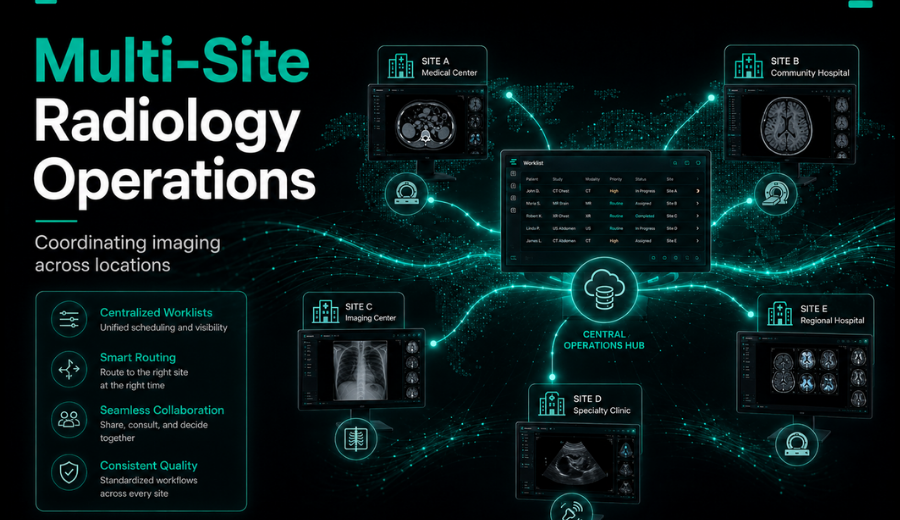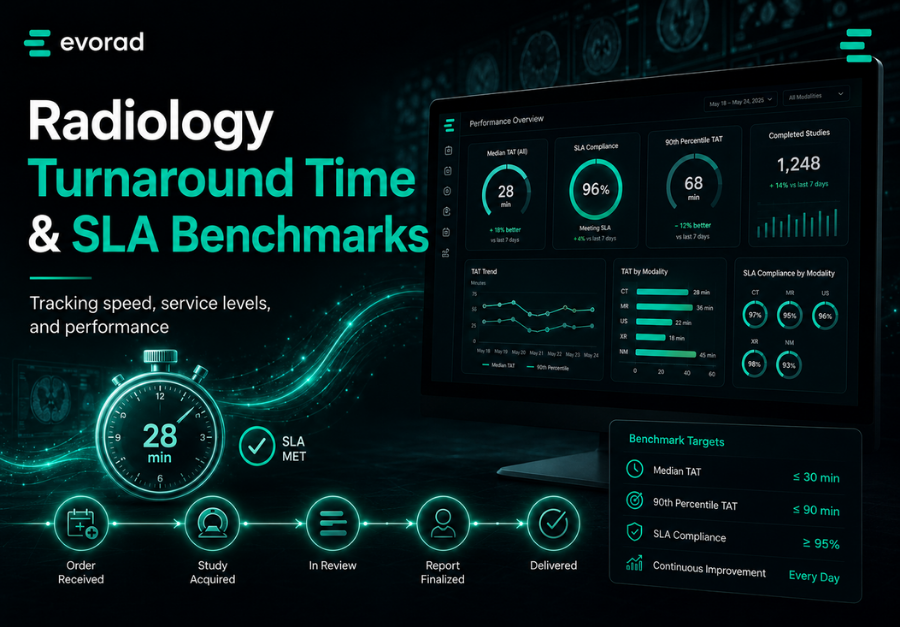
Radiology turnaround time (TAT) is a core operational measure for hospital departments, multi-site networks and external reading providers. It influences when results reach clinicians, how capacity is managed and whether agreed service levels are met.
There is no single universal radiology turnaround time benchmark. A useful target must reflect clinical urgency, modality, case complexity, coverage model and the exact points at which the clock starts and stops. This guide explains how to define TAT, structure service level agreements (SLAs), identify avoidable delays and monitor performance without assuming that one staffing model is inherently better.
Define TAT before setting a target
Many TAT disputes begin with different clock definitions. Does measurement start at exam completion, when images become available to the reading platform, or at case assignment? Does it stop at a preliminary report, a final report, or delivery into the referrer’s system? A two-hour target measured from completion to final delivery is not equivalent to one measured from assignment to preliminary report.
For an external reporting service, receipt-to-final-report delivery may be an appropriate definition because it reflects the part of the pathway under the provider’s control. An internal department may instead use exam-complete-to-final-report or exam-complete-to-delivery. The most defensible definition is clinically meaningful, consistently measurable and explicit about which parts of the pathway are included.
The SLA should also distinguish preliminary and final reports, define how addenda are handled, and state what happens when images, prior studies or clinical information are incomplete. Closing these ambiguities at the start makes later performance comparisons more reliable.
Set benchmarks by priority class and workflow
Published targets vary by health system, market, modality, case mix and measurement definition. A single range should therefore not be presented as a universal standard. Each organisation should set targets through clinical governance and capacity planning, then document them by priority class and operating model.
For each class – such as emergency or STAT, urgent and routine – define the clinical criteria, clock start and stop, expected reporting status, escalation rules and communication pathway. Critical-result notification should be governed separately when a finding requires immediate attention, because report completion and successful communication are different events.
Averages alone are incomplete. Report the distribution of turnaround times and the proportion of cases completed within the agreed target. A satisfactory mean can still conceal a smaller group of material breaches, while a single breach does not describe the overall reliability of the service.
External ranges may provide commercial context, but an organisation’s own trend is usually more actionable: compliance by priority class, modality, site and time of day, measured under a stable definition. This shows whether performance is improving and where local capacity or workflow needs attention.
Anatomy of a well-built SLA
- Priority classes and clocks: define what counts as STAT, urgent and routine; when each clock starts and stops; and how reclassification is handled.
- Compliance targets: specify the proportion of each priority class expected within its window and the reporting period used for assessment.
- Critical results: define the notification channel, acknowledgement requirement, escalation path and applicable timeframes according to clinical risk and local policy.
- Exclusions and pauses: identify image-quality failures, missing information and upstream outages narrowly; record each occurrence and retain it for review.
- Measurement governance: define the authoritative timestamps, reporting owner, data access and audit process.
- Remediation: define how sustained underperformance is investigated, corrected and, where relevant, handled contractually.
TAT commitments also depend on volume and coverage assumptions. Internal, external and hybrid models should document expected volumes, planned surge capacity and how unexpected peaks are managed. This makes performance expectations transparent without positioning one staffing model as inherently superior.
Use one authoritative event log or shared dashboard where possible. When all parties review the same underlying timestamps, performance discussions can focus on causes and corrective action rather than reconciling competing spreadsheets.
Where radiology turnaround time can be delayed
Delay can accumulate before, during or after interpretation. The most useful starting point is to timestamp each transition and identify where time is actually being spent:
- Receipt to assignment: a case may wait for manual allocation, enter the wrong queue or require clarification before assignment.
- Assignment to open: the assigned radiologist may be working across multiple queues, systems or competing priorities.
- Prior retrieval: relevant comparisons may be slow, unavailable or difficult to locate across sites.
- Access and interpretation environment: authentication, viewer performance, connectivity or interruptions may add delay.
- Final report to delivery and acknowledgement: interfaces, manual forwarding or incomplete critical-result escalation may delay the result reaching the care team.
- A useful event sequence is exam complete, images available, assigned, opened, preliminary, final, delivered and – when relevant – critical result acknowledged. Missing timestamps should be treated as a measurement gap.
If local time-in-state data show that cases spend longer waiting for assignment than being interpreted, the corrective action is more likely to involve routing, coverage or queue design than pressure to read faster. The conclusion should come from the organisation’s own data rather than assumptions.
Analyse nights and weekends separately because volumes, coverage and escalation paths may differ from weekday daytime operations. Blended statistics can conceal a recurring out-of-hours gap even when overall performance appears stable.
How SLA-aware routing can help
At high volume, manual list-watching can become difficult. SLA-aware routing can use priority, elapsed time, remaining time to target, subspecialty requirements and reader availability to surface cases at risk of breach and support escalation before the target expires.
Combined with subspecialty matching, coverage calendars and workload balancing, routing can reduce the need for radiologists to reconcile multiple queues manually. It supports clinical judgement by making the next relevant cases more visible; it does not replace clinical oversight.
Routing telemetry can also inform coverage planning by showing demand by hour, modality and priority class against reader availability. These data can support decisions about internal staffing, cross-site balancing, surge arrangements or approved external capacity.
Measuring and reporting compliance
- Report compliance by priority class and site, using both summary statistics and the percentage completed within target.
- Track time-in-state between each workflow transition and trend it over time.
- Separate workflow-controlled delays from approved exclusions and review exclusions rather than treating them as invisible.
- Review each breach for contributing factors; one case may have more than one cause.
- Use the findings to adjust routing rules, escalation timing, integration and coverage, then measure whether the change improves performance.
Treat the monthly compliance report as a management and governance tool. It should show performance, exceptions, recurring causes and actions taken. Transparent reporting gives internal leaders, clients and partners a shared view of the service and supports continuous improvement.
FAQs
What is a good radiology turnaround time?
There is no universal number. A good target matches the clinical need, modality, case complexity, available capacity and the organisation’s documented clock definition. It should be agreed through clinical governance and reviewed against local performance data.
What does SLA mean in radiology?
A service level agreement defines priority classes, turnaround commitments, measurement rules, critical-result procedures, exclusions, reporting and remediation. It can govern an internal service, an external reporting arrangement or a hybrid model.
Why can STAT cases breach even when interpretation is fast?
Delay can occur before or after interpretation: assignment, queue visibility, prior retrieval, access, report delivery or critical-result communication. Time-in-state data should be used to identify the relevant cause in each workflow.
Should critical findings have separate communication targets?
A separate critical-results process should define notification, acknowledgement and escalation according to clinical risk and local requirements. This communication pathway should be measured independently from report turnaround where appropriate.
How should TAT compliance be reported?
Report the percentage completed within target for each priority class, supported by median and percentile measures, site and time-of-day breakdowns, and a breach analysis. A single average is rarely sufficient on its own.
Protect the SLA every shift
Reliable turnaround depends on clear definitions, visible queues, well-matched capacity and closed-loop communication. evoTelerad and maestro can support live SLA timers, routing and workload visibility across internal, external or hybrid reading models. The organisation retains control of its clinical governance, staffing strategy and targets.
See how SLA-aware routing can support your workflow: https://www.evorad.com/platform/maestro/