In short: Good STAT prioritisation in teleradiology starts with a clinical decision at the referring site and ends with that decision being visible, timed and auditable on the remote reader’s worklist. The software’s job is to carry, display and escalate the priority it receives – never to decide which studies are urgent.
In teleradiology, the person who decides a study is urgent and the person who reads it are rarely in the same building or even the same country. Between them sit an order system, a RIS, one or more PACS, a transfer link and a reading worklist.
Every hand-off is a place where “urgent” can quietly become “routine”, and the study then waits behind everything else. That is why STAT prioritisation in teleradiology is less about a red icon and more about an unbroken chain from clinical decision to radiologist.
Who decides that a study is STAT?
STAT is a clinical designation assigned by the referring clinician or site when the examination is requested or reviewed, because the referring team holds the clinical picture.
Write that principle into your service agreement and your system design. The worklist, the routing rules and the teleradiology provider all act on the priority they receive; none of them should decide urgency.
In STAT prioritisation in teleradiology, what the reading side owns is the response: making sure a study marked STAT is seen and reported within the agreed window, and that someone is alerted if it is not.
How should a STAT flag travel from the order to the reading worklist?
For STAT prioritisation in teleradiology to work, the STAT designation should travel as structured data in the standard priority fields, not as free text, which a human can miss and a rule cannot act on reliably.
| Stage | Where priority usually lives | What to check |
|---|---|---|
| Order (HL7 v2) | TQ1-9 Priority, coded from table 0485 (S = Stat, A = ASAP, R = Routine). Blank defaults to R [1][2] | Does the order system populate it, or leave it blank? |
| Scheduling/modality worklist (DICOM) | Requested Procedure Priority (0040,1003): STAT, HIGH, ROUTINE, MEDIUM, LOW [3] | Is the HL7 value mapped to DICOM correctly? |
| Reporting priority (DICOM) | Reporting Priority (0040,1009): HIGH, ROUTINE, MEDIUM, LOW – note there is no STAT value [3] | If you rely on this field, how is STAT represented? |
| Remote reading task | Scheduled Procedure Step Priority (0074,1200) in IHE Remote Reading Workflow [4] | Does the task carry an expected completion time as well? |
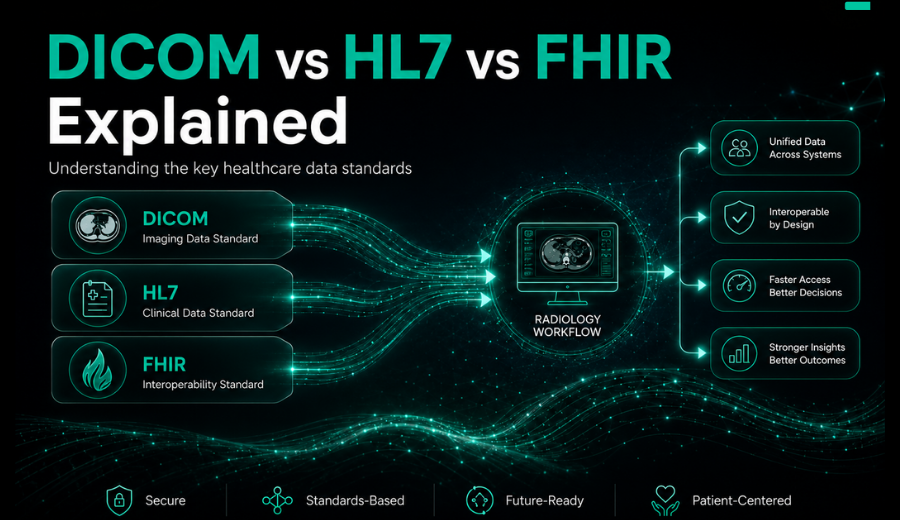
Two details catch teams off: an empty HL7 priority means routine, so a missing value fails silently; and DICOM Reporting Priority has no STAT value, so a careless mapping can downgrade a study. IHE’s Prioritisation of Worklists for Reporting (POWR) profile lists order priority among its baseline prioritisation factors – which only helps if the value arrives intact [5]. For a primer, see DICOM, HL7 and FHIR explained.
How do you make STAT studies impossible to miss?
Put STAT studies at the top of the worklist for every eligible reader by default, so visibility never depends on personal filters or sort order:

- Pin, don’t just sort. STAT studies sit above routine work regardless of the column a reader sorts by.
- Show them to every eligible reader, so one busy reader is not a single point of failure.
- Keep the indication and referring contact attached.
- Show the clock. Display time since images became available, not just time since the order.
- Prevent filter blind spots. If a reader filters to “MSK only”, decide in policy whether STAT studies from other groups still appear.
How should time-based escalation work for urgent studies?
Escalation is where STAT prioritisation in teleradiology becomes measurable. It should be rule-driven and tied to the turnaround window agreed with each referring site. A typical sequence:
- Assigned: the study lands at the top of the target reader group’s worklist.
- First threshold [T1 – set from contract]: not yet opened, so it is offered to the wider eligible pool.
- Second threshold [T2]: still unopened or unreported, so the on-call lead or duty coordinator is alerted.
- Breach: the referring site is contacted under the agreed procedure, and the event is logged.
IHE’s Remote Reading Workflow profile models the same pairing: an urgent task carries “Urgency = STAT” and an expected completion time, for example, two hours ahead [4]. Set your own thresholds from your contracts; our guide to radiology turnaround-time SLAs covers how to set them.
What governance and audit should surround STAT studies?
Good governance makes STAT prioritisation in teleradiology auditable: you should be able to reconstruct, for any STAT study, who set the priority, when each system received it, who saw it, who opened it, when it was reported and how urgent findings were communicated.
On the reporting side, the ACR’s practice parameter on communication says interpreting physicians should document nonroutine communications, including “the date and time, method of communication, and the name of the person to whom the communication was delivered” [6]. In the UK, the Academy of Medical Royal Colleges’ 2022 recommendations set out alert categories, including a CRITICAL alert for findings indicating “immediate or acute harm to the patient” [7]. For teleradiology specifically, the RCR’s standards say that “where results are especially urgent, the teleradiologist should be able to have a discussion with the referrer and/or the responsible clinician” [8].
The STAT flag gets the study read quickly; critical-findings communication gets the result acted on. Both need an audit trail and named out-of-hours contacts. Our explainer on what teleradiology is covers the wider service model.
Where does STAT prioritisation in teleradiology usually fail?
Most failures are integration or process gaps, not reader negligence:
- Priority sent as free text in clinical history, not in the coded field.
- Blank HL7 is prioritising defaulting silently to routine.
- Lossy mapping between HL7 and DICOM, or into a field with no STAT value.
- Priority not updated when the referring site upgrades or downgrades a request.
- Clock starts at the wrong time, such as at order, not at image availability.
- One reader as the only route, with no escalation if they are busy.
- No feedback loop: breaches are not reviewed with the referring site.
These gaps matter most out of hours, when emergency teleradiology coverage carries the bulk of urgent work.
Where Evorad fits
The worklist side of STAT prioritisation in teleradiology is what Evorad’s maestro worklist orchestration addresses. maestro displays STAT and urgent designations that have already been set through clinical review by the referring clinician or site and places those studies at the top of the worklist. It does not detect pathology or decide urgency. Its configurable rule engine works from study metadata, organises work by reader group, subspeciality and radiologist availability, and applies time-based routing rules. It connects to existing PACS through an API, and radiologists view the worklist in the Evorad exams portal. For the wider picture, start with our guide to radiology workflow orchestration.
Frequently asked questions
Can worklist software decide which studies are STAT?
It should not. Urgency is a clinical judgement made by the referring clinician or site, based on information the reading service does not fully hold. Worklist and orchestration software should carry, display and escalate the priority it receives and log what happened, while clinical responsibility for urgency stays with the referrer and for the report with the radiologist.
Which HL7 field carries order priority?
In HL7 v2.5 and later, order priority is carried in TQ1-9 Priority, coded from table 0485, where S means Stat, A means ASAP and R means Routine. If the field is blank, the default is routine. Older interfaces may carry priority inside the timing/quantity data type, so check your interface specification.
What is the DICOM equivalent of a STAT order?
The Requested Procedure Priority attribute (0040,1003) accepts STAT, HIGH, ROUTINE, MEDIUM and LOW. The separate Reporting Priority attribute (0040,1009) has no STAT value. Confirm which field each of your systems reads and writes and how STAT is mapped between them so that urgent studies are not silently downgraded in transit.
Is STAT prioritisation the same as critical-findings communication?
No. STAT prioritisation gets an urgent study read quickly. Critical-findings communication gets an urgent result for the responsible clinician, promptly and with documentation of who was told and when. They often occur together, but they need separate processes, named contacts and audit records, and each should be reviewed with referring sites.
To check how clinically assigned STAT flags would surface and escalate in your own set-up, review how a rule-based worklist layer handles urgent studies.
Sources
- TQ1 – Timing/Quantity segment (TQ1-9 Priority), HL7 Europe v2+ refactored demo site. https://hl7.eu/refactored/segTQ1.html
- HL7 Table 0485 – Extended Priority Codes, HL7 Terminology (THO) v5.2.0, HL7 International. https://terminology.hl7.org/5.2.0/CodeSystem-v2-0485.html
- DICOM PS3.3, Section C.4.11 (Requested Procedure Priority; Reporting Priority), NEMA, current edition. https://dicom.nema.org/medical/dicom/current/output/chtml/part03/sect_C.4.11.html
- IHE Radiology Technical Framework Supplement: Radiology Remote Reading Workflow (RRR-WF), Rev. 1.1 – Trial Implementation, IHE International, 14 December 2015. https://ihe.net/uploadedFiles/Documents/Radiology/IHE_RAD_Supp_RRR-WF.pdf
- IHE Radiology Technical Framework Supplement: Prioritization of Worklists for Reporting (POWR), Rev. 1.1 – Trial Implementation, IHE International, 22 August 2023. https://www.ihe.net/uploadedFiles/Documents/Radiology/IHE_RAD_Suppl_POWR.pdf
- ACR Practice Parameter for Communication of Diagnostic Imaging Findings, American College of Radiology, revised 2025 (Resolution 9). https://gravitas.acr.org/PPTS/DownloadPreviewDocument?DocId=74
- Alerts and notification of imaging reports: recommendations, Academy of Medical Royal Colleges, October 2022. https://aomrc.org.uk/publication/alerts-notification-imaging-reports-recommendations
- Standards for the provision of teleradiology within the United Kingdom, second edition, The Royal College of Radiologists, December 2016. https://rcr.ac.uk/media/g02ahlp2/rcr-publications_standards-for-the-provision-of-teleradiology-within-the-united-kingdon-second-edition-standards_december-2016.pdf