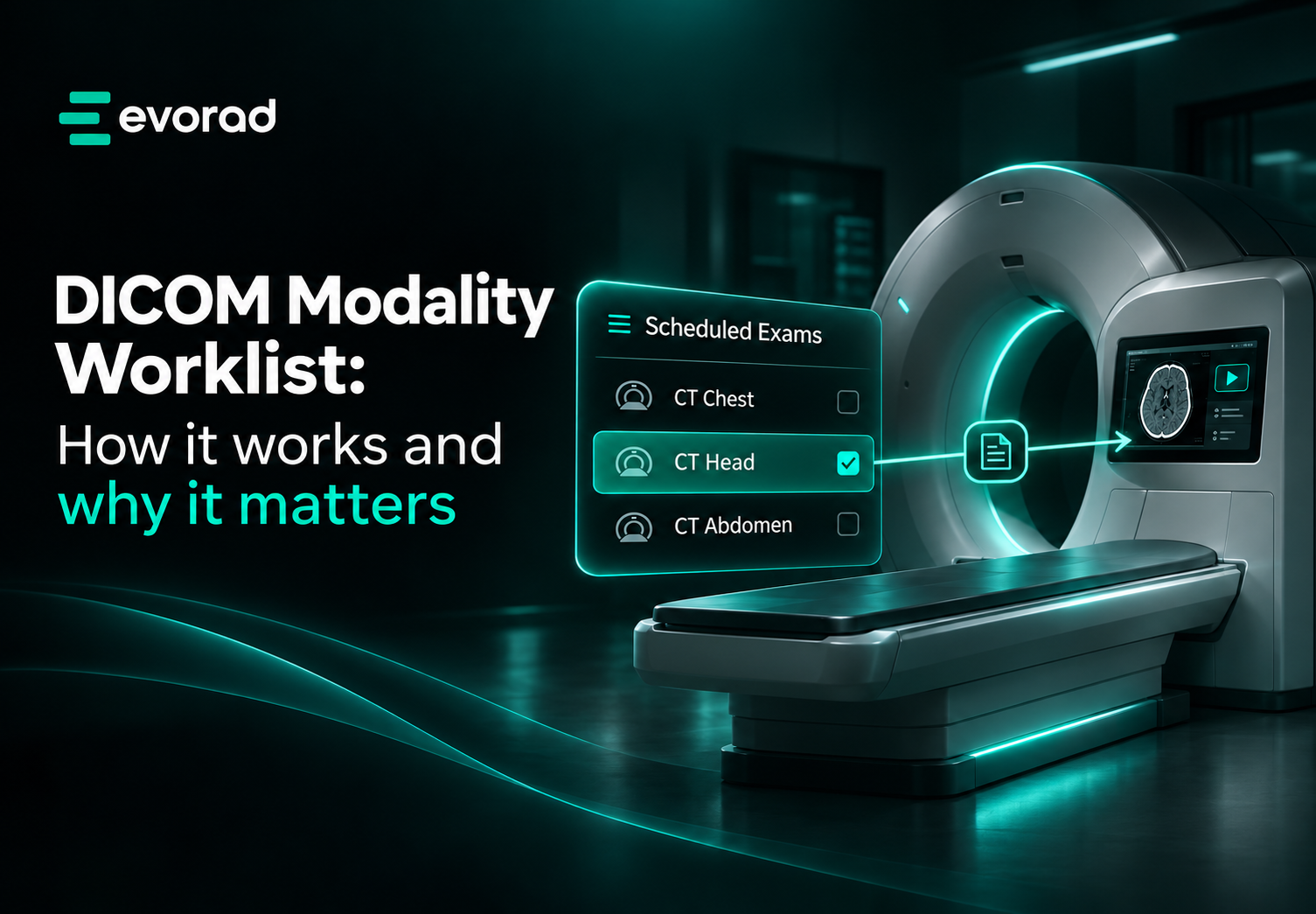
In short: A DICOM modality worklist (MWL) lets an imaging device query the radiology workflow system and retrieve scheduled exam details, including patient demographics, accession number and procedure information, instead of a technologist typing them at the console. It prevents most mismatched-study and identity errors in imaging, and its value grows with the distance between the scanner and the reader.
The DICOM modality worklist is the single highest-value control in the imaging workflow, and one of the least discussed. Every downstream step, from routing and prior retrieval to the teleradiology workflow from order to report, inherits whatever identity quality the scanner console produces. This guide explains how MWL works, what breaks without it, and how to enforce it.
How does a DICOM modality worklist work?
The sequence is short:
- A clinician orders imaging; the order becomes a scheduled exam with a procedure code and accession number in the RIS.
- At the scanner, the technologist queries the worklist, typically filtered by modality, date or scheduled station.
- The modality returns matching scheduled procedures with full patient and exam detail.
- The technologist selects the correct entry, and the modality fills the DICOM header from it automatically.
- Acquired images carry identifiers that match the order exactly, so the study binds correctly on arrival at the archive.
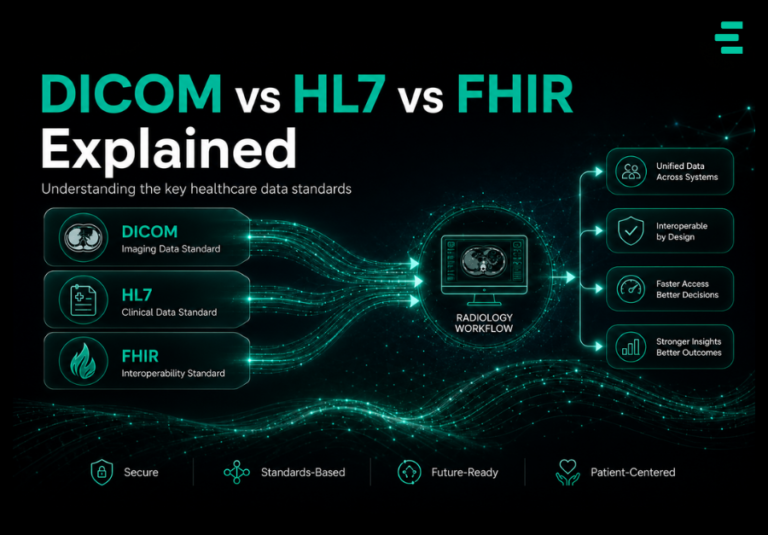
The technical exchange uses the Modality Worklist service class defined in DICOM Part 4. From the technologist’s point of view it replaces typing with selecting: a small interface change with large downstream consequences. If you need a refresher on how DICOM relates to the messaging standards around it, see DICOM vs HL7 vs FHIR.
What goes wrong without a modality worklist?
Manual entry at the console produces a predictable set of failures:
- Mismatched studies and orders, where images cannot be reconciled to the request
- Inconsistent identifiers, particularly accession numbers entered in varying formats
- Name and date-of-birth variants that fragment a patient’s imaging history across records
- Missing priors, because the comparison sits under a slightly different identity
- Reconciliation work that surfaces downstream and costs more to fix than to prevent
Every one of these is cheap to prevent at the console and expensive to resolve after the study has been read.
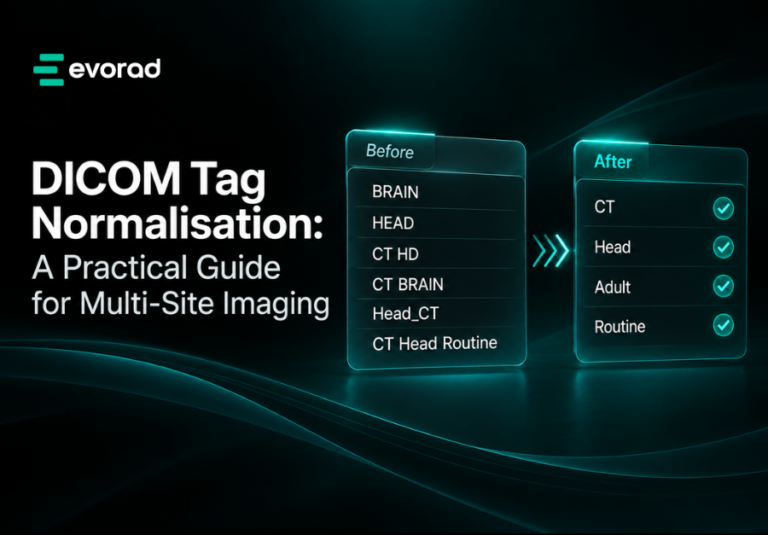
Identity errors are a close relative of inconsistent metadata. Our guides to DICOM tag normalisation and study description normalisation cover the other half of the problem.
Why the DICOM modality worklist matters more in teleradiology
An onsite radiologist who notices a demographic discrepancy can walk to the control room and resolve it in minutes. A radiologist reading remotely cannot. Their options are to reject the study, report it with a caveat, or raise a query and wait.
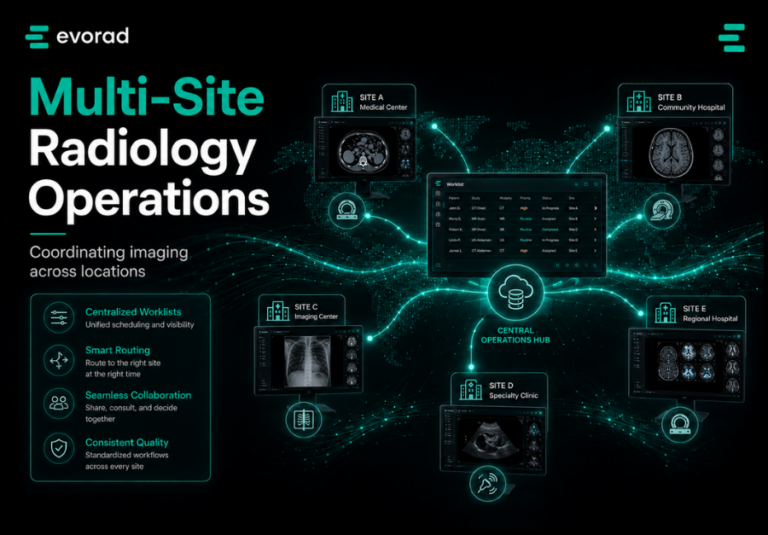
All three cost more than the correction would have. This is why worklist discipline is disproportionately important in teleradiology and multi-site radiology operations: the same error costs more the further away the reader sits.
The IHE Scheduled Workflow profile treats worklist-based coordination as a core mechanism for keeping acquisition aligned with orders, precisely because manual entry is where identity most reliably breaks.
What is the difference between MWL and MPPS?
Modality Performed Procedure Step (MPPS) is the companion mechanism. Where the DICOM modality worklist tells the modality what was scheduled, MPPS tells downstream systems what was actually performed: an added sequence, an abandoned study, a changed protocol.
Without it, status tracking drifts out of step quietly. The workflow believes one thing happened while the images show another, and the discrepancy surfaces later as confusion about whether a study is complete.
How do you know if worklist discipline is failing?
| Signal | What it indicates |
|---|---|
| Studies corrected or merged after reading begins | Manual entry in use, or worklist not enforced |
| Accession numbers in inconsistent formats | Free-text entry at one or more stations |
| Patients with fragmented imaging history | Demographic variants across studies |
| Frequent “no priors available” despite known history | Identity fragmentation rather than genuine absence |
| Exam status not matching what was performed | MPPS absent or not consumed downstream |
The reconciliation rate is the summary metric worth tracking. It should be close to zero, and where it is not, the cause is almost always at the console.
5 steps to enforce the DICOM modality worklist
- Configure every station to query the worklist, including mobile and portable units, which are the most common exceptions.
- Restrict free-text entry where the modality permits it, so selection is the path of least resistance.
- Define an emergency path for unscheduled and unidentified patients, with a set reconciliation step rather than ad hoc typing.
- Audit the reconciliation rate by station. Failures cluster at specific devices and shifts far more often than they spread evenly.
- Consume MPPS downstream so status reflects performed rather than scheduled work.
The emergency path deserves attention. Trauma and unidentified patients are the legitimate exception, and where no defined process exists, staff improvise, which is how manual entry re-enters a workflow that had eliminated it. Fast, correct identity matters most in exactly these cases, as our article on teleradiology in emergency care explains.
Where Evorad fits
Clean identity at the console is what makes automated routing trustworthy. maestro radiology workflow orchestration reads study metadata to route each case to the right reader group, subspecialty and radiologist, so accession and patient context need to be right from the start. evoTelerad carries that context across every site in a teleradiology network, with cross-facility priors and standards-based integration (DICOM, DICOMweb, HL7 and IHE Scheduled Workflow) rather than bespoke interfaces per site.
Book a demo to see how identity integrity holds across a distributed reading network
Related guides
Frequently asked questions
What is a DICOM modality worklist?
A DICOM service that lets an imaging device retrieve scheduled exam details, including patient demographics, accession number and procedure information, from the radiology workflow system, so identifiers are selected rather than typed.
What is the difference between MWL and MPPS?
MWL delivers scheduled exam details to the modality before acquisition. MPPS reports back what was actually performed afterwards. MWL prevents identity errors; MPPS keeps status accurate.
Do all modalities support modality worklist?
Most current diagnostic equipment does. Older devices, portable units and some ultrasound systems are the common gaps, and they account for a disproportionate share of identity errors.
How do you handle unidentified emergency patients?
Through a defined temporary identity process with a mandatory reconciliation step once identity is established, not through free-text entry at the console.
Conclusion
DICOM modality worklist discipline is unglamorous and decisive. It costs little to enforce, prevents a whole category of downstream error, and its absence is the root cause of reconciliation work that most departments treat as unavoidable. It is also the first step in any imaging workflow automation programme, because every later improvement inherits the identity quality it produces.