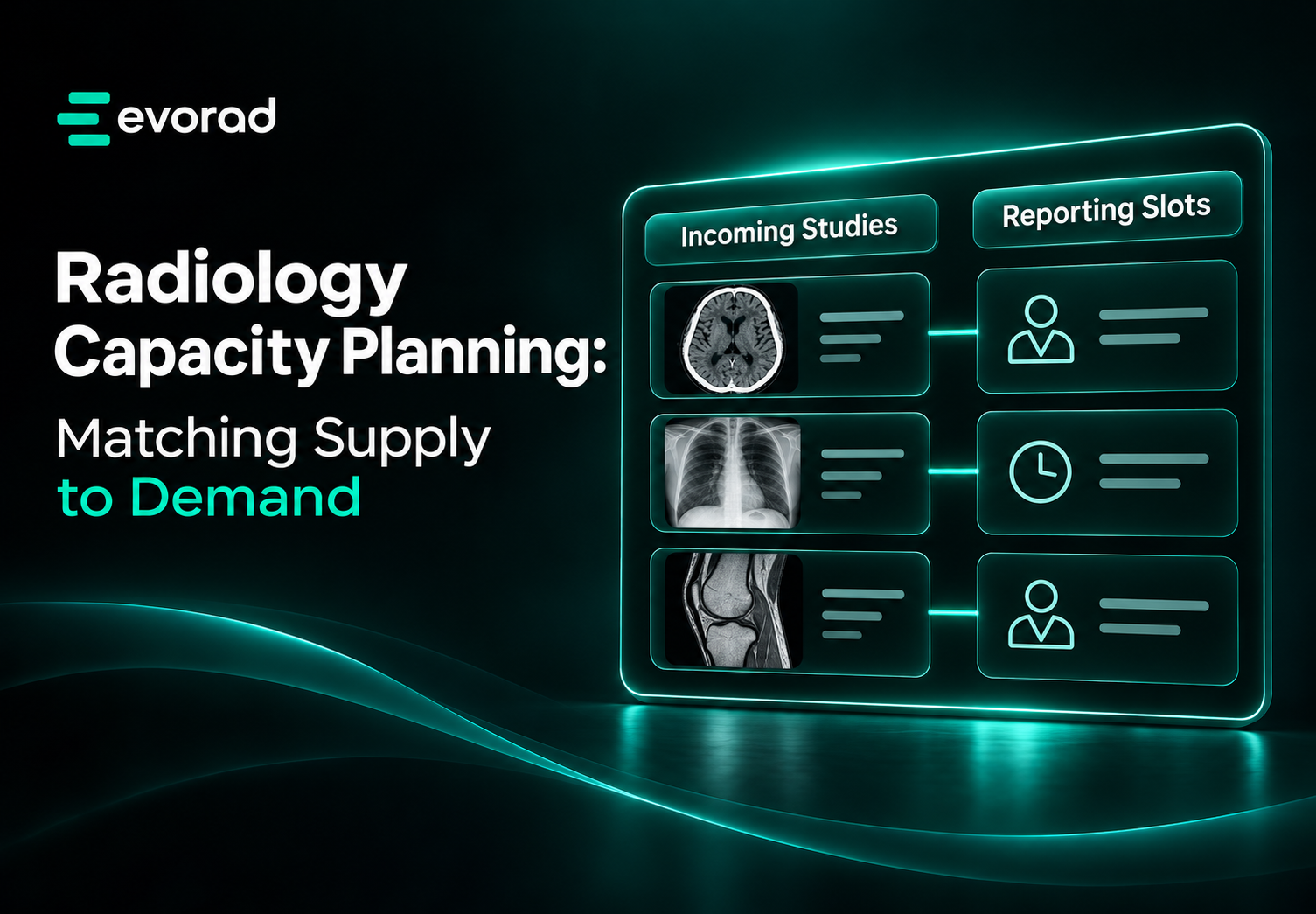
In short: Radiology capacity planning matches available reporting sessions against projected imaging demand. It needs supply measured in sessions rather than headcount, demand projected forward rather than measured after the fact, and explicit use of three levers: recruitment, external capacity and recovering capacity already inside the service. The third is usually the largest and is routinely tried last.
Radiology capacity planning fails most often not from bad forecasting but from measuring supply in the wrong unit. This guide covers how to count capacity properly, how to project demand, and why the lever most services reach for last is usually the fastest. It complements our article on radiology department management.
Why does radiology capacity planning fail?
Radiology capacity planning rarely fails because the demand forecast was wrong. Usually because supply was counted incorrectly.
An establishment counted in headcount overstates available capacity substantially: the RCR 2025 workforce census reports that 41% of UK clinical radiology consultants work less than full time. Add procedural commitments drawn from the same pool, leave, on-call recovery and administrative sessions, and the reporting capacity actually available can differ from the headcount figure by a wide margin.
Plan in sessions. An establishment counted in people is a recruitment target, not a capacity figure.
How should imaging demand be projected?
Forward, and with the growth rate stated explicitly rather than assumed flat. The same RCR census recorded complex imaging demand growing 9% in a year against 4.3% growth in the consultant workforce, and a UK shortfall of 32% forecast to reach 40% by 2030. Europe shows a similar gap, as we set out in Europe’s radiology capacity maths.
Three demand components should be projected separately, because they behave differently:
- Volume growth: more studies, driven by referral patterns and population
- Complexity growth: more images per study, more advanced protocols, longer reporting time per case
- Subspecialty demand: a rising share needing expertise the current pool may not hold
A plan that projects volume alone will underestimate the gap, because complexity growth increases reporting time per study independently of study count.
The 3 levers of radiology capacity planning
| Lever | Time to effect | Cost profile | When it fits |
|---|---|---|---|
| Recruit | 6 to 18 months, if successful | Permanent | Sustained structural need, fillable post |
| External capacity | Weeks | Variable, rising | Surge, subspecialty gap, bridging period |
| Recover internal capacity | Weeks to months | One-off, then low | Almost always worth doing first |
In radiology capacity planning, the sequencing error is nearly universal. Services try the first two before the third, because recruitment and contracting are familiar processes with clear owners, while recovering internal capacity needs workflow change that crosses departmental boundaries. Where external capacity is used, accurate per-study billing in teleradiology keeps its real cost visible.
Where does recoverable internal capacity sit?
Most of the capacity a radiology capacity planning exercise can recover sits in allocation and access.
- Arrival-order worklists that read routine studies ahead of urgent ones and produce avoidable breaches. A 2025 quality improvement study in Oman reported turnaround compliance rising from 88% to 95% over roughly nine months through standardised triage and operating procedures, without added staff. Replacing arrival order with rule-based radiology workflow orchestration addresses this directly.
- Fragmented system access costing log-in and orientation time on every switch. Our article on ending the multi-login workflow explains where that time goes.
- Manual triage consuming coordinator hours that scale badly with volume.
- Absent priors extending individual reads and, in multi-site operations, doing so systematically.
- Identity reconciliation generated by manual entry at the console, which an enforced DICOM modality worklist prevents.
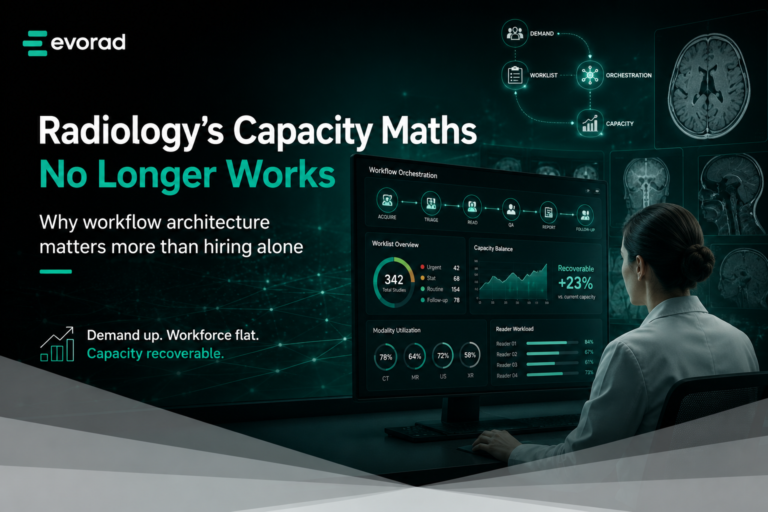
These are not marginal. In services that have never addressed them, the recoverable share can rival what a successful recruitment round would deliver, and it arrives faster.
How does equipment capacity fit?
Good radiology capacity planning treats equipment and reporting capacity together, not separately. Acquisition capacity without reporting capacity turns a scanning waiting list into a reporting backlog. The delay moves rather than resolving, and the capital is spent either way.
What should a radiology capacity plan contain?
- Current reporting capacity in sessions, net of procedural, leave and administrative commitments
- Demand projected 12 to 36 months forward, split by volume, complexity and subspecialty
- The gap, stated in sessions rather than percentages
- Recoverable internal capacity, quantified and with an owner
- Recruitment assumptions with realistic fill probability, not just established posts
- External capacity requirement and its cost trajectory
- A stated position on acceptable external dependency
The final item is the one most often left out and the most consequential. Without a stated position, dependency accumulates by default. Turnaround is the measure that shows whether the plan is working; see how to define and protect radiology turnaround SLAs.
Where Evorad fits
Evorad targets the lever most radiology capacity planning leaves out. maestro radiology workflow orchestration connects to your existing PACS and sequences studies by reader group, subspecialty and radiologist availability rather than arrival order. evoViewer removes log-in and interface switching with zero-footprint access across every site, and evoTelerad manages internal and external reading pools in one teleradiology platform with distinct routing rules and cross-facility priors.
Book a demo to see how much capacity your current workflow is holding
Related guides


Frequently asked questions
How do you calculate radiology capacity?
In reporting sessions available, net of procedural, leave, on-call recovery and administrative commitments, not in consultant headcount, which overstates availability where less-than-full-time working is common.
How far ahead should imaging capacity be planned?
Twelve to thirty-six months. Recruitment lead times alone can exceed a year, so a twelve-month horizon leaves no room for the slowest lever.
What is the fastest way to increase reporting capacity?
In most services that have not already done so, recovering internal capacity through better allocation and unified access. External capacity is fast to contract but carries a rising cost trajectory.
Conclusion
Radiology capacity planning works when supply is counted in sessions, demand is projected with complexity growth included, and all three levers are used in the right order. The lever most services reach for last is the one that is fastest, cheapest and most reliably available. It is also the only one that does not depend on a labour market that cannot supply what is being asked of it.
Sources
- Royal College of Radiologists. Clinical Radiology Workforce Census 2025
- Ayaad O. et al. Improving Turnaround Times and Operational Efficiency in Radiology Services: Quality Improvement Study in Oman. Asian Pacific Journal of Cancer Prevention, 2025
- EU-REST project. Radiology workforce and imaging demand projections to 2030