In short: Radiology department management covers workforce deployment, service configuration, performance oversight and the interface with referring specialties. Its central difficulty is that most departmental structures assume a staffing establishment that can be filled. The workforce data no longer supports that assumption, which shifts management from filling posts to allocating scarce capacity.
Most departmental structures were designed for a workforce that no longer exists. The practical question for radiology department management today is which structures still function under sustained shortage, and how routing, rotas and measurement need to change to support them. This article covers both, and links to our deeper guides on
radiology capacity planning and
radiology workflow orchestration.
What has changed about radiology department management?
For most of radiology’s modern history, managing a department meant filling an establishment and organising the work of the people in it. Vacancies were temporary.
That assumption has broken. The
Royal College of Radiologists’ 2025 clinical radiology workforce census reports a 32% UK consultant shortfall, forecast to reach 40% by 2030 if current trends continue, with the consultant workforce growing 4.3% in a year against 9% growth in complex imaging demand. Across Europe, the picture we describe in
Europe’s radiology capacity maths is similar: demand rising faster than headcount.
A vacancy that will not be filled is not a gap in the establishment. It is the establishment.
Departments that keep managing as though the shortfall is temporary tend to run permanent locum arrangements, permanent overtime and permanent reliance on goodwill, all of which wear down.
5 structures that hold under sustained shortage
| Structure |
Holds because |
Fails when |
| Subspecialty teams with defined cross-cover |
Expertise is matched without single points of failure |
Cover is nominal rather than rostered |
| Network-wide reading pools |
Capacity is shared rather than site-bound |
Access is fragmented across systems |
| Blended internal and external capacity |
Surge is absorbed without permanent overstaffing |
External use becomes structural without a plan |
| Separated procedural and reporting rotas |
Interventional commitments do not consume reporting capacity unpredictably |
Both are drawn from one undifferentiated pool |
| Explicit less-than-full-time planning |
Reflects actual available capacity |
Establishment is counted in headcount, not sessions |
The last row deserves emphasis. The RCR reports that 41% of UK clinical radiology consultants work less than full time, the highest figure on record. Headcount overstates capacity substantially where this is not accounted for, and departments planning on headcount consistently over-commit.
Network-wide reading pools only work when access is unified. Our article on
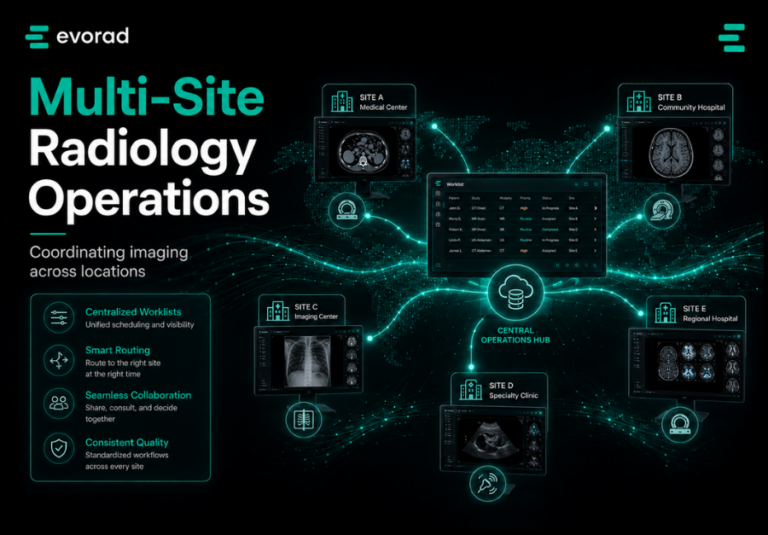
running one worklist across many sites explains why fragmented system access quietly cancels the capacity gain.
How should the reporting and procedural split be managed?
Interventional and procedural work needs physical presence and cannot be distributed. Reporting can be. Managing both from a single pool means procedural demand consumes reporting capacity unpredictably, and reporting backlogs then look like capacity problems when they are scheduling problems.
Separating the rotas makes the trade-off explicit and lets the reporting component extend across a network, through internal reading pools or
teleradiology groups, while the procedural component stays local.
What should departmental oversight monitor?
- Sessions available versus sessions required, not headcount. This is the real capacity figure.
- Reporting backlog trend, separated from procedural throughput.
- External reporting dependency, tracked over time. Rising dependency without a stated plan is a strategic exposure, not an operational detail.
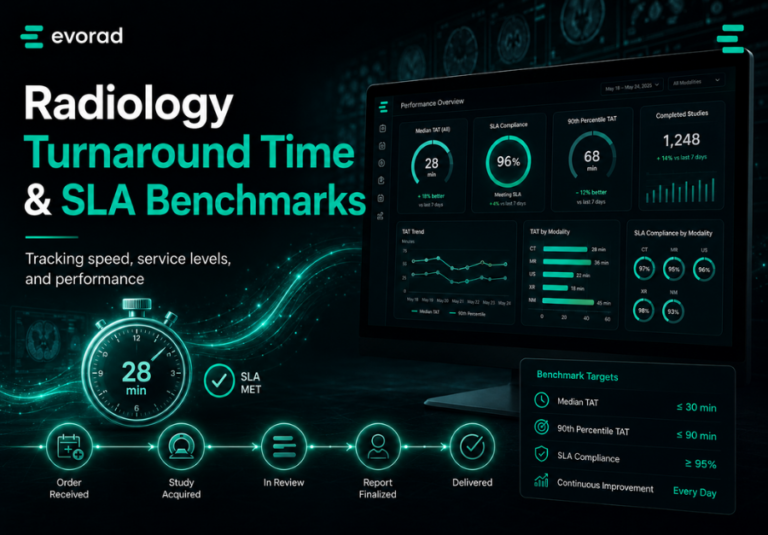
- Turnaround compliance by site, where the department covers more than one. See our guide to radiology turnaround time and SLAs.
- Attrition and less-than-full-time movement, which are leading indicators of capacity change.
- On-call intensity per consultant, which predicts both retention risk and burnout.
The last matters clinically as well as operationally. A
systematic review in the European Journal of Radiology Open found burnout prevalence among radiologists ranging from 33% to 88% across studies, with workload intensity a recognised contributor. Our article on
the limits of the 24/7 coverage model looks at how out-of-hours cover adds to that load.
Managing the interface with referring specialties
Radiology department management includes managing demand, not only supply. Two levers are usually available and usually underused.
Order quality. Vague indications and inconsistent urgency assignment generate downstream work. Where STAT has been diluted through overuse, radiologists distrust the flag and apply personal rules of thumb, a cost that lands on radiology but starts with referrers. Our guide to
STAT prioritisation sets out how to keep the flag meaningful.
Vetting and protocolling policy. Clear criteria reduce inappropriate requests and the reporting burden they create, but need agreement with referring specialties rather than unilateral imposition. The same applies to
worklist governance: who reads what, and who decides.
Where Evorad fits
Evorad supports departments managing capacity across sites and sources.
maestro radiology workflow orchestration connects to your existing PACS and organises one prioritised worklist by reader group, subspecialty and radiologist availability, so internal and external readers work to the same rules.
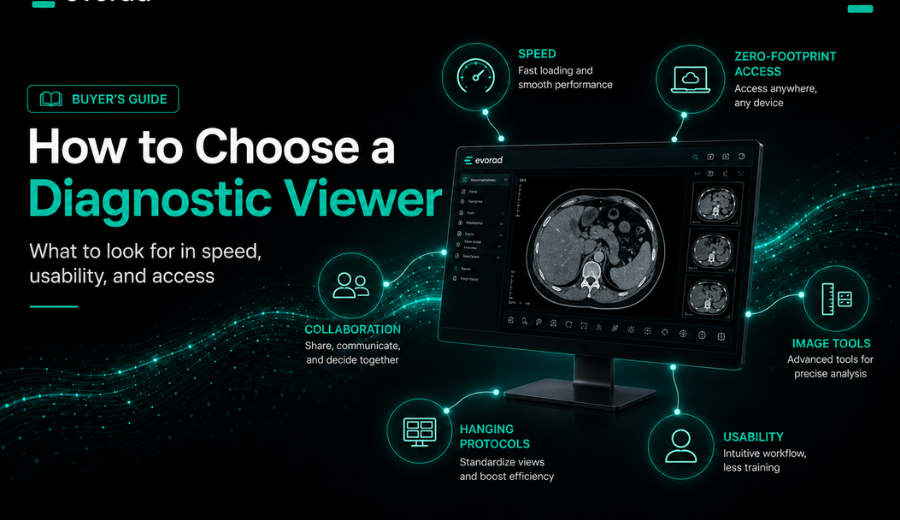
evoViewer gives zero-footprint browser access to every site through one interface, and
evoTelerad extends reporting across a distributed network with SLA monitoring by site and reader.
Book a demo to see where recoverable capacity sits in your department
Related guides
Frequently asked questions
What does a radiology department manager do?
Deploys the workforce across sites and sessions, configures the service to meet demand, oversees performance, and manages the interface with referring specialties and with external reporting capacity.
How do you manage a radiology department with persistent vacancies?
By planning on available sessions rather than headcount, separating procedural from reporting rotas, sharing reporting capacity across a network, and treating external capacity as a planned component rather than an emergency measure.
What is the biggest challenge in radiology department management?
Allocating capacity that cannot be increased on the timescale demand requires. Recruitment takes years; demand grows every year.
Conclusion
Radiology department management under sustained shortage is a different discipline from managing a filled establishment. It means planning on sessions rather than headcount, making the procedural and reporting trade-off explicit, and treating external capacity as a designed component rather than a stopgap. It also means recovering capacity already inside the service, through better allocation, consolidated access and measurement that separates waiting from working.
Sources