Streamlining Clinical and Healthcare Workflows in Imaging Centres
An imaging study passes through many hands before a referrer reads the report. Every hand-off is an opportunity for delay, lost information or duplicated effort. Streamlining clinical and healthcare workflows means removing those friction points systematically rather than relying on staff to absorb them. This guide walks the imaging centre pathway end to end and sets out a practical, seven-step approach.
What does streamlining clinical workflows mean?
|
Definition Streamlining clinical workflows is the practice of redesigning the steps in a care or diagnostic process so that work moves with fewer delays, hand-offs and manual re-entries. In an imaging centre, it spans the journey from referral to final report distribution, and aims to shorten turnaround, reduce errors and free staff for higher-value work. |
The emphasis on redesign is deliberate. Automating a poorly designed process simply makes a bad workflow run faster. Streamlining starts by understanding how work actually flows today, then removing the steps that add no value.
The imaging centre workflow, end to end
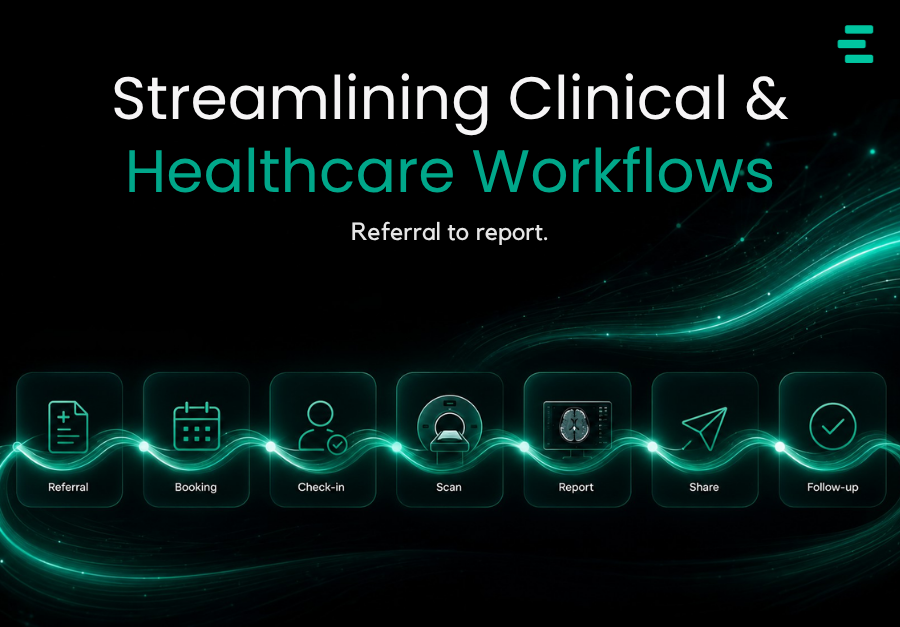
A typical outpatient imaging study moves through seven stages. The underlying hand-offs follow the IHE Scheduled Workflow profile; for system roles, see what PACS is in radiology and how it works with RIS and VNA.
- Referral and order. A clinician requests imaging, ideally with full clinical context and the right study specified.
- Scheduling and preparation. The centre books a slot and sends preparation instructions to the patient.
- Arrival and registration. The patient is checked in and their details and consent confirmed.
- Image acquisition. A radiographer performs the scan on the appropriate modality.
- Reading and reporting. A radiologist interprets the images, with priors available, and produces the report.
- Report distribution. The verified report and images reach the referrer and, where appropriate, the patient.
- Follow-up and billing. Any recommended follow-up is arranged and the episode is billed.
Each stage depends on the one before it. A delay early in the pathway — an incomplete referral, for example — ripples through every later step.
Where workflows commonly break
In most centres, problems cluster at the hand-offs rather than within any single stage. We explore the root cause in fragmentation in radiology workflow.
- Referrals by fax or phone force staff to re-key information and often arrive without the clinical detail the radiologist needs.
- Scheduling gaps and no-shows leave expensive scanners idle while patients wait elsewhere on the list.
- Priors that are not available at reading time slow interpretation and lead to duplicate exams.
- Reporting backlogs build up when dictation and verification rely on disconnected steps.
- Reports that do not reach referrers promptly generate chasing calls and erode referrer confidence.
- Disconnected billing creates rework and delays payment.
Seven steps to streamline clinical workflows
The following sequence can be applied incrementally; each step delivers value on its own.
- Map the current workflow. Document every step from referral to distribution and time how long each one takes.
- Digitise referrals and orders. Replace fax and phone with structured electronic intake that captures clinical context up front.
- Optimise scheduling and reduce no-shows. Use online booking, automated reminders and clean modality worklists to keep scanners full.
- Make priors and images instantly available. A unified archive ensures the radiologist has relevant history at the point of reading.
- Standardise reporting. Shared structured templates make reports consistent, faster to produce and easier to act on.
- Automate distribution. Give referrers and patients secure portal access so reports arrive without manual sending or chasing.
- Measure and iterate. Use dashboards to review key metrics regularly and keep refining the pathway.
The technology layer that makes it stick
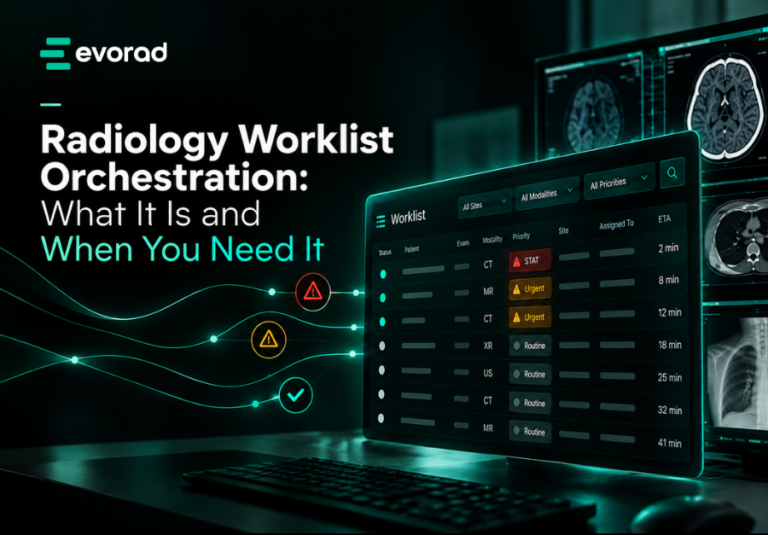
Process redesign sets the direction, but technology is what holds the improvement in place. Three systems carry most of the load: a Radiology Information System for scheduling, orders and reporting status; a PACS for images; and a patient and referrer portal for distribution. They must be connected through standards such as HL7 or FHIR, DICOM and IHE profiles, so information flows without re-entry. See radiology workflow orchestration and radiology patient portals.
The decisive factor is integration. A string of disconnected tools simply recreates the hand-offs the centre is trying to remove. An integrated imaging platform for outpatient centres keeps scheduling, imaging, reporting and distribution on one system, so a study moves through the pathway without leaving the platform.
In Evorad’s case, evoRIS manages clean modality worklists, scheduling and reporting, evoPortal gives referrers and patients secure access to images and reports, and maestro orchestrates the workflow end to end.
Measuring the impact
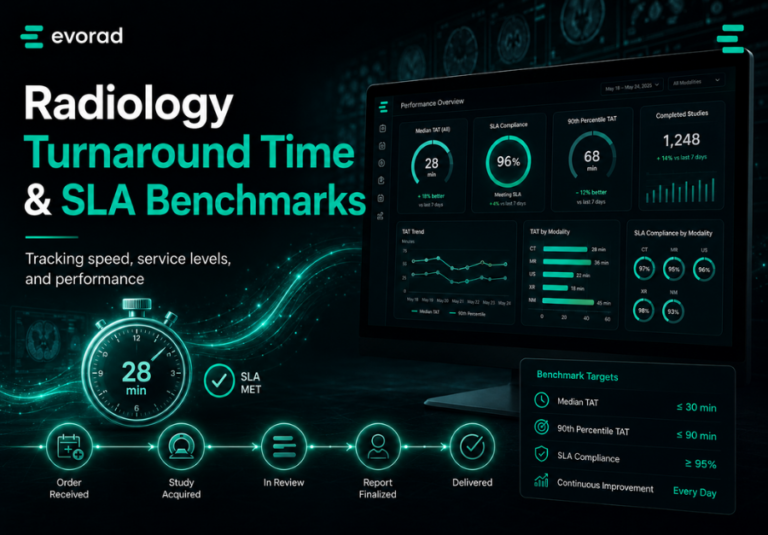
To know whether streamlining is working, track a small set of metrics consistently against a baseline. Start with radiology turnaround time.
- Referral-to-scan time — how quickly a request becomes a booked, completed study.
- Report turnaround time — from study completion to verified report.
- No-show rate and scanner utilisation — how fully capacity is used.
- Duplicate exam rate — a direct signal of whether priors are reaching the reading room.
- Referrer satisfaction and staff time spent on manual administration.
Why streamlining is a commercial priority
Workflow friction is often treated as an unavoidable cost of running an imaging centre. It is not. Each delay and hand-off carries a price, and naming those prices helps a centre decide where to invest.
Slow turnaround puts referral relationships at risk, because referrers send work to the centre that reports reliably. Idle scanner time and duplicate exams waste capacity the centre has already paid for. Manual re-keying of referrals and chasing of reports consume staff hours that could be spent on patients. And a workflow that constantly fights its staff contributes to the turnover of experienced people, who are expensive and slow to replace.
Streamlining therefore protects three things at once: the referral base, the centre’s capacity, and its staff. That is why it deserves a place on the management agenda rather than being left as an operational afterthought.
What a streamlined imaging centre looks like in practice
It helps to picture the end state. In a streamlined imaging centre, a referral arrives electronically with the clinical context already attached, and is booked without anyone re-typing it. The patient receives clear, scan-specific preparation and a reminder they can act on, so they arrive ready and on time.
When the radiologist opens the study, the relevant priors are already there. Reporting uses shared structured templates, so reports are consistent and quick to produce. The verified report reaches the referrer automatically through a portal, and the patient can access their own images and report without telephoning the centre. A manager watching a dashboard can see turnaround and utilisation in real time, and act on a building backlog before it becomes one.
None of this is exotic. Each element exists today; the difference is that they are connected, so a study moves through the pathway without stalling at a hand-off.
Bringing staff with you
Workflow change succeeds or fails on the people who work the process every day. A new system imposed without consultation tends to be worked around rather than worked with. Involve radiographers, radiologists and administrative staff in mapping the current workflow — they know where the real friction is — and in testing changes before they are rolled out.
Introduce changes in stages rather than all at once, so staff can absorb each one, and share the metrics openly so the team can see the improvement they have helped to create. It also helps to give the change a clear owner — someone accountable for the workflow as a whole, not just for one system within it. Without that ownership, improvements tend to stall at the boundary between departments, which is exactly where most friction lives.
Common mistakes to avoid
- Automating a broken process instead of redesigning it first.
- Buying point tools that do not integrate, which recreates the original hand-offs.
- Designing the workflow without referrers and patients in mind, when they are central to the pathway.
- Skipping the baseline measurement, which makes it impossible to prove improvement.
Remove the hand-offs, not just the symptoms
Streamlined workflows depend on systems that actually talk to each other. See how an integrated imaging platform for outpatient centres connects scheduling, imaging and reporting, or book a 20-minute demo.
Related guides